
Explore the principles, types, applications, and selection factors of Current Sensing Diodes, an essential component in electronics.
Introduction to Current Sensing Diodes
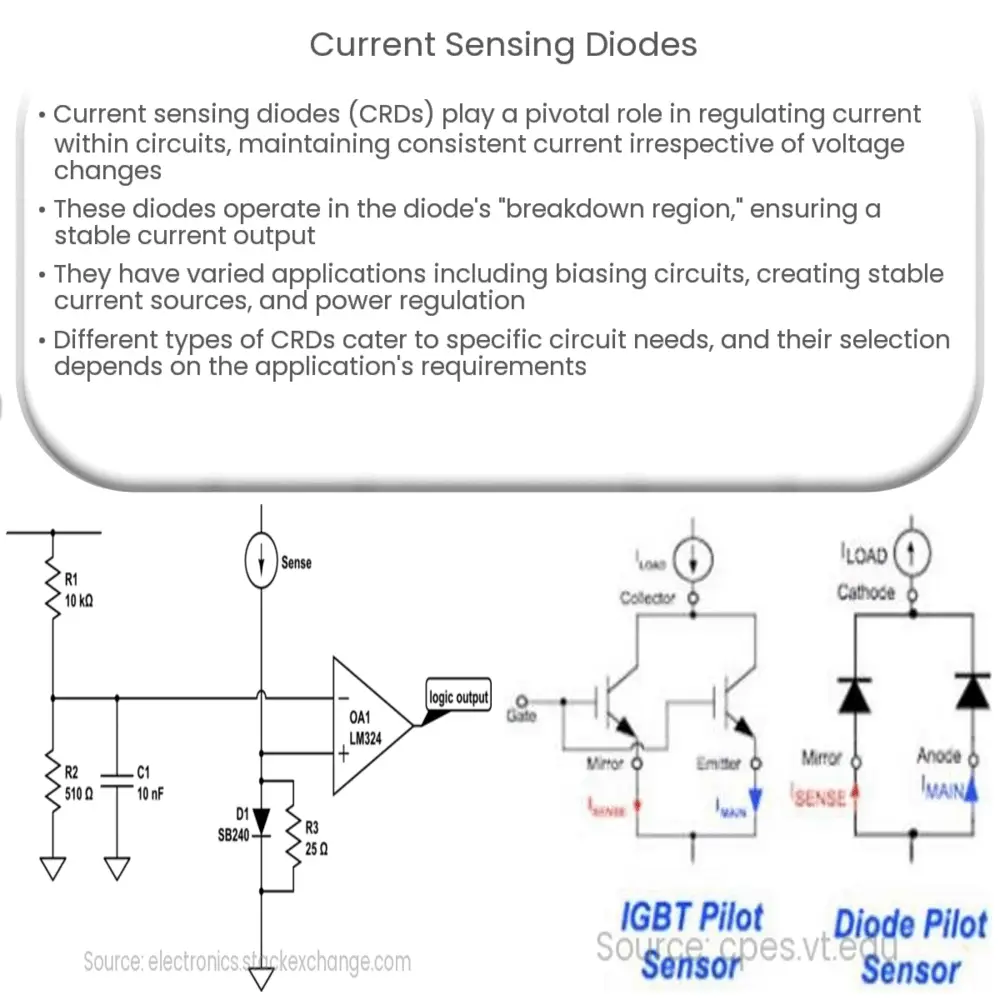
Current sensing diodes, also known as current regulating diodes (CRDs), are specialized electronic components that play a crucial role in current regulation within circuits. Unlike standard diodes that control the direction of current, current sensing diodes are used primarily to maintain a consistent current flow, irrespective of voltage fluctuations.
Principle of Operation
The operation of a current sensing diode can be understood from the fundamental principles of diodes. In a typical diode, the current flow is heavily influenced by the applied voltage. However, in a current regulating diode, the current is nearly independent of the voltage. This property is exploited for current regulation.
The CRD operates in the ‘breakdown region’ of the diode’s characteristic curve, an area where the voltage remains relatively constant while the current can vary significantly. This region allows the diode to maintain a constant current output even when the voltage across it changes.
Applications of Current Sensing Diodes
Due to their inherent properties, current sensing diodes find a wide range of applications in various electronic systems. A few of them are:
Types of Current Sensing Diodes
There are several types of current sensing diodes, each having their unique characteristics and applications. The three main types include:
The choice of diode type depends upon the specific requirements of the circuit in which it is to be used.
Selecting Current Sensing Diodes
Several factors influence the selection of a current sensing diode for a particular application. These include:
Advantages and Disadvantages of Current Sensing Diodes
Like all electronic components, current sensing diodes come with their advantages and disadvantages.
Maintaining Current Sensing Diodes
Maintenance of current sensing diodes involves regular checks to ensure they are operating within their specified parameters. Also, appropriate measures should be taken to protect them from possible damages, such as overvoltage conditions and high-temperature environments.
Conclusion
Current Sensing Diodes serve as essential components in numerous electronic systems, providing a stable current source against varying voltage conditions. Despite some limitations, their value in establishing control over current in diverse applications cannot be overstated. Understanding the operational principles, types, applications, and the factors involved in their selection can help optimize their usage and extend their operational lifespan.
As technology advances, further research and development in the field will likely yield even more effective and efficient current sensing diodes, expanding their potential applications and enhancing the performance of the electronic systems in which they are used.



