
Explore the fundamentals of Current Feedback Amplifiers (CFAs), their advantages, limitations, applications, and key design considerations.
Introduction
Feedback in electronic systems is a fundamental concept that plays a crucial role in controlling the behavior of a system. In the context of amplifiers, feedback refers to the process of taking a portion of the output signal and feeding it back to the input. There are various types of feedback amplifiers, and the type that is used can greatly influence the performance and characteristics of the amplifier. In this article, we will explore the concept of current feedback amplifiers.
What is a Current Feedback Amplifier?
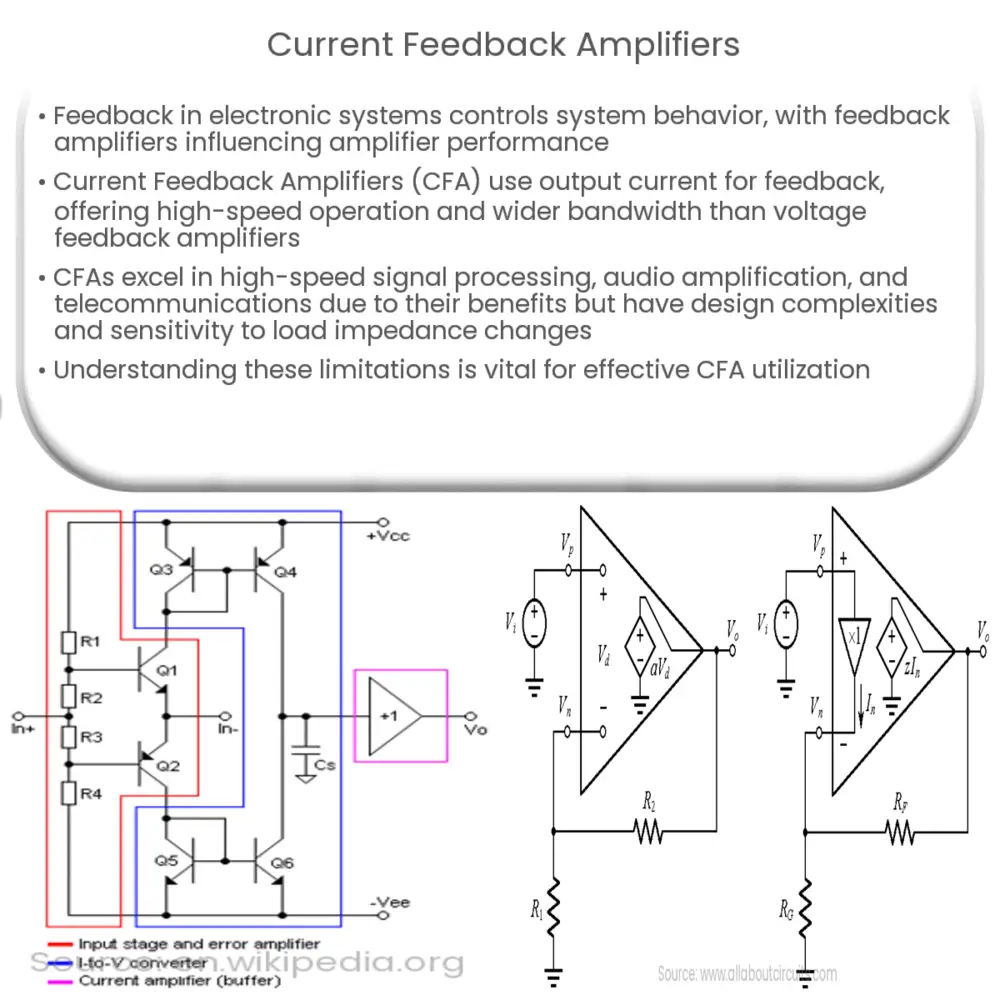
A current feedback amplifier (CFA) is a type of feedback amplifier where the feedback is based on the output current. In a current feedback amplifier, the output current is monitored and fed back into the input signal. This type of amplifier configuration can offer high-speed operation and a wider bandwidth compared to voltage feedback amplifiers.
Working Principle of a Current Feedback Amplifier
The fundamental operation of a current feedback amplifier involves feeding a portion of the output current back to the input. In the simplest form of a CFA, the output is coupled to the input through a feedback resistor. As the output current changes, the voltage across the feedback resistor changes, and this change in voltage is used to modulate the input.
Applications of Current Feedback Amplifiers
-
High-speed signal processing: Due to their wide bandwidth and high-speed operation, CFAs are often used in high-speed signal processing applications. They are particularly useful in situations where speed is a critical factor.
-
Audio amplification: CFAs can also be used in audio amplification systems. Their ability to handle high frequencies makes them suitable for high-quality audio applications.
-
Telecommunication systems: Current feedback amplifiers can be utilized in telecommunication systems due to their ability to process high-frequency signals.
These are just a few examples of how current feedback amplifiers can be used. In the next section, we will delve deeper into the advantages and limitations of CFAs, and the considerations for their design.
Advantages and Limitations of Current Feedback Amplifiers
Current Feedback Amplifiers offer several distinct advantages, including high speed, wide bandwidth, and better transient response compared to voltage feedback amplifiers. CFAs are typically used in applications where the response speed is critical, like video and RF amplification.
-
Advantages:
-
High Speed: CFAs can achieve high slew rates, which makes them ideal for high-speed signal processing.
-
Wide Bandwidth: CFAs have a wider bandwidth compared to voltage feedback amplifiers, allowing them to process a broad range of frequencies.
-
Better Transient Response: CFAs can respond quickly to changes in the input signal, resulting in better transient response.
-
-
Limitations:
-
Complexity: The design of CFAs is more complex than that of voltage feedback amplifiers. This complexity can increase the cost and difficulty of manufacturing these devices.
-
Sensitivity: CFAs can be sensitive to changes in load impedance, which can impact their performance in certain applications.
-
Design Considerations for Current Feedback Amplifiers
When designing a current feedback amplifier, there are several key considerations to bear in mind. Firstly, the feedback resistor should be chosen carefully to ensure stability and desired bandwidth. Secondly, the load impedance should be considered as CFAs can be sensitive to changes in load. The input impedance should also be kept low to maximize the feedback signal.
Conclusion
In conclusion, Current Feedback Amplifiers offer a host of benefits such as high speed, wide bandwidth, and improved transient response. However, their design can be more complex, and they may be sensitive to changes in load impedance. Therefore, while they offer powerful advantages in high-speed applications, understanding their limitations is key to utilizing them effectively. Despite these challenges, the versatility and performance of CFAs make them an important tool in modern electronic systems, particularly in high-speed signal processing, audio amplification, and telecommunications.



