
Explore the role of Charge Decay Testers in mitigating electrostatic risks in various sectors, from electronics to healthcare.
Understanding Charge Decay Testers
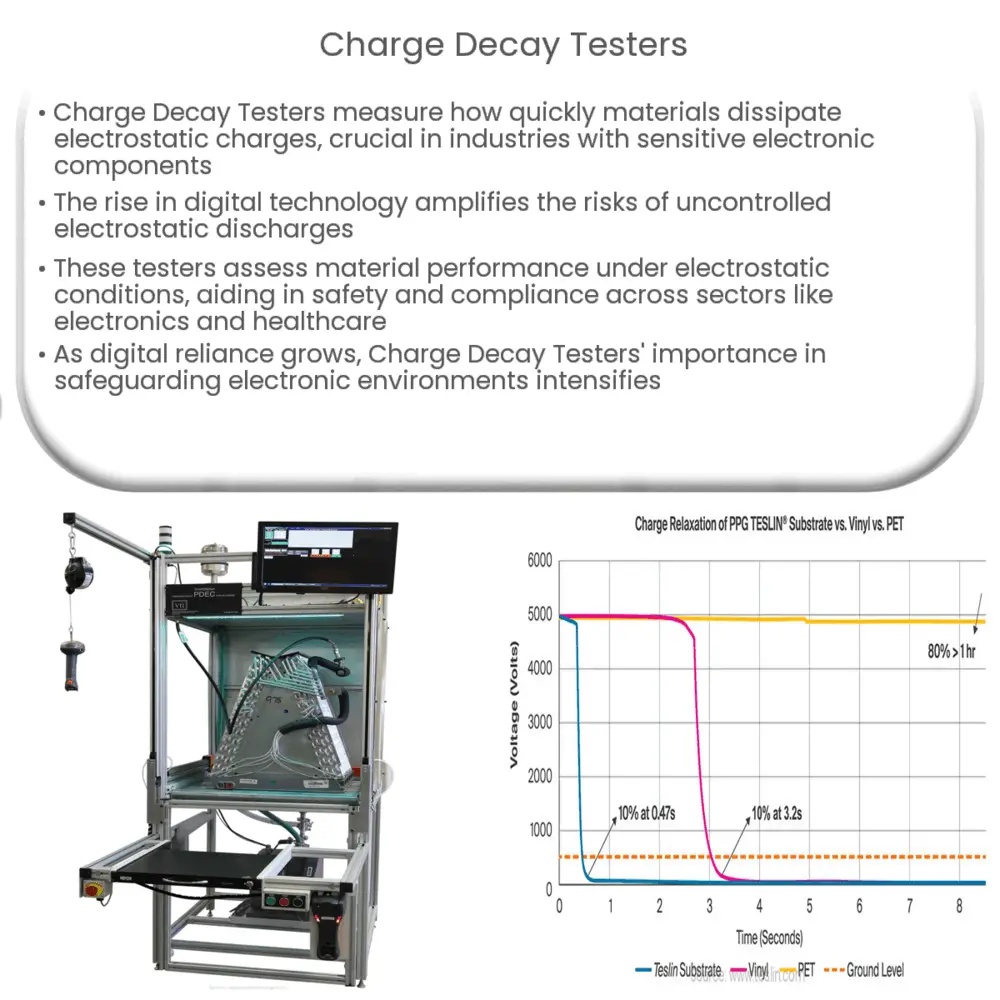
Charge Decay Testers are a critical tool in the world of electronics and material science. They allow us to measure the speed at which a material dissipates an electrostatic charge, a characteristic which can have significant implications for the real-world use of that material. In industries where handling or manufacturing processes involve highly sensitive electronic components, understanding the charge decay properties of materials is essential for maintaining product integrity and preventing potential electrostatic discharge (ESD) related failures.
The Importance of Charge Decay Testing
In our increasingly digitized world, the consequences of uncontrolled electrostatic discharge are more severe than ever. Everything from individual electronic components to large-scale manufacturing systems can suffer from ESD, leading to significant downtime, expensive repair or replacement costs, and potential data loss. Charge Decay Testers offer a proactive means of mitigating these risks by providing valuable insight into material performance under electrostatic conditions.
How Charge Decay Testers Work
- Charge Application: A high voltage corona discharge is used to apply an electrostatic charge to the material surface. This is achieved by creating a strong electric field between a pointed electrode and the test material.
- Charge Decay Measurement: Once the material has been charged, the tester measures the time taken for the charge to dissipate to a predetermined level. This is done using an electrostatic field meter which measures the field strength at a fixed distance from the material surface.
Common Applications of Charge Decay Testers
Charge Decay Testers have a wide range of applications across various sectors:
- Electronics Manufacturing: Used to assess the ESD properties of materials used in production environments, such as protective packaging, work surfaces, and clothing.
- Pharmaceuticals and Healthcare: Used in sterile environments where electrostatic charges can attract contaminants, interfere with electronic equipment, or cause ignitions in an oxygen-rich environment.
- Telecommunications: Helps in the evaluation of ESD protection measures in environments where sensitive communications equipment is installed or maintained.
Whether you’re an electronics manufacturer, a pharmaceutical company, or a telecom provider, understanding how quickly materials in your environment can dissipate a charge could be key to maintaining the safety and effectiveness of your operations.
Standards and Compliance
In many industries, especially those dealing with sensitive electronics or sterile environments, there are standards that materials must meet in terms of their ESD properties. Charge Decay Testers play an instrumental role in this context. They ensure materials comply with international standards such as IEC 61340-2-2 and ASTM D257. Without such critical testing, businesses risk non-compliance penalties, not to mention the potential loss and damage due to ESD.
Choosing the Right Charge Decay Tester
When considering which Charge Decay Tester to use, several factors should be taken into account:
- Test Speed: The speed at which tests can be performed is crucial, especially in high volume production environments.
- Accuracy: The device should provide reliable and accurate measurements that can be trusted.
- Usability: The tester should be user-friendly, allowing personnel at various skill levels to operate it effectively.
- Support and Calibration: Ongoing support and calibration services from the manufacturer or supplier can ensure that the tester continues to operate at optimal performance.
Conclusion
In conclusion, Charge Decay Testers represent an invaluable tool in a vast array of sectors. They are essential for ensuring that materials and products are safe, effective, and compliant with industry standards. By evaluating the speed of charge dissipation, these testers enable businesses to mitigate risks associated with electrostatic discharge, ultimately protecting their operations, products, and bottom line. As our reliance on electronics continues to grow, the role of Charge Decay Testers will only become more critical in maintaining the integrity and safety of our increasingly digitized world.



