
Explore the world of capacitive voltage-to-frequency converters: their mechanism, applications, advantages, and future prospects.
Introduction to Capacitive Voltage-to-Frequency Converters
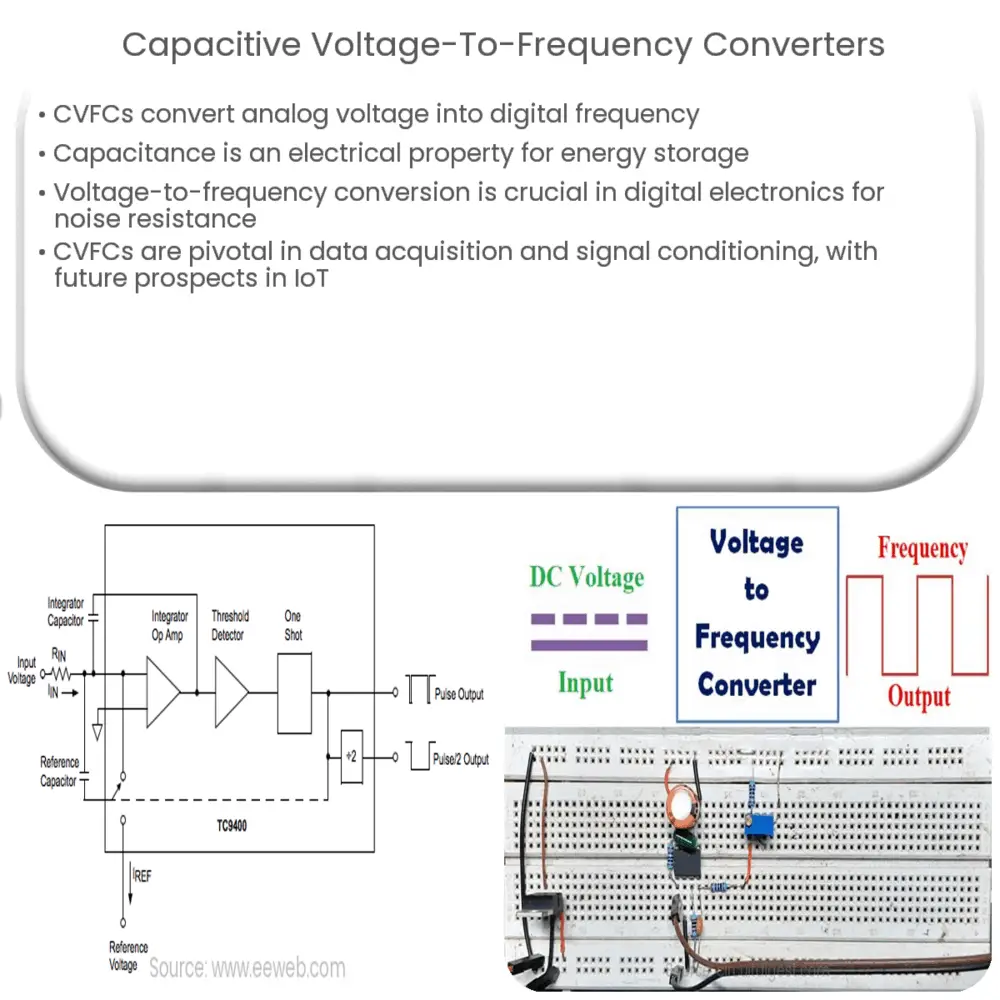
A capacitive voltage-to-frequency converter (CVFC) is a crucial electronic component used in various applications where voltage needs to be transformed into frequency. It operates based on the principle of converting an analog voltage input into a digital frequency output. To understand CVFCs better, it’s beneficial to break down its main components: capacitance and frequency conversion.
Understanding Capacitance
Capacitance is a property of an electrical circuit that allows it to store electrical energy. In layman’s terms, you can think of it as an electrical reservoir. The unit of capacitance is the farad (F). Capacitance depends on the size of the plates involved, the distance between them, and the type of insulating material or dielectric used. Capacitors, the devices that utilize this property, come in different shapes and sizes, each with unique characteristics to serve various applications.
Voltage-to-Frequency Conversion
Voltage-to-frequency conversion is an essential concept in digital electronics. It’s a process by which an analog voltage signal is transformed into a digital frequency signal. This process is vital in applications like data transmission and signal processing where digital signals are preferred over analog signals due to their resilience against noise and distortion. Voltage-to-frequency converters (VFCs) are the devices that carry out this conversion process.
The Mechanism of Capacitive Voltage-to-Frequency Converters
A capacitive voltage-to-frequency converter works by charging and discharging a capacitor at a rate proportional to the input voltage. As the capacitor charges, it builds up energy until it reaches a threshold. Upon hitting this threshold, the capacitor discharges, sending out a pulse. The frequency of these pulses is directly related to the input voltage. Hence, a higher voltage would result in a higher frequency output and vice versa.
Applications of CVFCs
- Data Acquisition Systems: In data acquisition systems, CVFCs serve a pivotal role in converting the analog signals from various sensors into digital signals for further processing and analysis.
- Signal Conditioning: CVFCs are also used extensively in signal conditioning circuits where they help in transforming signal formats for easier processing.
Additional Applications and Uses
Besides the applications mentioned, CVFCs also play an important role in numerous other industries and domains.
- Telecommunications: CVFCs are often utilized in telecommunication systems to convert voice signals into digital signals for transmission and then convert them back at the receiving end.
- Measurement Instruments: Many measurement instruments, such as digital voltmeters and frequency counters, use CVFCs for accurate readings.
- Control Systems: In industrial control systems, CVFCs are used to convert voltage levels into frequencies that can be used to control various aspects of the system, such as speed, temperature, and pressure.
Advantages of CVFCs
The popularity of CVFCs stems from their distinct advantages. First, they offer a high level of accuracy and precision, making them ideal for applications where these traits are paramount. Second, they are quite robust and resistant to environmental changes, which ensures consistent performance. Third, as digital devices, they can interface easily with other digital systems, reducing the need for additional conversion hardware. Lastly, they are cost-effective solutions for many applications, as they integrate multiple functionalities into a single device.
Future Prospects
The future for CVFCs looks promising. With the rise of Internet of Things (IoT) devices, the need for effective voltage-to-frequency conversion is only expected to grow. Developments in microelectronics and semiconductor technologies will likely lead to even smaller, more efficient, and more powerful CVFCs. This is anticipated to broaden their range of applications and increase their prevalence in our everyday electronics.
Conclusion
In conclusion, capacitive voltage-to-frequency converters play a vital role in modern electronics, transforming analog voltages into digital frequency signals. Their inherent benefits such as precision, resilience, and cost-effectiveness make them an ideal choice for many applications, from data acquisition systems to industrial control systems. As technology continues to evolve, the importance and utilization of CVFCs are expected to grow, further cementing their place in the world of digital electronics.



