
Explore capacitive voltage-to-current converters: their operation, types, applications, and design considerations in electronics.
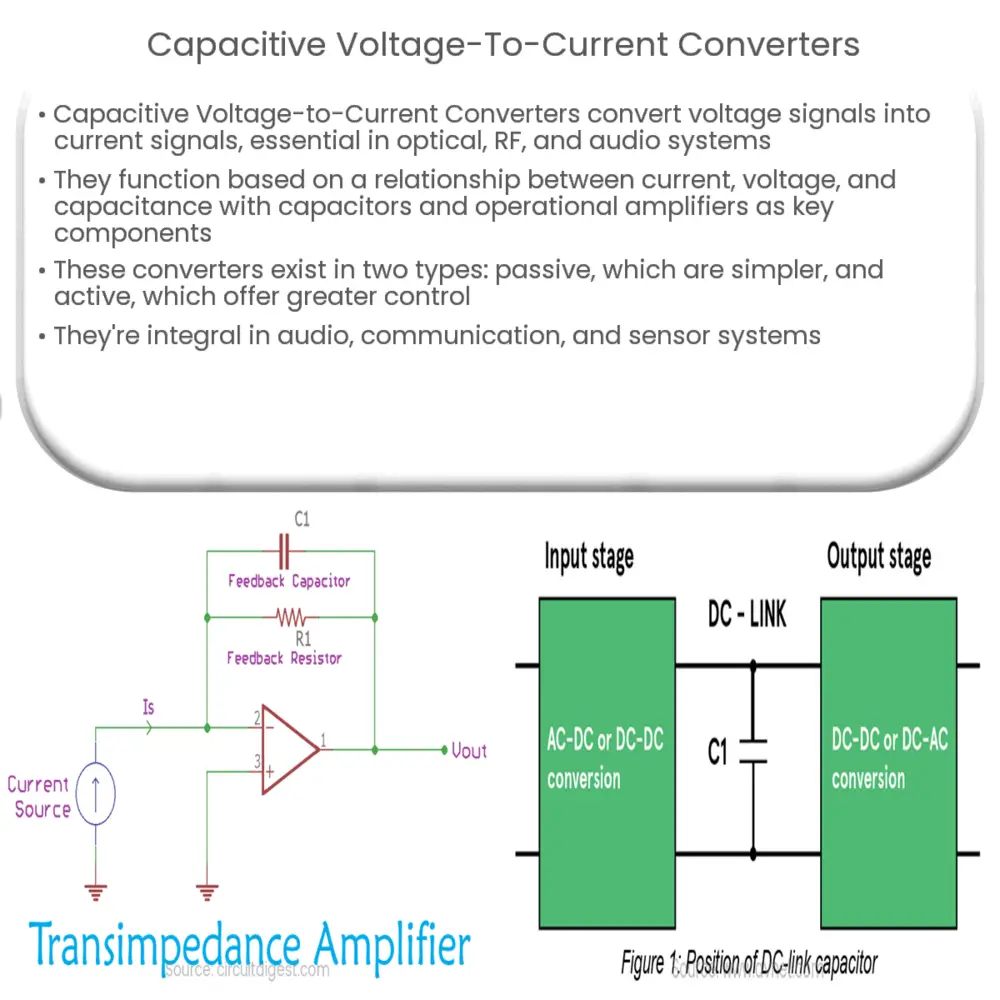
Introduction to Capacitive Voltage-to-Current Converters
Capacitive Voltage-to-Current Converters are crucial components in electronic devices that facilitate the conversion of voltage signals into equivalent current signals. This process is essential in systems where the current signal is more readily handled or manipulated than the voltage signal, such as in optical, RF, and audio systems.
Working Principle
The operation of capacitive voltage-to-current converters hinges on the fundamental relationship between current, voltage, and capacitance in an electronic circuit. Given by the formula I = C dv/dt, where I is the current, C the capacitance, and dv/dt the rate of change of voltage.
Key Components
-
Capacitor: This is the fundamental component in these converters. It temporarily stores electrical energy and controls the relationship between voltage and current in the circuit.
-
Operational Amplifier (Op-Amp): This acts as a comparator, magnifying the difference in voltage between its inputs, thereby driving the current flow. Depending on the configuration, the op-amp can also provide an additional layer of control over the output current.
Types of Capacitive Voltage-to-Current Converters
Capacitive Voltage-to-Current Converters come in two main types: passive and active. The difference between these two types lies in how they handle the voltage-to-current conversion process.
-
Passive Converters: In these devices, the voltage-to-current conversion is achieved primarily through passive components like resistors and capacitors. These converters are simpler and cheaper, but they offer less control over the output current and are less efficient.
-
Active Converters: These involve the use of active components such as transistors and operational amplifiers. They provide greater control over the output current and are more efficient, but they are also more complex and expensive.
In conclusion, capacitive voltage-to-current converters are vital electronic components that convert voltage signals into current signals. They operate based on the fundamental relationship between current, voltage, and capacitance, and consist of key components such as capacitors and operational amplifiers. They come in two main types, passive and active, each with its own benefits and drawbacks.
Applications of Capacitive Voltage-to-Current Converters
The varied applications of capacitive voltage-to-current converters highlight their significance in the electronics industry. Their usage can be primarily seen in areas such as:
-
Audio Systems: These converters are often used in audio systems to match the impedance of the speakers with the amplifier, ensuring maximum power transfer and high audio quality.
-
Communication Systems: In communication systems, these converters are crucial in modulating and demodulating signals for transmission and reception, respectively.
-
Sensor Systems: In sensors that measure physical parameters, these converters help in translating the variations in parameters into current changes that can be easily measured and interpreted.
Considerations in Designing Capacitive Voltage-to-Current Converters
Designing an effective capacitive voltage-to-current converter involves careful consideration of a few crucial aspects:
-
Capacitance Value: The value of the capacitor influences the range of voltage that can be converted to current. The capacitance must be chosen carefully to ensure the converter functions within the desired range.
-
Operational Amplifier Characteristics: The characteristics of the operational amplifier, such as its gain and frequency response, can significantly impact the performance of the converter. Hence, an op-amp suitable for the application’s requirements should be selected.
-
Circuit Layout: A well-designed circuit layout is crucial for minimizing noise and ensuring stable operation of the converter.
Conclusion
In conclusion, capacitive voltage-to-current converters play an indispensable role in modern electronics, providing vital functionality in a diverse range of applications including audio, communication, and sensor systems. The design of these converters requires a deep understanding of their operation and careful selection of components and circuit design to ensure optimal performance. With technological advancements, the future holds promising enhancements in the efficiency and applications of these converters, further solidifying their place in the landscape of electronic components.



