
Explore the role of Capacitive Voltage Stabilizers in maintaining steady voltage levels, their benefits, applications, and future prospects.
Introduction to Capacitive Voltage Stabilizers
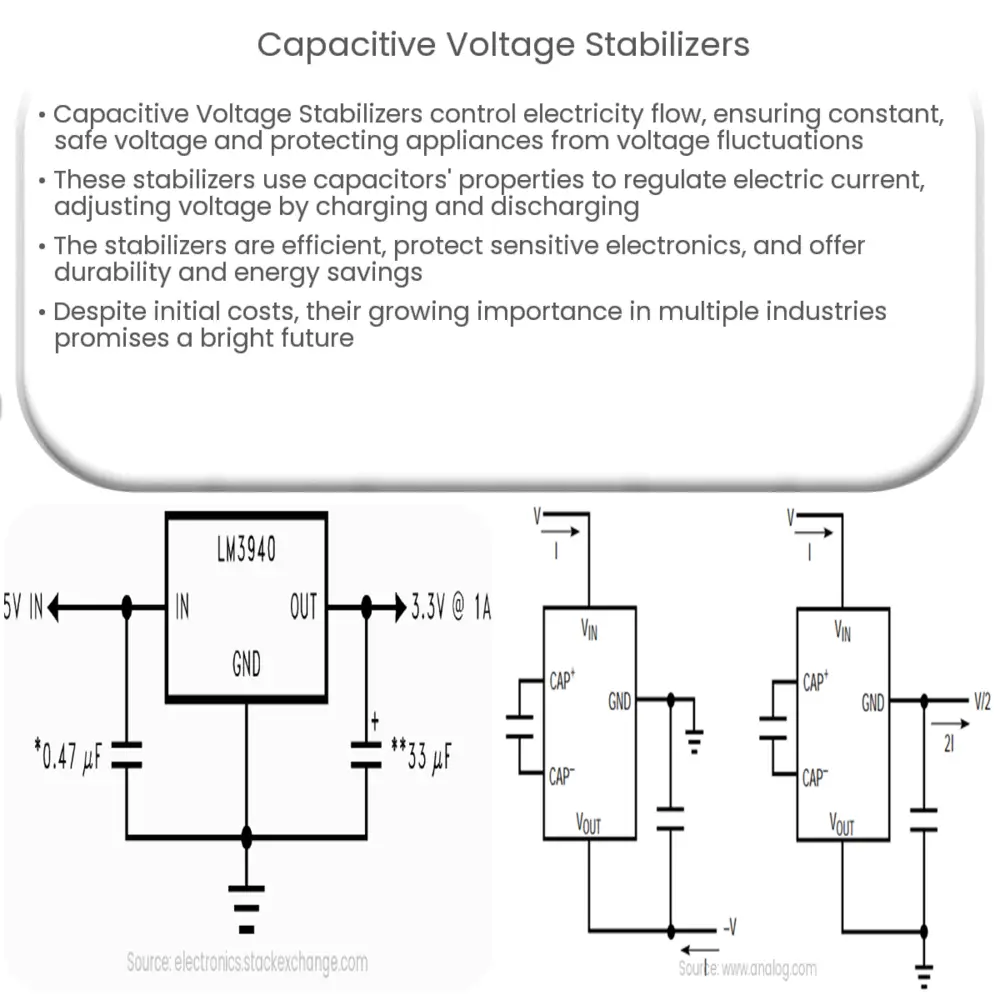
Among the pantheon of tools designed to maintain and control the flow of electricity, capacitive voltage stabilizers have a vital role to play. Their function, as the name suggests, centers on stabilizing voltage levels, providing a constant and safe voltage to electrical and electronic appliances, and protecting them from potential damage due to voltage fluctuations.
Understanding the Basics
A Capacitive Voltage Stabilizer is an automatic voltage control device, leveraging the inherent properties of a capacitor. Capacitors, known for their energy storing capability, are utilized in these stabilizers to help control the flow of electric current and ensure a stable output.
How Capacitive Voltage Stabilizers Work
Before we delve deeper into the workings of these stabilizers, it’s important to have a basic understanding of a capacitor’s function. A capacitor is an electronic component designed to store and release electric charge. Its charging and discharging process enables it to smoothen out or filter electrical signals. By manipulating this characteristic, a Capacitive Voltage Stabilizer can adjust and correct voltage levels.
- When the input voltage exceeds the desired range, the capacitive voltage stabilizer uses the capacitor to absorb the excess voltage, reducing the voltage to a safe level.
- On the other hand, when the voltage is lower than the required level, the stabilizer discharges the stored energy in the capacitor to compensate for the deficit, thereby increasing the voltage to an acceptable range.
This continual cycle of charging and discharging effectively maintains the output voltage within a predetermined safe range, protecting your appliances from electrical faults caused by voltage fluctuations.
Benefits of Capacitive Voltage Stabilizers
Capacitive Voltage Stabilizers offer several benefits over traditional voltage stabilizers. Here are a few to consider:
- Efficiency: Capacitive voltage stabilizers are known for their high efficiency. They can maintain a stable output voltage even under a wide range of input voltage variations.
- Protection: These stabilizers are particularly effective in protecting sensitive electronic appliances that can be damaged by voltage fluctuations.
In the next section, we will continue to explore the other benefits of capacitive voltage stabilizers and delve into their applications in various industries. We’ll also take a look at the challenges faced in their implementation and the advancements in technology that are paving the way for their widespread adoption.
Additional Benefits and Applications
Continuing from where we left off, capacitive voltage stabilizers bring with them additional advantages:
- Durability: Due to the robust nature of their design, these stabilizers are able to withstand severe voltage fluctuations and load variations, providing them with a longer lifespan.
- Energy Saving: By maintaining optimal voltage levels, these devices can help to reduce power consumption, leading to significant energy savings.
With such profound benefits, Capacitive Voltage Stabilizers find applications in a wide range of industries. They are commonly used in healthcare, where stable voltage is critical for medical equipment. Similarly, in the telecom sector, they ensure the seamless operation of communication devices. Industries that employ sensitive electronic and electrical equipment, such as IT, also rely heavily on these stabilizers for smooth operations.
Challenges and Future Prospects
Despite their advantages, capacitive voltage stabilizers also face certain challenges. The major one is the initial cost of installation, which can be high, deterring smaller businesses from their adoption. Also, their maintenance needs require specific expertise.
However, technological advancements continue to reduce these hurdles. Research is ongoing to make these stabilizers more affordable and easier to maintain. Furthermore, the growing awareness about energy conservation and the need to protect equipment from power-related issues are pushing the demand for these stabilizers. Their future seems promising.
Conclusion
In conclusion, capacitive voltage stabilizers represent a significant innovation in the field of voltage stabilization. By harnessing the unique properties of capacitors, these devices are capable of maintaining stable voltage levels, thereby protecting sensitive appliances and potentially saving on energy costs. Despite some challenges in their implementation, they are increasingly becoming indispensable in various industries due to their high efficiency and durability. As technological advancements continue to address their limitations, capacitive voltage stabilizers stand poised for wider acceptance and application.



