
Explore the workings, applications, advantages, and future of Capacitive Energy Harvesting Systems, a sustainable power solution for low-energy devices.
Introduction
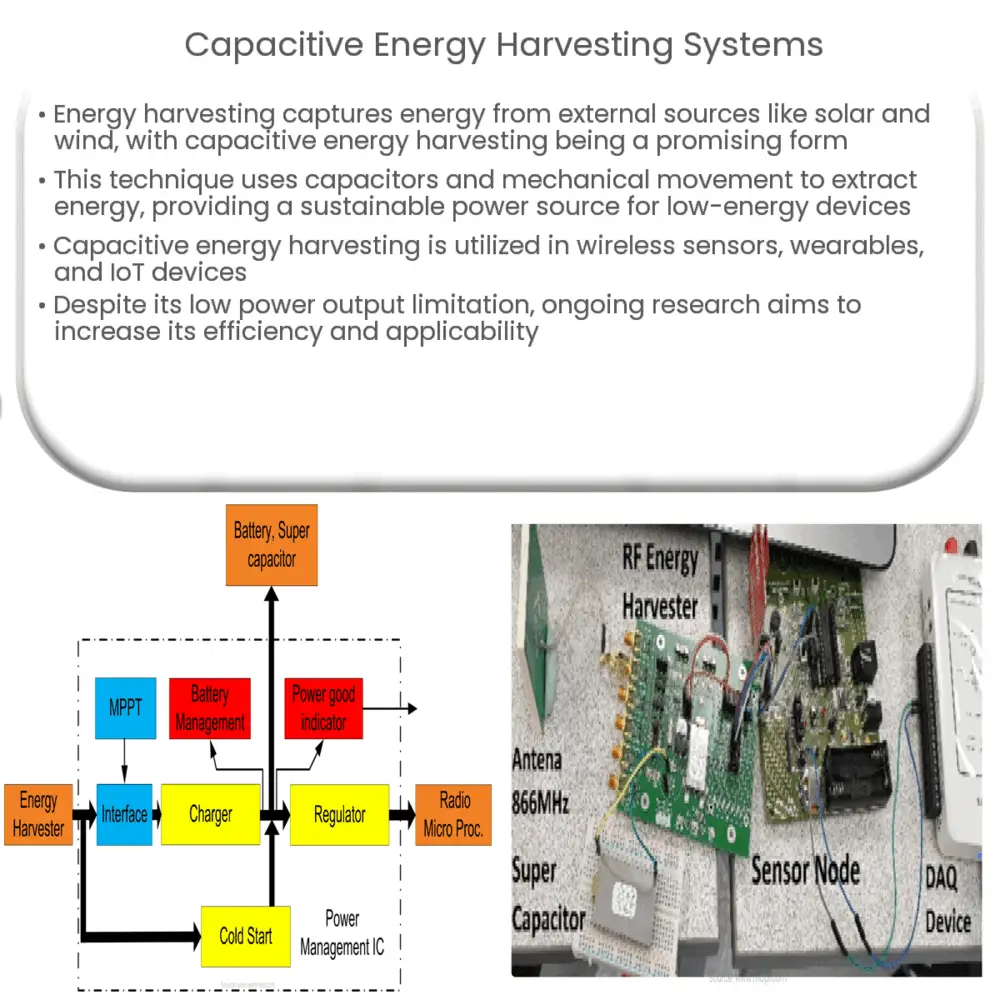
Energy harvesting, also known as power harvesting or energy scavenging, refers to the process of capturing and storing small amounts of energy from external sources, such as solar, thermal, wind, or kinetic energy. One promising form of energy harvesting is Capacitive Energy Harvesting, which involves the extraction of energy from the environment by varying the capacity of a capacitor, typically by mechanical movement. This technology offers a sustainable approach to powering low-energy electronic devices without the need for batteries.
Working Principle of Capacitive Energy Harvesting Systems
The core principle of capacitive energy harvesting systems lies in the properties of a capacitor. A capacitor is a two-terminal electronic component that stores energy in an electric field. When a mechanical force displaces one of the plates of the capacitor, the device’s capacitance changes, resulting in a voltage fluctuation. This change in voltage can be harnessed and transformed into usable electric power.
Types of Capacitive Energy Harvesting
- Electrostatic energy harvesting: This method involves the extraction of energy from an electric field. The key principle behind this process is the change in capacitance due to the variation in electric field strength between the capacitor plates.
- Triboelectric energy harvesting: In this case, the energy is harvested from the triboelectric effect, a type of contact electrification where certain materials become electrically charged after they come into frictional contact with a different material. Here, the change in capacitance is caused by the relative movement of materials and subsequent generation of electric charge.
Applications of Capacitive Energy Harvesting Systems
- Wireless sensor networks: One of the major applications of capacitive energy harvesting is in powering wireless sensor networks. These networks, often consisting of numerous interconnected nodes, can benefit significantly from this self-sustaining power source.
- Wearable devices: Capacitive energy harvesting can also find application in wearable technology, providing a continuous and reliable power source that eliminates the need for frequent recharging.
- Internet of Things (IoT): The IoT ecosystem comprises billions of devices globally. Given their low-power requirements, these devices are ideal candidates for capacitive energy harvesting, allowing for more efficient and sustainable operation.
Advantages and Disadvantages of Capacitive Energy Harvesting
Capacitive energy harvesting systems provide a sustainable and reliable source of power for low-energy electronic devices, reducing reliance on traditional batteries and decreasing the overall environmental footprint. By converting the otherwise wasted ambient energy into usable electricity, these systems can provide continuous power supply, thereby increasing the operational lifespan of devices.
However, like all technologies, capacitive energy harvesting systems come with their own set of challenges. The primary limitation is the relatively low power output, which makes them unsuitable for devices with high power demands. Additionally, the efficiency of energy conversion can be significantly affected by environmental factors, such as temperature and humidity.
Future Perspectives
With continuous advancements in technology, the efficiency of capacitive energy harvesting systems is expected to improve, making them viable for a wider range of applications. Moreover, the growth of IoT, wearable technology, and wireless sensor networks will likely increase the demand for these systems, further accelerating research and development efforts in this field. The integration of these systems with advanced energy storage solutions could potentially overcome the challenge of low power output, paving the way for more sustainable and self-sufficient electronic devices.
Conclusion
Capacitive energy harvesting represents an innovative and sustainable solution to power small, low-energy devices. Despite current limitations, ongoing research and development promise to enhance the efficiency and broaden the applicability of this technology. In an era increasingly dominated by IoT, wearable technology, and wireless sensor networks, capacitive energy harvesting offers a path towards more energy-efficient and environmentally friendly electronic systems. As we continue to innovate and push the boundaries of technology, the importance of such sustainable solutions will only become more apparent, redefining our approach towards energy consumption and conservation.



