
Explore the world of capacitive data converters, their functioning, types, key components, benefits, and diverse applications in digital signal processing.
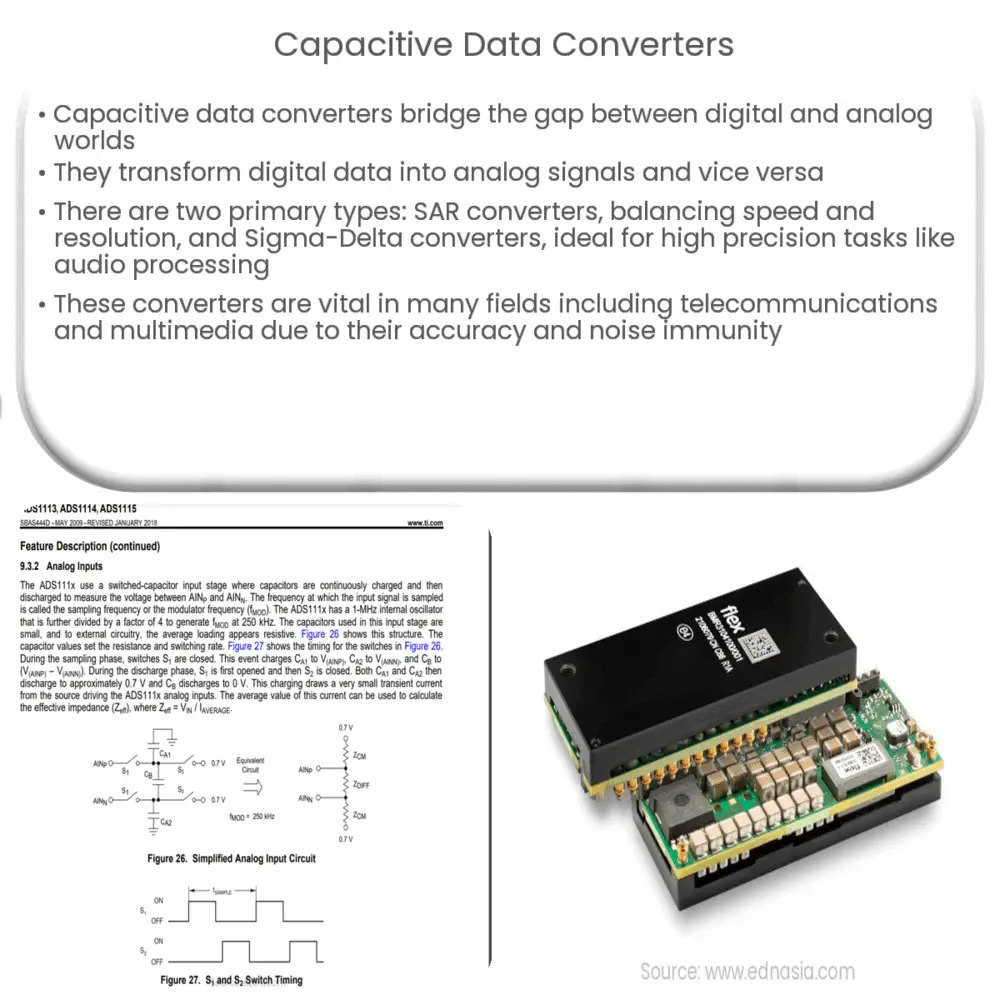
Introduction to Capacitive Data Converters
Capacitive data converters, also known as Capacitive Digital-to-Analog Converters (CDACs), are pivotal components in the realm of digital signal processing and electronics. They serve as the conduit between the digital world, characterized by binary data, and the analog world, characterized by continuous signals.
Role and Functionality
Capacitive data converters are primarily used to transform digital data into an analog signal, a process known as digital-to-analog conversion, and vice versa in a process known as analog-to-digital conversion. To this end, capacitive data converters use an array of capacitors and switches to realize their conversion function.
- The process of digital-to-analog conversion involves the creation of an analog signal that corresponds to the digital input, thereby allowing digital data to be used in analog systems or equipment.
- The process of analog-to-digital conversion, on the other hand, involves sampling an analog signal at regular intervals and then quantizing these samples to represent them in digital form. This allows analog signals to be processed or stored in digital systems.
Types of Capacitive Data Converters
There are primarily two types of capacitive data converters: successive approximation register (SAR) and sigma-delta (ΣΔ) converters, each possessing unique features and applications.
- Successive Approximation Register (SAR) converters: SAR converters use a binary search algorithm to find the digital value corresponding to the analog input. They provide a balance between speed and resolution, making them suitable for applications requiring moderate speed and precision.
- Sigma-Delta (ΣΔ) converters: These converters use oversampling and noise shaping techniques to provide higher resolution conversion. This makes them ideal for applications that require high resolution and precision, such as audio processing and seismic data acquisition.
Working Principle
The basic working principle of capacitive data converters involves charging and discharging an array of capacitors. The switches control the connection of capacitors to the reference voltage or ground, and the output voltage represents the digital data.
Key Components of Capacitive Data Converters
At the heart of capacitive data converters are two essential components:
- Capacitor Array: This is a group of capacitors configured in a binary-weighted or thermometer-coded arrangement. In a binary-weighted configuration, each capacitor in the array has twice the capacitance of its neighbor. In a thermometer-coded configuration, all capacitors are of equal value, and the number of capacitors switched to the reference voltage depends on the digital code.
- Switches: The switches serve the crucial role of connecting capacitors either to the reference voltage or to the ground, depending on the binary value of the corresponding bit in the digital data. This allows the converter to accurately represent the digital data as an analog voltage.
Advantages and Applications of Capacitive Data Converters
Capacitive data converters offer several advantages such as high accuracy, high resolution, and excellent linearity. They also offer good immunity to noise, making them ideal for applications in harsh environments where robustness against noise is essential.
Capacitive data converters find wide-ranging applications in diverse fields. In telecommunications, they are used in modems and digital telephony. In multimedia, they find use in sound cards and digital audio recording and playback devices. They are also used in scientific and industrial equipment such as digital oscilloscopes and medical devices.
Conclusion
In conclusion, capacitive data converters stand as a testament to the seamless interplay between the digital and analog worlds. These ingenious devices, through the process of data conversion, enable the utilization of digital computing power to analyze and process analog signals from the physical world. As we move forward in this digital age, capacitive data converters will continue to play a crucial role in numerous applications, ranging from telecommunications to multimedia to scientific research. They not only signify the fusion of digital and analog technologies but also highlight the vast potential of this fusion in shaping our increasingly digital future.



