
A buck-boost current regulator combines buck and boost converter functionalities for efficient power management across diverse applications.
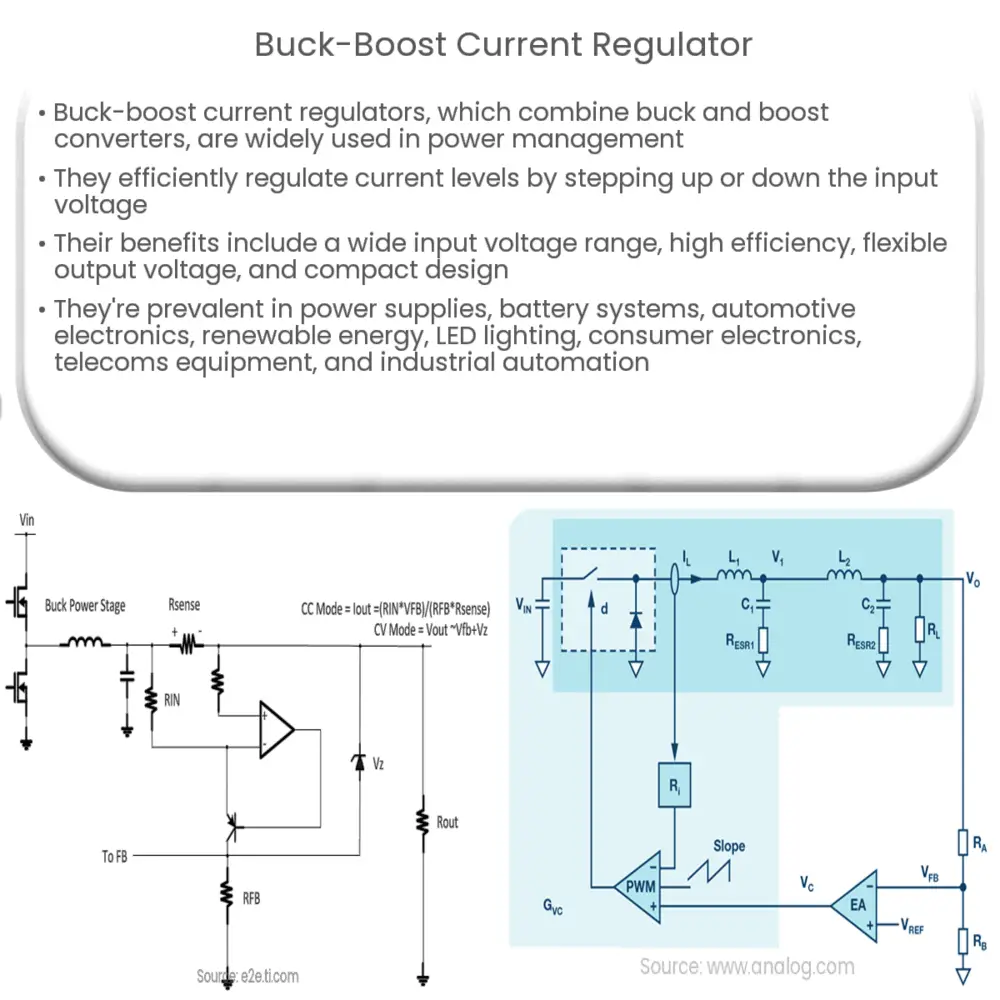
Buck-Boost Current Regulator: Overview and Applications
The buck-boost current regulator is an advanced electronic circuit topology widely used in power management applications. This versatile device combines the functionalities of a buck converter and a boost converter to efficiently regulate current levels in a system. In this article, we will explore the underlying principles of buck-boost current regulators, their advantages over traditional regulators, and their potential applications in various industries.
Principles of Buck-Boost Current Regulation
A buck-boost current regulator operates based on the principles of inductor-based switching circuits. It can either step down or step up the input voltage depending on the requirements of the load. The basic structure of a buck-boost regulator consists of a power switch, an inductor, a diode, and a capacitor. By controlling the switching frequency and duty cycle of the power switch, the regulator can precisely manage the current flow through the inductor and the diode, ultimately regulating the output current to the desired level.
When the regulator operates in buck mode, the input voltage is stepped down to provide a lower output voltage. Conversely, when operating in boost mode, the input voltage is stepped up to generate a higher output voltage. The ability to switch between these two modes seamlessly allows the buck-boost current regulator to provide a stable output current despite fluctuations in input voltage or load demands.
Advantages of Buck-Boost Current Regulators
There are several advantages to using buck-boost current regulators over traditional linear regulators and single-mode switching regulators. Some key benefits include:
- Wide input voltage range: Buck-boost regulators can accommodate a wide range of input voltages, making them suitable for applications with varying power supply conditions.
- High efficiency: Due to their switching nature, buck-boost regulators typically exhibit higher efficiency levels compared to linear regulators, especially in high voltage difference scenarios. This results in reduced heat generation and improved system reliability.
- Flexible output voltage: The ability to both step up and step down input voltage enables buck-boost regulators to cater to various load requirements, providing a flexible solution for diverse applications.
- Compact design: As buck-boost regulators require fewer components than separate buck and boost converters, they often have a smaller footprint, making them ideal for space-constrained applications.
Applications of Buck-Boost Current Regulators
Buck-boost current regulators find use in a wide array of industries and applications due to their versatility and efficiency. Some common applications include:
- Power supplies: In power supply designs, buck-boost regulators help maintain stable output currents despite varying input voltages or load conditions.
- Battery management systems: In battery-powered devices, buck-boost regulators optimize the charging and discharging process to maximize battery life and performance.
- Automotive electronics: Buck-boost regulators are used in automotive applications to manage fluctuating power supply voltages and ensure stable operation of electronic components.
Renewable Energy Systems
Renewable energy systems, such as solar and wind power installations, often experience varying input voltages due to environmental factors. Buck-boost current regulators play a critical role in ensuring a consistent output voltage in these systems, improving the overall efficiency and performance.
LED Lighting
LED lighting systems require precise current control to maintain consistent brightness levels and prevent damage due to excessive current. Buck-boost current regulators are widely used in LED driver circuits to maintain the required current levels, enabling efficient and reliable operation.
Consumer Electronics
Consumer electronic devices, such as smartphones, tablets, and laptops, require efficient power management to ensure optimal battery life and performance. Buck-boost current regulators are commonly used in these devices to manage the power distribution among various internal components, extending battery life and improving overall device efficiency.
Telecommunications Equipment
Telecommunication equipment, including cellular base stations and network routers, require stable power supplies to ensure reliable data transmission. Buck-boost current regulators help maintain consistent voltage levels in these systems, contributing to reliable network connectivity and performance.
Industrial Automation
Industrial automation systems involve numerous sensors, actuators, and other electronic components that require a stable power supply for accurate operation. Buck-boost current regulators are employed in these systems to maintain the required current levels, ensuring precise control and reliable performance.
Conclusion
In conclusion, buck-boost current regulators offer a versatile and efficient solution for power management in various applications and industries. Their ability to accommodate a wide range of input voltages, provide flexible output voltages, and maintain high efficiency levels make them a popular choice in power supply designs, battery management systems, automotive electronics, renewable energy systems, LED lighting, consumer electronics, telecommunications equipment, and industrial automation. As technology continues to advance, it is expected that buck-boost current regulators will play an increasingly important role in shaping the future of efficient and reliable electronic systems.



