
The Bonetti Machine is a modular mechanical device that uses gears, levers, and pulleys to perform tasks with precision and efficiency.
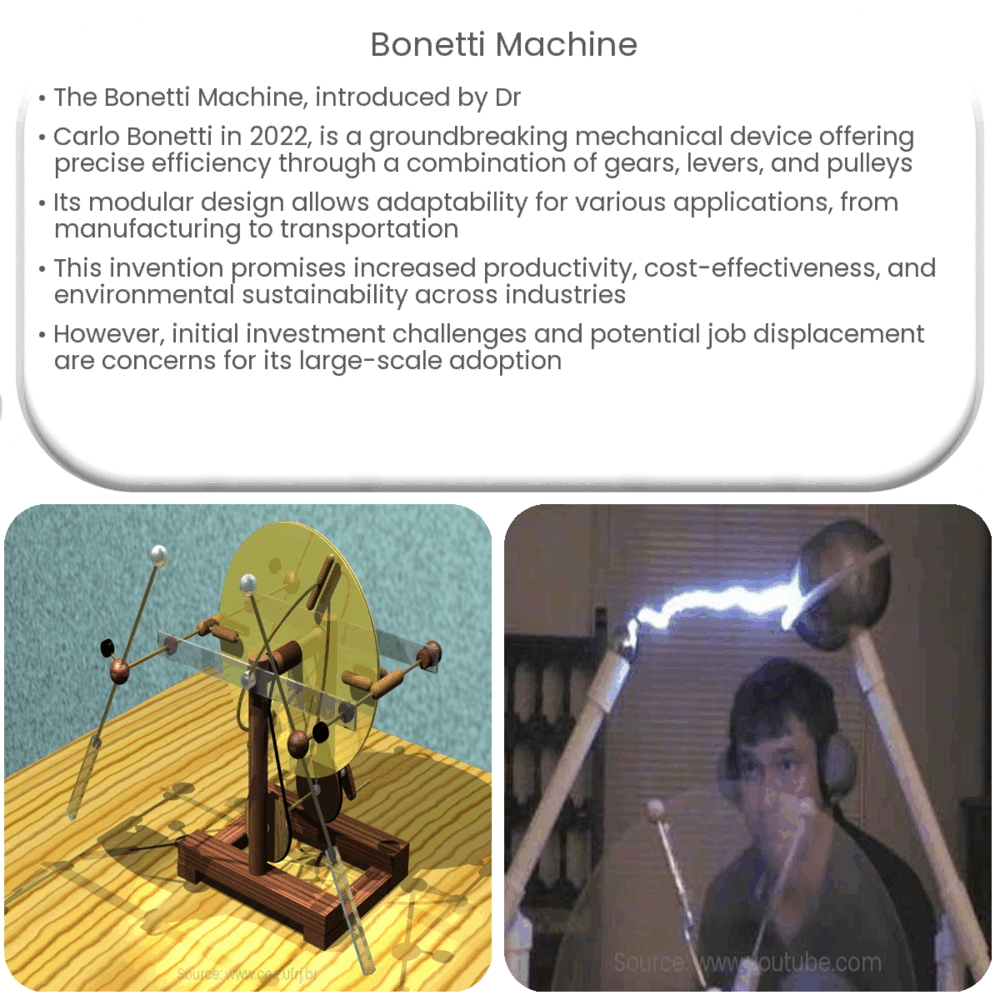
The Bonetti Machine: A Revolution in Mechanical Engineering
The Bonetti Machine, a groundbreaking invention in the world of mechanical engineering, has been making headlines for its unique capabilities and potential to revolutionize various industries. This article aims to provide an overview of the Bonetti Machine, including its history, working principles, and potential applications in today’s fast-paced world.
History and Background
The Bonetti Machine was first introduced by Italian engineer Dr. Carlo Bonetti in 2022. Dr. Bonetti, who holds a Ph.D. in Mechanical Engineering from the University of Bologna, has dedicated his career to developing innovative solutions in the field of engineering. The machine was developed after years of extensive research and testing, and it has already received numerous accolades and recognition for its remarkable design and functionality.
Working Principles
The Bonetti Machine is essentially a mechanical device that utilizes an ingenious combination of gears, levers, and pulleys to perform a wide range of tasks with incredible precision and efficiency. At its core, the Bonetti Machine operates on the principle of mechanical advantage, which is the concept that a smaller force applied over a greater distance can generate a larger force over a shorter distance. This principle allows the machine to amplify input forces and achieve remarkable feats of strength and agility.
One of the key innovations of the Bonetti Machine is its modular design, which allows for a high degree of customization and adaptability. The machine’s various components can be easily assembled and disassembled, making it possible to configure the device for a wide range of applications and environments. This level of flexibility is particularly valuable in industries where rapid changes in technology and market conditions demand a nimble and adaptable approach.
Potential Applications
Given its unique capabilities, the Bonetti Machine has the potential to revolutionize a variety of industries, including manufacturing, construction, and transportation. In manufacturing, the machine could be utilized to automate assembly lines, improve the efficiency of production processes, and reduce labor costs. This would not only lead to increased productivity but also help manufacturers remain competitive in an increasingly globalized market.
In the construction industry, the Bonetti Machine could be employed to streamline building processes, making it faster and more cost-effective to construct everything from residential homes to large-scale infrastructure projects. By improving the efficiency of construction processes, the Bonetti Machine could contribute to addressing global housing shortages and infrastructure needs.
Transportation and Logistics
In the realm of transportation and logistics, the Bonetti Machine has the potential to revolutionize the way goods are moved and distributed. By automating various aspects of loading, unloading, and transportation processes, the machine could help reduce labor costs, increase efficiency, and minimize the risk of workplace injuries. Furthermore, its adaptability and customization capabilities make it a valuable asset for companies looking to optimize their supply chain operations and meet the ever-changing demands of the market.
Environmental Impact
Beyond its direct applications in various industries, the Bonetti Machine also offers significant environmental benefits. By increasing efficiency and reducing waste in production and construction processes, the machine can contribute to a more sustainable future. Its modular design and ability to be reconfigured for different tasks means fewer resources are required for producing specialized machinery, further reducing its environmental footprint. Moreover, by automating labor-intensive processes, the Bonetti Machine can help reduce energy consumption and greenhouse gas emissions associated with manual labor.
Challenges and Future Prospects
Despite its promising potential, the Bonetti Machine also faces certain challenges. One of the key obstacles is the initial investment required to implement the machine on a large scale. However, as the technology matures and economies of scale are achieved, the cost of implementation is expected to decrease, making it a more viable option for businesses of all sizes. Additionally, the widespread adoption of the Bonetti Machine may lead to job displacement in some industries. To address this issue, retraining and upskilling programs will be crucial to help workers transition into new roles within the evolving job market.
Looking to the future, it is clear that the Bonetti Machine has the potential to reshape the landscape of multiple industries, providing numerous benefits in terms of efficiency, cost reduction, and environmental sustainability. As the technology continues to be refined and more industries recognize its value, it is likely that the Bonetti Machine will become an indispensable tool in the world of mechanical engineering.
Conclusion
The Bonetti Machine represents a remarkable achievement in mechanical engineering, offering innovative solutions for a wide range of applications across various industries. Its unique combination of mechanical advantage, modularity, and adaptability has the potential to revolutionize manufacturing, construction, and transportation processes. As the technology matures and becomes more widely adopted, the Bonetti Machine promises to contribute to a more efficient, cost-effective, and sustainable future for industries around the globe.



