
Explore the properties and applications of Bismuth Ferrite (BFO), a multiferroic material with potential uses in memory, energy, and sensing.
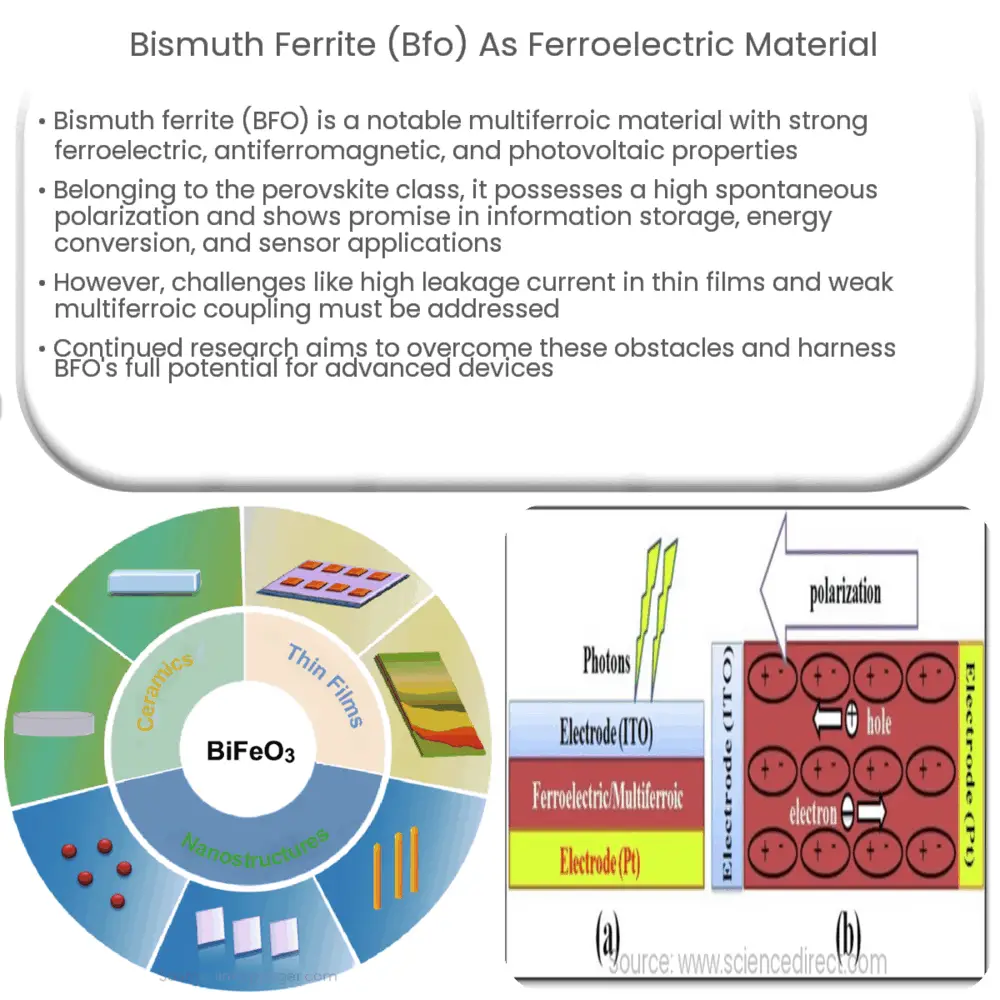
Bismuth Ferrite (BFO) as a Ferroelectric Material
Introduction to Bismuth Ferrite (BFO)
Bismuth ferrite (BiFeO3 or BFO) is a multiferroic material known for its strong ferroelectric and antiferromagnetic properties. It has attracted significant interest in recent years due to its potential applications in various fields, including information storage, energy conversion, and sensors. In this article, we will discuss the properties of BFO and its potential use as a ferroelectric material.
Properties of Bismuth Ferrite
Bismuth ferrite belongs to the perovskite class of materials, which is characterized by a unique crystal structure that results in a wide range of interesting physical properties. Some key properties of BFO include:
- Ferroelectricity: BFO exhibits a spontaneous polarization of about 100 μC/cm2 at room temperature, making it one of the strongest ferroelectric materials known. This high polarization is a result of the presence of Bi3+ and Fe3+ ions in the crystal lattice, which create an off-center displacement of the ions, leading to a polar structure.
- Magnetism: BFO also exhibits antiferromagnetic ordering with a Neel temperature (TN) of around 640 K. This property is primarily attributed to the interaction between the Fe3+ ions in the crystal lattice.
- Multiferroicity: The coexistence of ferroelectric and magnetic properties in BFO makes it a multiferroic material. Multiferroics are rare and have the potential to enable novel device functionalities by coupling the electric and magnetic properties.
- Photovoltaic and photocatalytic effects: BFO exhibits a strong photoresponse, which can be exploited for energy conversion applications such as photovoltaics and photocatalysis.
Applications of Bismuth Ferrite as a Ferroelectric Material
The unique combination of ferroelectric and magnetic properties in BFO has made it a promising candidate for a variety of applications, some of which include:
- Non-volatile memory: The high ferroelectric polarization of BFO can be used to store information in the form of electric dipoles, which can be read and written using an electric field. This makes BFO a promising material for the development of high-density, low-power non-volatile memory devices.
- Energy harvesting: The photovoltaic and photocatalytic properties of BFO can be utilized in solar cells and photocatalysts for efficient conversion of solar energy into electricity and chemical energy, respectively.
- Sensors and actuators: The ferroelectric properties of BFO can be employed in the development of sensors and actuators that can detect and respond to changes in electric fields, temperature, pressure, and other stimuli.
Challenges and Future Directions
Despite its promising properties, BFO faces some challenges that need to be addressed before it can be fully utilized in practical applications. Some of these challenges include:
- Leakage current: High leakage current in BFO thin films can hamper their performance in non-volatile memory devices. This issue can be mitigated by introducing suitable dopants or utilizing advanced fabrication techniques to improve the film quality.
- Control of multiferroic coupling: The coupling between the ferroelectric and magnetic properties in BFO is relatively weak, which limits its potential for novel device applications. Research is ongoing to enhance the coupling by modifying the crystal structure or applying external stimuli such as electric or magnetic fields.
- Scalability and integration: The successful integration of BFO into existing device architectures requires scalable and cost-effective fabrication methods, as well as a thorough understanding of the material’s properties at the nanoscale.
Addressing these challenges will pave the way for the realization of advanced devices based on BFO and other multiferroic materials.
Conclusion
Bismuth ferrite (BFO) is an exciting ferroelectric material that holds great potential for a variety of applications, thanks to its unique combination of ferroelectric, magnetic, and photovoltaic properties. Research in this field has been growing rapidly, and significant progress has been made in understanding the fundamental properties and mechanisms of BFO. However, there are still several challenges to overcome before BFO can be widely adopted in practical devices. By continuing to investigate and address these challenges, researchers can unlock the full potential of BFO and other multiferroic materials, paving the way for a new generation of advanced devices with novel functionalities.
References
- Wang, J., Neaton, J. B., Zheng, H., Nagarajan, V., Ogale, S. B., Liu, B., Viehland, D., Vaithyanathan, V., Schlom, D. G., Waghmare, U. V., Spaldin, N. A., Rabe, K. M., Wuttig, M., and Ramesh, R. (2003). Epitaxial BiFeO3 Multiferroic Thin Film Heterostructures. Science, 299(5613), 1719-1722.
- Eerenstein, W., Mathur, N. D., and Scott, J. F. (2006). Multiferroic and magnetoelectric materials. Nature, 442(7104), 759-765.
- Chu, Y.-H., and Ramesh, R. (2008). Bismuth ferrite based thin films and heterostructures for applications in sensing, photovoltaics and nanoelectronics. Advanced Functional Materials, 18(9), 1323-1331.



