
Explore the principles, structure, operation, applications, benefits, and limitations of avalanche transistors in modern electronics.
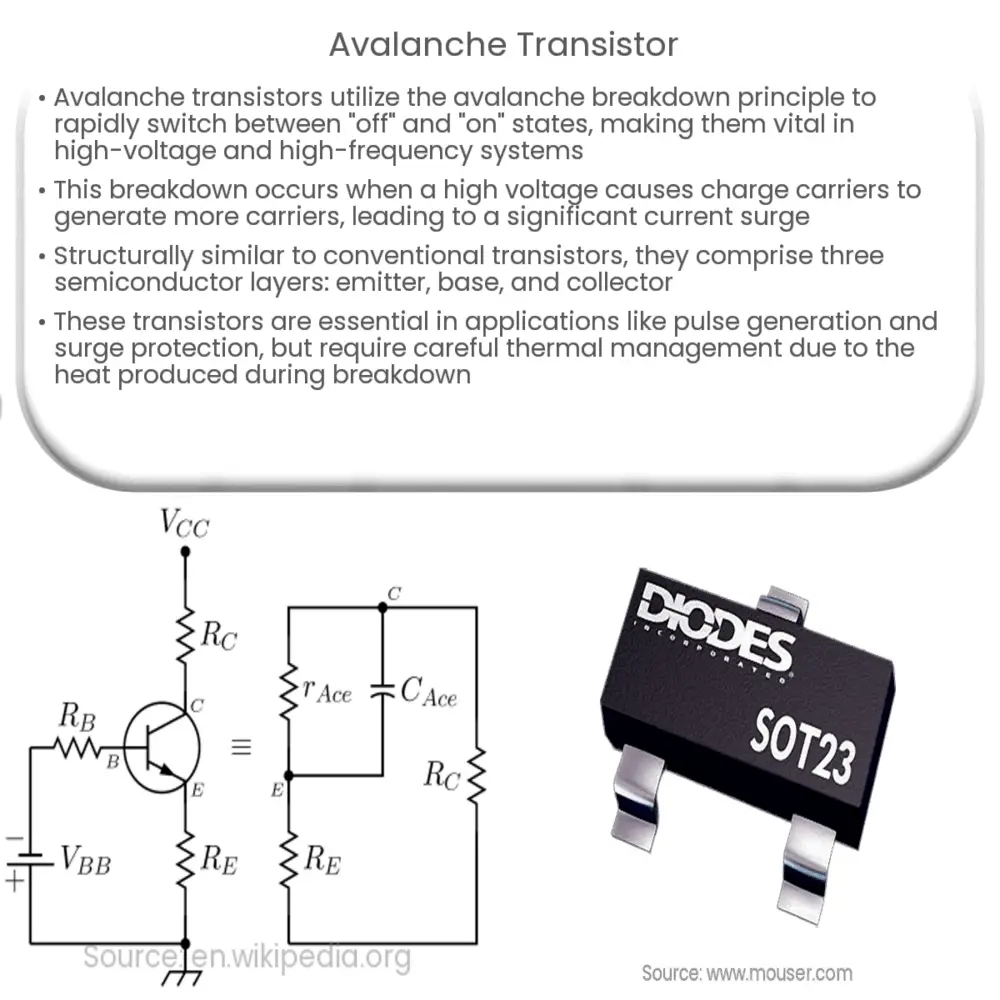
Introduction to Avalanche Transistors
Avalanche transistors are semiconducting devices that utilize the avalanche breakdown principle, a unique phenomenon that occurs when a high voltage is applied to a p-n junction, to switch from an “off” to an “on” state. These transistors are integral components in various high-voltage and high-frequency electronic systems.
Understanding the Principle of Avalanche Breakdown
The avalanche breakdown is a phenomenon that occurs when a high electric field is applied across a p-n junction in a semiconductor. This high electric field imparts sufficient energy to the charge carriers (electrons or holes), enabling them to knock out other electrons from the atoms in the lattice, thereby creating more charge carriers. This process results in a sudden, large increase in current, even for a small increase in voltage.
- Breakdown Voltage: The voltage at which avalanche breakdown occurs is known as the breakdown voltage. The breakdown voltage is a critical parameter in the design of avalanche transistors, as it determines the voltage at which the transistor switches from off to on.
- Avalanche Multiplication: The process of charge carriers gaining energy and knocking out other electrons is known as avalanche multiplication. This process leads to a rapid multiplication of the number of charge carriers, which is what causes the sudden surge in current.
Structure and Operation of Avalanche Transistors
Avalanche transistors are similar in structure to conventional transistors, consisting of three layers of semiconductor material that form two p-n junctions. These layers are known as the emitter, base, and collector.
- Emitter: The emitter is the region where charge carriers (either electrons or holes) are injected into the base.
- Base: The base is a thin layer of semiconductor material. The injected charge carriers need to traverse this region to reach the collector. The thinness of the base layer ensures that a large number of carriers reach the collector.
- Collector: The collector is the region where the charge carriers are collected. In the case of an avalanche transistor, the collector-base junction is designed such that it undergoes avalanche breakdown at a specified voltage.
The operation of an avalanche transistor is characterized by the breakdown of the collector-base junction. When the voltage across this junction exceeds the breakdown voltage, the transistor rapidly switches from off to on, allowing a large current to flow. This rapid switching capability makes avalanche transistors ideal for use in high-frequency applications.
Applications of Avalanche Transistors
Avalanche transistors are employed in a variety of applications due to their unique characteristics. Some of the key applications include:
- Pulse Generators: The rapid switching ability of avalanche transistors makes them an ideal choice for use in pulse generation circuits, where they are used to generate short, high-power pulses.
- Microwave Frequency Generation: Avalanche transistors can be used in circuits designed to generate microwave frequencies. The high switching speeds and breakdown characteristics enable the generation of very high frequencies.
- Switching Power Supplies: In switching power supplies, the rapid switching capability of avalanche transistors is utilized to convert a DC voltage to a different DC voltage efficiently.
- Surge Protection: Avalanche transistors can also be used in surge protection circuits, where they help to protect sensitive electronic devices from voltage spikes.
Benefits and Limitations
While avalanche transistors offer numerous advantages, like rapid switching and the ability to handle high voltages, they also come with a few limitations. One of the primary challenges is thermal management. The process of avalanche breakdown generates a significant amount of heat, which must be effectively managed to prevent damage to the transistor. Moreover, designing circuits using avalanche transistors requires a precise understanding of the breakdown voltage to ensure reliable operation.
Conclusion
In conclusion, avalanche transistors are crucial components in high-voltage and high-frequency electronic applications. They operate based on the principle of avalanche breakdown, which allows for rapid switching and the handling of high voltages. While their application requires careful design and thermal management, their unique characteristics make them an integral part of modern electronics, ranging from pulse generators to surge protection circuits. As technology continues to advance, the role of avalanche transistors in electronic systems is expected to expand, highlighting their importance in the field of electronics.



