
Explore Phase Control Thyristors (PCTs) – their basics, mechanism, features, applications, and impact on power electronics.
Introduction to Phase Control Thyristors (PCTs)
Phase Control Thyristors, often abbreviated as PCTs, represent a subset of thyristors that are extensively utilized in power electronics. They are semiconductor devices that can regulate the power flow through a circuit by controlling the phase angle between the input and output voltages. This phase control capability is what sets them apart and makes them indispensable in various applications.
Understanding the Basics of Thyristors
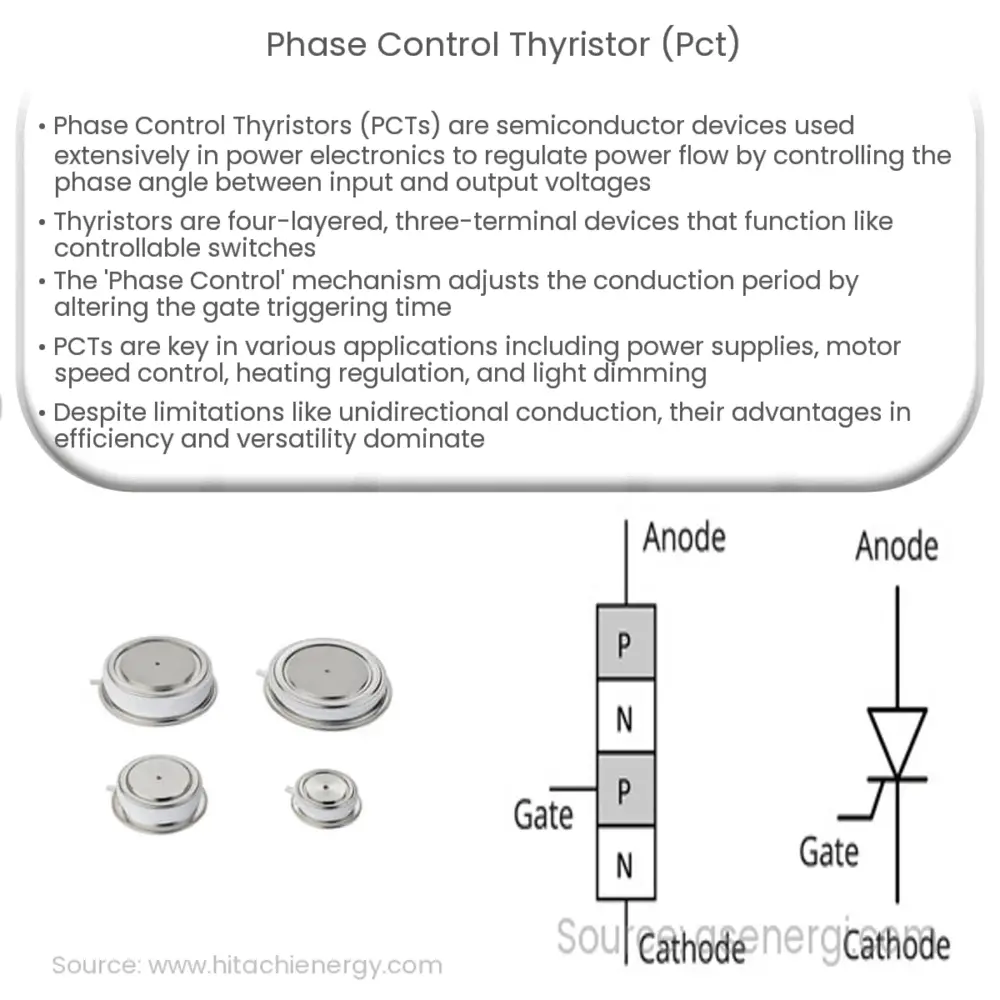
Before delving into the specifics of PCTs, it’s crucial to understand what a thyristor is. A thyristor is a four-layered, three-terminal semiconductor device. The three terminals are the anode, cathode, and gate. Its operation hinges on the principle of p-n junctions, much like a diode. However, the inclusion of a control terminal or ‘gate’ renders the thyristor a controllable switch. The thyristor remains in its off state until the gate receives a triggering signal, upon which it switches on, allowing current to flow.
The Mechanism of Phase Control
The term ‘Phase Control’ refers to the method of regulating the conduction angle or ‘phase’ during which the thyristor allows current to pass. This control is achieved by manipulating the gate triggering time. When the gate signal is applied later in the AC cycle, the thyristor conducts for a shorter period, reducing the output power. Conversely, triggering the gate signal earlier allows the thyristor to conduct for a more extended period, thereby increasing the output power.
Construction and Features of PCTs
- Anode and Cathode: These are the main terminals, where the anode is connected to the p-type material and the cathode to the n-type material. Current flows from the anode to the cathode when the device is in the on state.
- Gate: This control terminal is responsible for switching the PCT on or off. It’s usually connected to the p-type material near the cathode.
- Control Characteristics: PCTs have high current and voltage handling capabilities, allowing them to control substantial power levels. They are also known for their fast switching speeds.
From these basic characteristics, we can start to see the utility of PCTs in various applications, which we will explore in the following section.
Applications of Phase Control Thyristors (PCTs)
Thanks to their unique characteristics, PCTs find their use in several industrial and domestic applications:
- Power Supplies: PCTs are employed in both DC and AC power supplies, where they regulate the output voltage and current. They are especially useful in variable power supplies.
- Motor Control: In electric motor drives, PCTs are used for speed control. By altering the phase angle, the motor’s speed can be efficiently controlled.
- Heating Control: PCTs play a vital role in controlling electric heaters. By modulating the phase angle, the heat output can be efficiently regulated.
- Light Dimming: Light dimming circuits often use PCTs. They adjust the illumination levels of lamps by controlling the conduction period.
The Advantages and Limitations of PCTs
PCTs come with several advantages like high efficiency, excellent reliability, and capability to handle large currents and voltages. They are compact and require minimal maintenance. Their fast switching capabilities make them suitable for high-frequency operations. However, they also have some limitations. PCTs lack the ability to conduct in both directions, which makes them unsuitable for certain applications. They also generate heat during operation, necessitating efficient cooling mechanisms.
Conclusion
In conclusion, Phase Control Thyristors are versatile and powerful semiconductor devices that have transformed the power electronics landscape. They allow precise control over power flow by adjusting the conduction phase, thereby increasing efficiency and functionality in numerous applications, ranging from power supplies to light dimming circuits. Despite some limitations, the advantages of PCTs far outweigh the drawbacks, making them an integral part of modern electronic systems. As technology continues to evolve, we can expect further enhancements in PCTs and their applications, cementing their place in the future of power electronics.