
The Yagi-Uda antenna is a highly directional and affordable antenna, commonly used in TV reception, amateur radio, and wireless communication systems.
Introduction to the Yagi-Uda Antenna
The Yagi-Uda antenna, commonly known as the Yagi antenna, is a directional antenna widely utilized in communication systems, television reception, and amateur radio. Named after its inventors, Hidetsugu Yagi and Shintaro Uda, this antenna was first introduced in the 1920s and has since become a popular choice for various applications due to its simplicity, affordability, and effectiveness in receiving and transmitting signals.
Principle and Structure of the Yagi-Uda Antenna
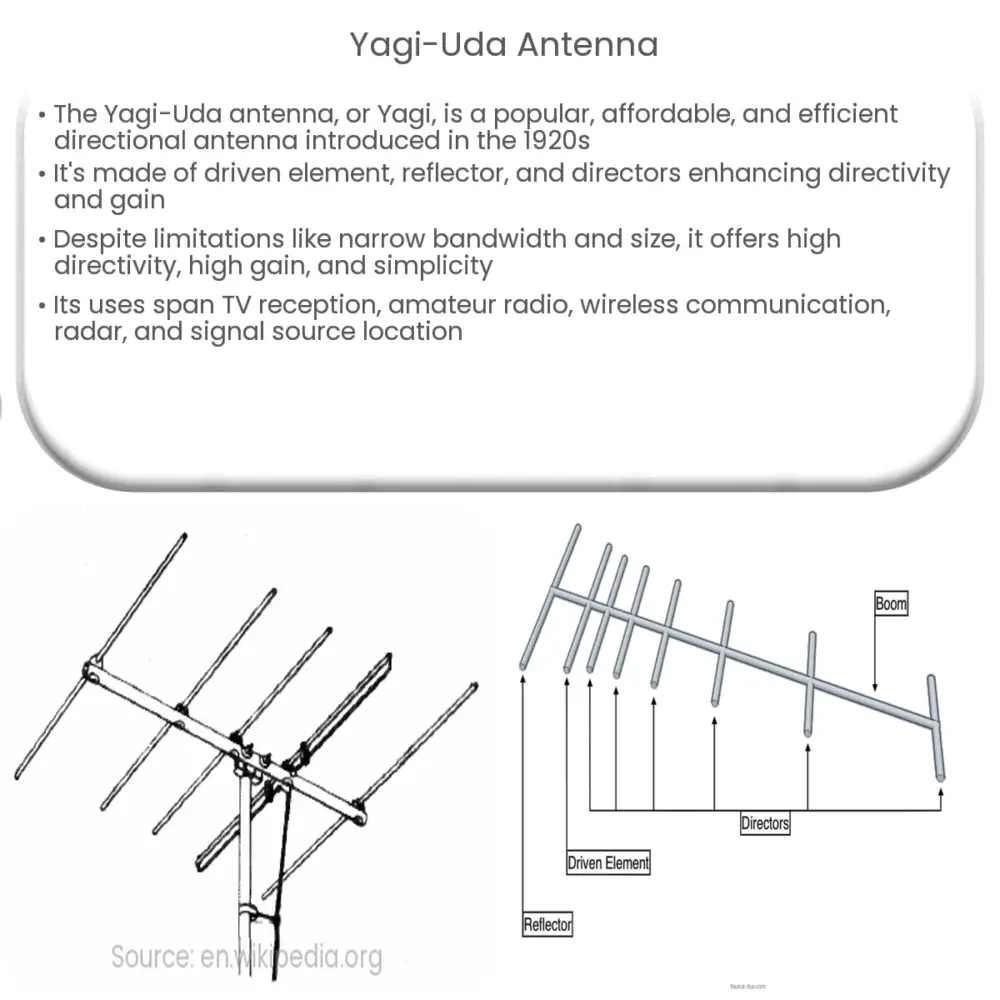
The Yagi-Uda antenna operates on the principle of array antennas, which are composed of multiple elements that work together to increase the antenna’s directivity and gain. In the case of the Yagi antenna, these elements are typically made of metal rods and are arranged in a linear configuration. The three main components of a Yagi-Uda antenna include the driven element, reflector, and director(s).
- Driven Element: This is the active element of the antenna, responsible for receiving and transmitting signals. It is typically a half-wavelength dipole, which is connected to the transmitter or receiver through a feedline.
- Reflector: Positioned behind the driven element, the reflector is a passive element designed to improve the antenna’s front-to-back ratio and directivity. The reflector is usually slightly longer than the driven element, causing the signals to reflect back towards the front of the antenna.
- Director(s): These are additional passive elements placed in front of the driven element. Directors are generally shorter than the driven element and serve to focus the radiated energy in a specific direction, further enhancing the directivity and gain of the antenna. The number of directors can vary depending on the desired performance, with more directors leading to higher directivity and gain.
Advantages and Disadvantages of the Yagi-Uda Antenna
The Yagi-Uda antenna offers several advantages, which have contributed to its widespread use:
- High Directivity: The Yagi antenna is highly directional, making it an excellent choice for point-to-point communication, as well as signal reception from specific sources, such as TV stations or radio repeaters.
- High Gain: With the addition of multiple director elements, the Yagi antenna can achieve high gain, improving signal strength and reducing the impact of noise and interference.
- Simple and Affordable Design: The Yagi-Uda antenna is relatively easy to construct and inexpensive compared to other antenna designs, making it an attractive option for various applications.
Despite its many advantages, the Yagi-Uda antenna has some limitations:
- Narrow Bandwidth: The Yagi antenna’s performance is optimized for a specific frequency range, which means its effectiveness decreases as the operating frequency deviates from this range.
- Size and Weight: Due to its linear structure and the need for multiple elements, the Yagi antenna can be large and unwieldy, particularly when designed for low-frequency applications.
Applications of the Yagi-Uda Antenna
Over the years, the Yagi-Uda antenna has found widespread use in various fields, thanks to its unique characteristics. Some common applications include:
- Television Reception: Yagi antennas are widely used as rooftop antennas for receiving over-the-air (OTA) television signals, providing a cost-effective alternative to cable or satellite TV.
- Amateur Radio: Ham radio operators often employ Yagi antennas for long-distance communication on high-frequency (HF) bands, as well as VHF and UHF frequencies, due to their high directivity and gain.
- Wireless Communication: Yagi antennas are used in point-to-point wireless communication systems, such as Wi-Fi links and microwave relay systems, offering reliable connectivity over long distances.
- Radar Systems: In some radar systems, Yagi antennas serve as an affordable option for detecting and tracking targets.
- Direction Finding: The high directivity of Yagi antennas allows them to be used in radio direction finding (RDF) systems, which are employed to locate the source of a signal.
Design and Optimization of Yagi-Uda Antennas
Designing and optimizing a Yagi-Uda antenna involves several factors, such as the choice of element lengths, spacings, and the number of director elements. To achieve the best possible performance, these parameters must be carefully selected based on the desired operating frequency, gain, and directivity.
Various design tools and software packages are available to help engineers and hobbyists design and optimize Yagi antennas. These tools can simulate the antenna’s performance, allowing for iterative adjustments to the design parameters. Some popular software options include EZNEC, 4nec2, and MMANA-GAL, among others.
Conclusion
The Yagi-Uda antenna has remained a popular choice for communication systems, television reception, and amateur radio for almost a century. Its high directivity, gain, and simplicity have made it a versatile and cost-effective solution for a variety of applications. While the Yagi antenna has some limitations, such as narrow bandwidth and size, its numerous advantages continue to make it a reliable option in the world of antennas.