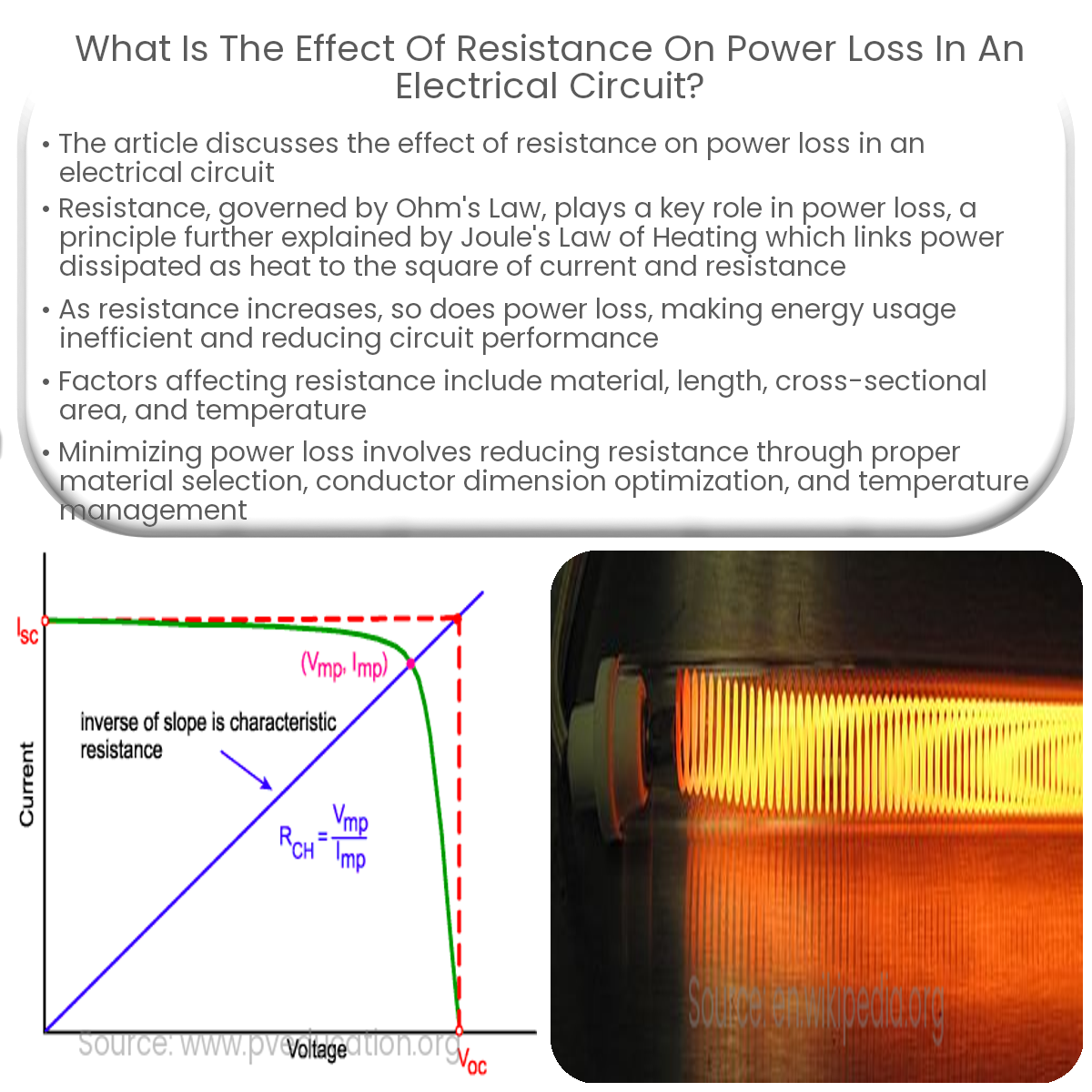
Resistance impacts power loss in a circuit, as increased resistance results in higher power dissipation in the form of heat, reducing energy efficiency.
Effect of Resistance on Power Loss in an Electrical Circuit
Resistance is an inherent property of any electrical circuit, playing a crucial role in determining the amount of power loss within the circuit. The relationship between resistance, voltage, and current is governed by Ohm’s Law, which states that the voltage (V) across a resistor is equal to the product of the current (I) and the resistance (R). Mathematically, it is represented as V = IR.
Joule’s Law of Heating
To understand the effect of resistance on power loss, we need to look at Joule’s Law of Heating. This law states that the power (P) dissipated in the form of heat in a resistor is proportional to the square of the current (I) flowing through it and the resistance (R) of the resistor. The formula for power dissipation is P = I2R.
Increased Resistance Leads to Increased Power Loss
From Joule’s Law of Heating, it’s clear that as resistance increases, the power loss in the circuit also increases. This is because the resistor converts electrical energy into heat energy, which is then lost to the surroundings. In practical applications, high resistance is undesirable, as it leads to inefficient energy usage and reduces the overall performance of the circuit.
Factors Affecting Resistance
Several factors can impact the resistance of an electrical circuit, including:
- Material: Different materials have different resistivity, a property that determines the resistance of the material. Conductive materials like copper have low resistivity, while insulating materials like rubber have high resistivity.
- Length: The longer the conductor, the higher the resistance, as electrons need to travel a longer distance, increasing the likelihood of collisions with the conductor’s atoms.
- Cross-sectional area: A larger cross-sectional area of the conductor results in lower resistance, as there are more paths for the electrons to travel, reducing the chances of collisions with the conductor’s atoms.
- Temperature: Resistance generally increases with temperature, as the atoms within the conductor gain more energy and vibrate, making it harder for electrons to pass through.
Minimizing Power Loss
To minimize power loss in an electrical circuit, designers should focus on reducing resistance by selecting appropriate materials, optimizing conductor dimensions, and considering the impact of temperature. It is also essential to utilize energy-efficient components and maintain proper circuit conditions for optimal performance.