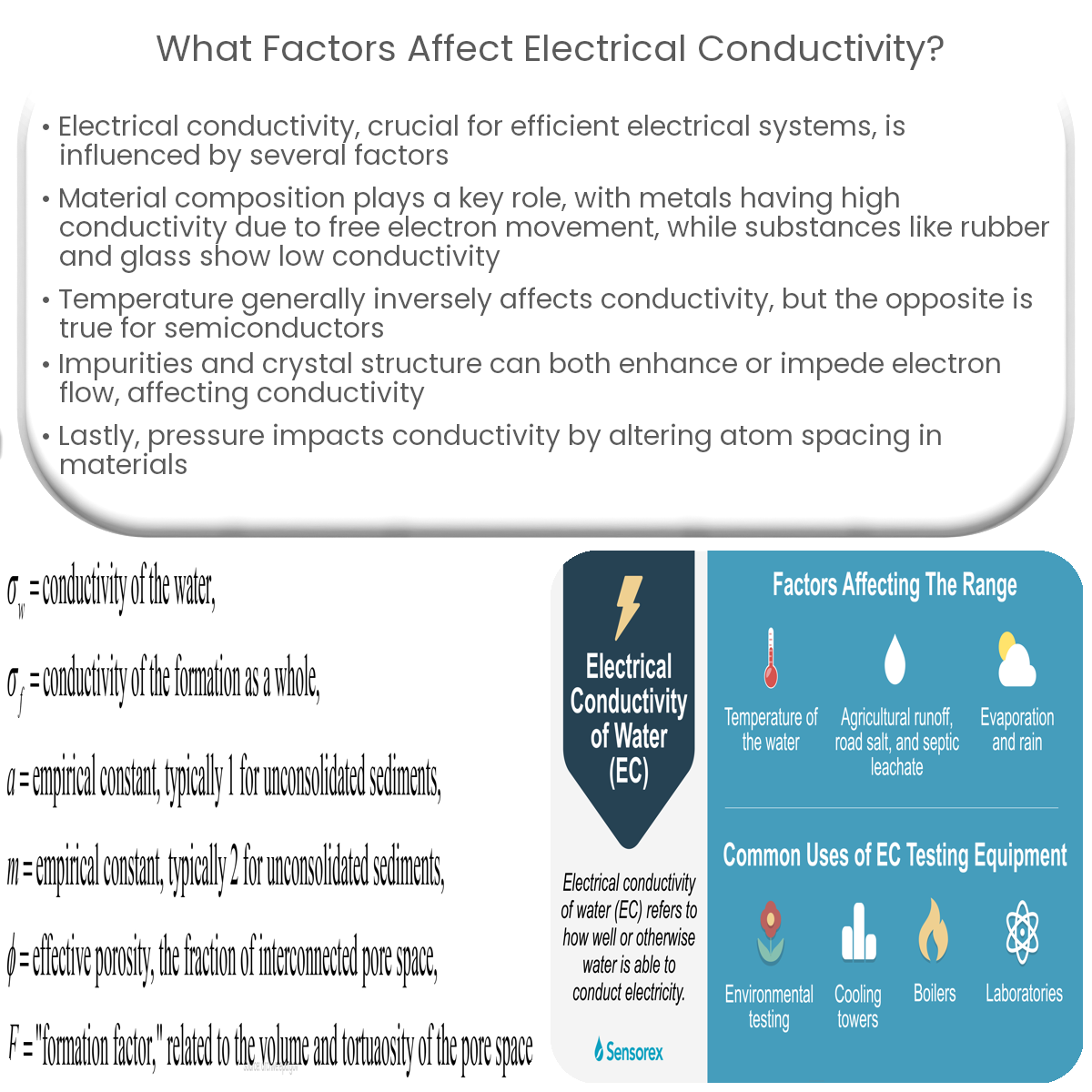
Factors affecting electrical conductivity include material composition, temperature, impurities, crystal structure, and pressure.
Factors Affecting Electrical Conductivity
Electrical conductivity is a material’s ability to conduct electric current. Several factors can influence conductivity, which plays a significant role in determining the efficiency and performance of electrical systems. Here, we will discuss some key factors affecting electrical conductivity.
1. Material Composition
One of the most crucial factors in determining a substance’s electrical conductivity is its chemical composition. Metals like copper, silver, and gold have high electrical conductivity due to their atomic structure, which allows for the free movement of electrons. On the other hand, materials like rubber, plastic, and glass have low conductivity due to the lack of free electrons to conduct electricity.
2. Temperature
Temperature can significantly affect a material’s conductivity. In general, as the temperature of a material increases, its resistance increases, and its conductivity decreases. This is mainly due to the increased vibrations of atoms and ions within the material, which impede the flow of electrons. However, this relationship is reversed for certain materials, like semiconductors, where increasing temperature increases conductivity.
3. Impurities
Impurities in a material can have a substantial impact on its electrical conductivity. For example, adding impurities to a metal can create defects in the crystal structure, which can impede electron flow, reducing conductivity. In semiconductors, impurities can introduce additional charge carriers, increasing conductivity.
4. Crystal Structure
The arrangement of atoms within a material, known as its crystal structure, can also affect conductivity. Materials with regular and well-ordered crystal structures, like metals, tend to have high conductivity due to the ease with which electrons can move through the lattice. Conversely, materials with irregular or disordered crystal structures can have lower conductivity.
5. Pressure
Pressure can influence electrical conductivity by affecting the spacing between atoms in a material. As pressure increases, atoms are forced closer together, which can affect electron mobility and, in turn, conductivity. The impact of pressure on conductivity is typically more significant in materials with more open crystal structures, like gases and some liquids.
Conclusion
Understanding the factors that affect electrical conductivity is essential for selecting materials and designing efficient electrical systems. By considering factors like material composition, temperature, impurities, crystal structure, and pressure, engineers can optimize conductivity and improve overall system performance.