
Explore the role of Voltage Controlled Crystal Oscillators (VCXOs) in digital systems, their applications, and future trends.
Introduction to Voltage Controlled Crystal Oscillators (VCXOs)
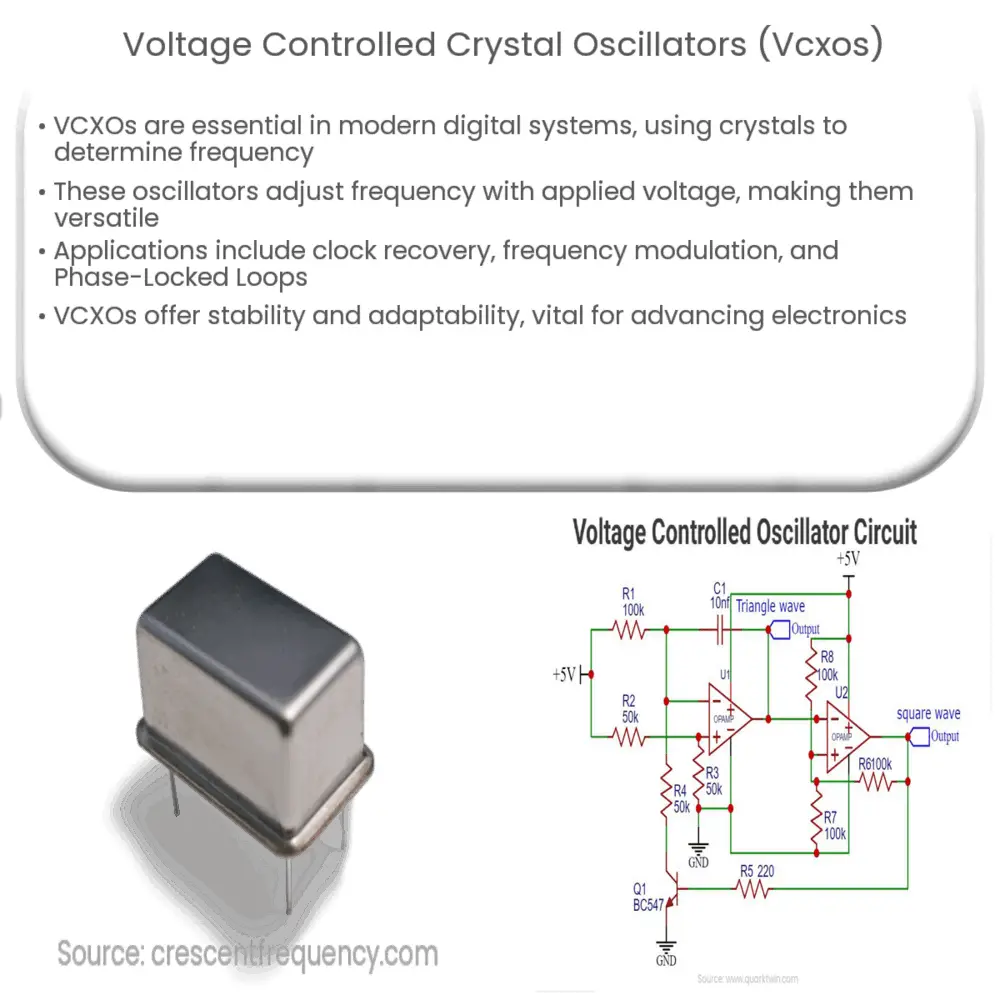
Voltage Controlled Crystal Oscillators, commonly referred to as VCXOs, form an integral part of modern digital systems. They are oscillators that employ a crystal as their primary frequency-determining element and are designed to control their frequency output with an applied voltage input.
Understanding the Basics of VCXOs
A fundamental component of many electronic devices, the VCXO is used where the frequency of operation, which is controlled by the crystal, can be adjusted slightly by applying a voltage across the device. The core of a VCXO is the piezoelectric crystal, typically quartz, which exhibits the useful property of resonating at a specific frequency when a voltage is applied.
Working Mechanism of VCXOs
When a voltage is applied to the VCXO, it changes the resonant frequency of the crystal. The frequency is increased or decreased depending on the polarity of the applied voltage, thereby enabling frequency modulation. The range over which the frequency can be adjusted is known as the pulling range of the VCXO.
Applications of VCXOs
The Advantages of Using VCXOs
VCXOs provide several advantages, including their stability and the ability to adjust frequency, making them suitable for many applications. Furthermore, the high frequency stability of VCXOs, which is derived from the crystal oscillator circuit, can be crucial in maintaining the optimal operation of digital systems. This combination of stability and flexibility makes VCXOs an invaluable tool in the field of electronics.
Considerations When Selecting VCXOs
When choosing a VCXO for a specific application, there are several important parameters to consider:
Advanced VCXOs
In the era of advanced electronics and high-speed communications, the performance requirements of VCXOs have become increasingly stringent. In response to these needs, advanced VCXOs that offer superior performance characteristics such as low jitter and phase noise are now available.
Future of VCXOs
As electronics continue to evolve, VCXOs are expected to keep pace. Advances in fabrication technologies and the growing demand for high-performance electronic devices suggest a future where VCXOs may become even more efficient, accurate, and versatile.
Conclusion
In conclusion, Voltage Controlled Crystal Oscillators are an indispensable component in modern digital systems due to their unique capabilities, such as frequency stability and adjustability. From telecommunications to radio frequency applications, VCXOs play a crucial role in many sectors. As we move into the future, the technological advancements in VCXOs are set to meet the growing demands of increasingly complex electronic systems. Their continued evolution will be exciting to watch, and their application will no doubt continue to broaden.