
Explore the concept of Serial-In Parallel-Out (SIPO) shift registers in digital systems, their operation, components, and broad applications.
Understanding Serial-In Parallel-Out (SIPO)
The Serial-In Parallel-Out (SIPO) system is a fundamental concept in digital electronics and computing. It relates to how data is transferred and processed within digital systems and is crucial to their operation.
What is a Serial-In Parallel-Out (SIPO) Shift Register?
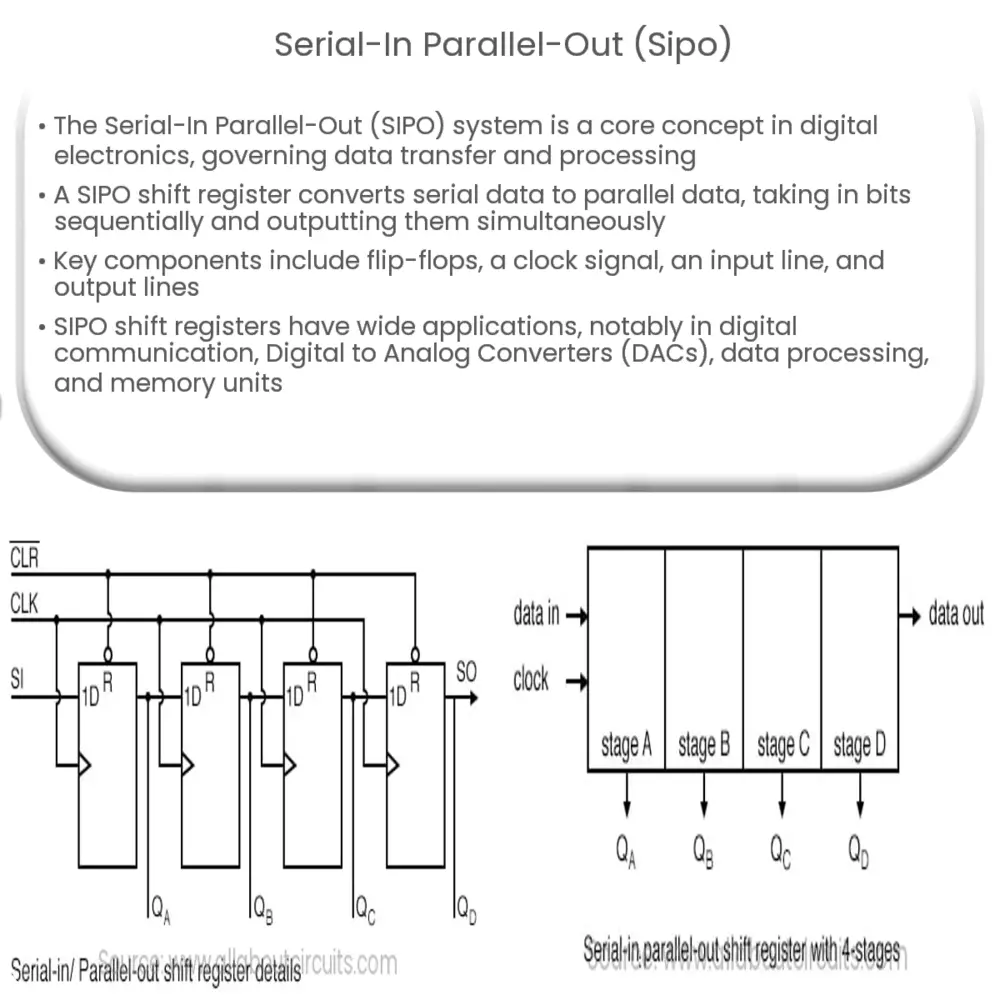
A Serial-In Parallel-Out (SIPO) shift register is a type of digital circuit that is primarily used for converting serial data to parallel data. In other words, it takes in data one bit at a time (serial input), processes it, and then outputs the data all at once in parallel format.
Working of SIPO Shift Register
The operation of a SIPO shift register is relatively straightforward. A sequence of binary data (bits) is inputted sequentially through a single line. Each bit is then shifted down the register with each clock cycle. After several clock cycles, equivalent to the number of bits in the data word, the data is available at the output lines simultaneously, thus converting the data from serial format to parallel format.
Components of SIPO Shift Register
- Flip-Flops: The SIPO shift register consists of flip-flops, which are fundamental building blocks in digital circuits. Each flip-flop holds one bit of information.
- Clock: The clock signal is a vital component as it dictates when data is moved or “shifted” within the register. A pulse of the clock signal represents one shift operation.
- Input Line: This is the line through which the binary data is fed into the register in a serial format.
- Output Lines: These are the lines through which the data is outputted in a parallel format.
Applications of SIPO Shift Register
The SIPO shift register is used in a variety of applications within digital electronics. It is commonly utilized in digital communication for data transmission, digital to analog converters (DACs), data processing, and memory units. Understanding SIPO shift registers is fundamental to the comprehension of digital system design and digital communication.
Further Details on Applications of SIPO Shift Register
Digital Communication: SIPO shift registers play an essential role in digital communication systems. The conversion of serial data to parallel is an integral part of many communication protocols. This is because serial transmission of data is more efficient and less prone to interference compared to parallel transmission, especially over long distances. However, once the data reaches its destination, it is often more convenient to process in parallel format.
Digital to Analog Converters (DACs): SIPO shift registers are also used in Digital to Analog Converters. DACs are devices that convert digital signals, which are discrete and binary in nature, into analog signals, which are continuous. In DACs, the SIPO shift register is used to convert the incoming serial digital data into parallel format, which is then converted into an analog signal.
Data Processing: In computer systems, SIPO shift registers are used for data processing. They are part of larger integrated circuits that perform a wide variety of functions such as arithmetic operations, data storage, and data transfer.
Memory Units: Memory units of a computer, such as RAM and cache memory, use shift registers including the SIPO shift register. Data is transferred in and out of these memory units in serial format for efficiency but is stored internally in parallel format for fast access and processing.
Conclusion
In conclusion, the Serial-In Parallel-Out (SIPO) shift register is a key component of digital systems, having broad applications in digital communication, DACs, data processing, and memory units. Understanding its function and operation is crucial for those studying or working in the field of digital electronics and computing. The SIPO shift register stands as a testament to the ingenuity and sophistication of modern digital systems, elegantly solving the challenge of converting data from serial to parallel format.