
Explore the world of RFID Readers: understand their workings, types, applications across industries, and future trends.
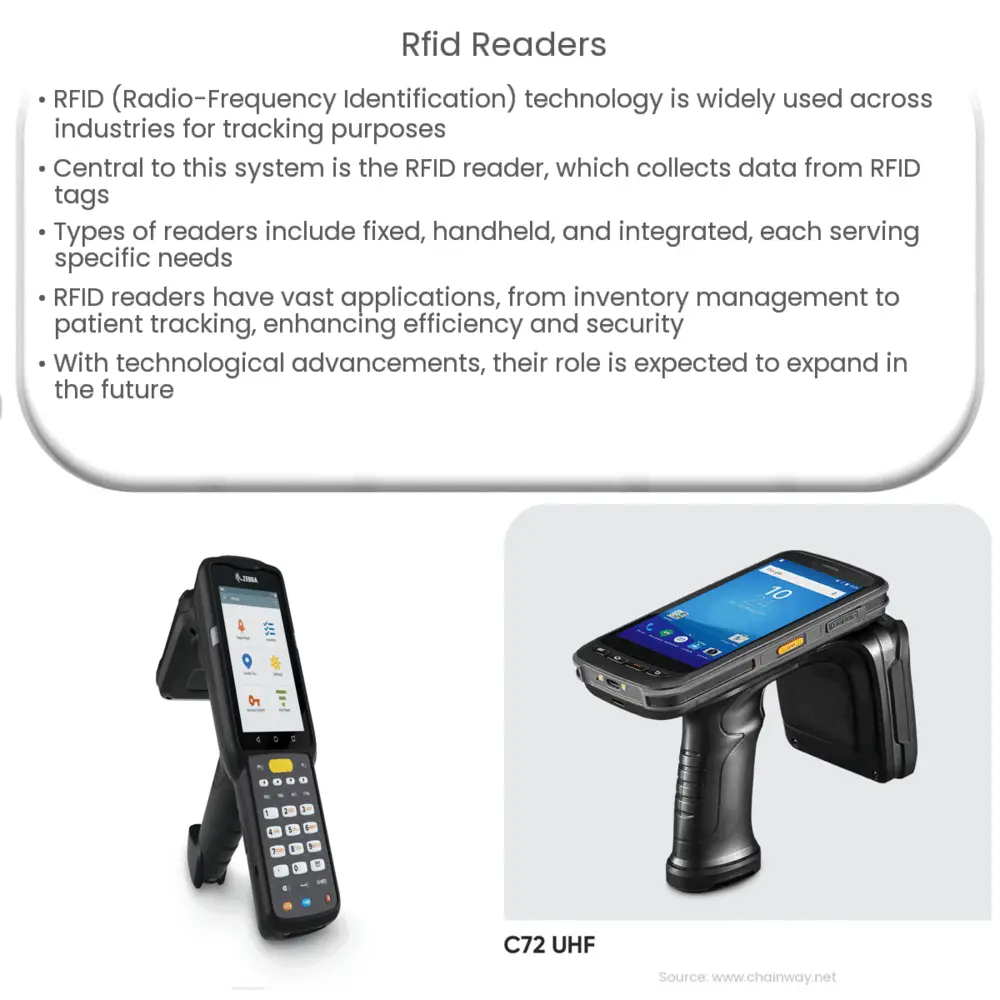
Understanding RFID Readers
Radio-Frequency Identification (RFID) has become a widespread technology in recent years, with numerous applications across various industries. At the heart of this technology lies a crucial component – the RFID reader. This article aims to provide a comprehensive understanding of RFID readers, their types, how they work, and their diverse applications.
What is an RFID Reader?
An RFID reader, also known as an interrogator, is a device used to gather information from an RFID tag which is used to track individual objects. It sends out radio waves and reads the response from the RFID tags. The data collected is then passed on to a computer system to interpret and make meaningful use of it.
Types of RFID Readers
How Does an RFID Reader Work?
RFID technology operates by utilizing radio waves to communicate between the RFID reader and the RFID tag. The process involves an RFID reader sending a signal to the tag via an antenna. The tag, which is dormant, receives this signal and wakes up. It then responds to the reader, transmitting its stored information back.
The operation of an RFID reader can be broken down into several steps:
The range and frequency of the RFID system depend on the type of RFID tag (Active, Passive, or Semi-passive) and the reader’s specifications.
Stay tuned for the next part of the article, where we will delve into the applications of RFID readers and their impact on various industries.
Applications of RFID Readers
RFID readers have a wide array of applications across different sectors. Given their ability to track and identify objects, they have proven to be incredibly beneficial in streamlining processes and improving efficiency.
The Impact of RFID Readers
RFID readers, combined with RFID tags, form a powerful tool for businesses, providing them with valuable real-time information that can significantly enhance operational efficiency. It has also made it possible to automate many labor-intensive tasks, reducing costs and human errors. Furthermore, RFID systems have greatly improved security in various sectors, from access control in corporate settings to counterfeit prevention in retail.
Future of RFID Readers
The future of RFID readers is promising. As technology continues to advance, we can expect to see improvements in the range, speed, and accuracy of these devices. Moreover, with the growth of the Internet of Things (IoT), RFID readers’ role is becoming even more crucial, as they are essential in linking physical objects to the digital world.
Conclusion
In conclusion, RFID readers play an integral role in the functioning of RFID technology. They are not just simple devices used to read tags, but rather, are part of a complex system that has far-reaching applications in numerous industries. The use of RFID readers has revolutionized the way businesses operate, offering greater efficiency, cost savings, and improved security. As technology continues to evolve, the importance and capabilities of RFID readers are set to increase, making them an indispensable tool in our increasingly connected world.