
Explore the world of reed relays, their components, types, applications, and the future outlook in modern electronics.
Understanding Reed Relays
Reed relays, an essential type of switch utilized in numerous electronics, carry significant importance in modern technology. Named after the reed switch, their key component, these relays provide efficient and reliable switching solutions in various applications.
Components and Working Mechanism
A typical reed relay is composed of a
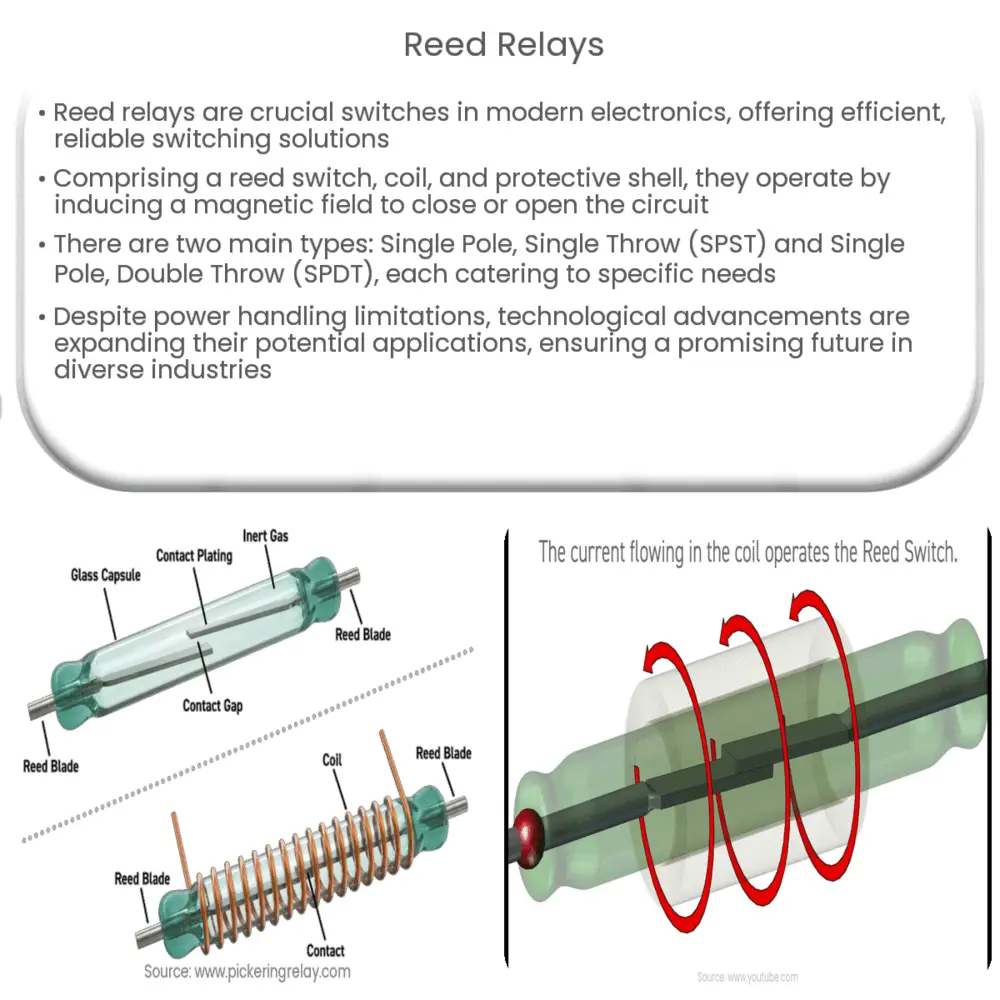
. The reed switch, usually encased within a glass envelope, is the heart of the relay, featuring two thin metal reed contacts. These reeds, when influenced by a magnetic field, move together to close the circuit.
The magnetic field, necessary for the operation of a reed relay, is generated by the coil. When electricity passes through this coil, it induces a magnetic field, attracting the metal reeds towards each other, resulting in the closing of the circuit. Once the current ceases, the magnetic field disappears, and the reeds separate, thus opening the circuit.
Types of Reed Relays
Reed relays are classified into two primary types:
. The choice between these two depends on the specific application and requirement.
1The Single Pole, Single Throw (SPST) relay has one switch. This type is further divided into Normally Open (NO) and Normally Closed (NC) categories. The NO relay maintains an open circuit until a current is applied, while the NC maintains a closed circuit until activated.
2On the other hand, the Single Pole, Double Throw (SPDT) relay comes with two switches – one normally open and one normally closed. This type allows the circuit to be connected to one of the two terminals, providing flexibility and control over the switching process.
Advantages and Applications
Reed relays offer various advantages, such as their compact size, high-speed operation, and minimal power requirements. Moreover, these relays provide a high degree of reliability and longevity, owing to the enclosed design that protects the reed switch from environmental factors.
With these strengths, reed relays find use in numerous applications. These range from telecommunication equipment and test equipment to security systems, medical devices, and automotive electronics. Reed relays also play a crucial role in high-frequency radio and telecommunication devices, where signal integrity is paramount.
Limitations of Reed Relays
Despite the numerous benefits, reed relays also come with a few limitations. The most notable of these is their inability to handle high power. As they are designed for low to medium power applications, they can’t endure heavy current loads. This limitation necessitates careful consideration of the application requirements when choosing to employ a reed relay.
Latest Innovations
In recent years, technological advancements have led to the development of new and improved reed relays. Manufacturers are focusing on overcoming the limitations, such as power handling capacity, and enhancing their overall performance. Some have managed to increase the switching capacity while maintaining the small footprint, opening up a wider array of potential applications.
The Future of Reed Relays
As technology continues to advance, reed relays are expected to see further improvements and wider usage. The demand for compact, reliable, and efficient components in the electronics industry is higher than ever, pushing the evolution of reed relays forward. Hence, their future looks promising, with potential applications expanding across a variety of industries.
Conclusion
In conclusion, reed relays serve as an important element in modern electronics, offering reliable and efficient switching solutions. Although they have certain limitations, ongoing research and development are set to overcome these and unlock even greater potential. Their small size, high reliability, and low power requirements, combined with their versatile application, make reed relays an indispensable component in the world of electronics. As technology advances, the importance of these efficient switches will only continue to grow, cementing their place in the electronic devices of the future.