
Explore the world of phototransistors, their structure, types, applications, and future prospects in our comprehensive guide.
Introduction to Phototransistors
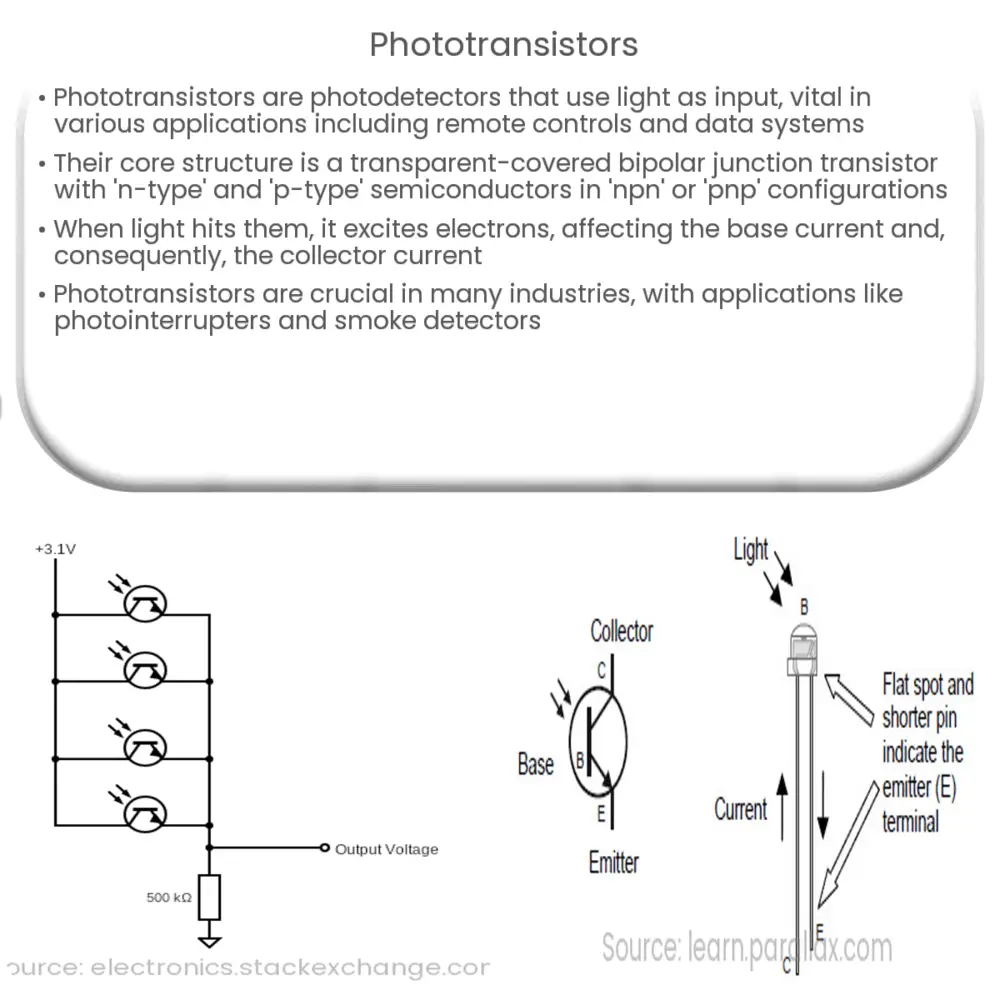
Phototransistors are a type of photodetector that function similarly to traditional transistors, but with light as the primary input instead of electrical current. They play a vital role in a myriad of applications ranging from remote controls and light detection to complex data transmission systems.
Structure and Working Principle
At its core, a phototransistor is a bipolar junction transistor (BJT) with a transparent cover that allows light to reach the base-collector junction. It usually consists of two types of semiconductors, ‘n-type’ and ‘p-type’, arranged in a ‘npn’ or ‘pnp’ configuration.
- npn Phototransistors: In this arrangement, two n-type semiconductors sandwich a p-type semiconductor.
- pnp Phototransistors: Conversely, in a pnp arrangement, two p-type semiconductors surround an n-type semiconductor.
Regardless of the configuration, the basic operation remains the same. When light—typically in the infrared spectrum—hits the base-collector junction, it excites the electrons, causing them to jump from the valence band to the conduction band. This results in a change in the base current, which, in turn, influences the collector current, given the transistor’s amplifying property.
Types of Phototransistors
Phototransistors can be categorized based on their structure or the type of light they respond to. Here are two common types:
- PNP Phototransistors: These phototransistors use a positive-negative-positive semiconductor configuration and are typically used in low-speed applications due to their slow response time.
- Two-Dimensional (2D) Phototransistors: These are a newer class of phototransistors made from 2D materials such as graphene. They offer a high level of sensitivity and a fast response time, making them suitable for high-speed applications.
Applications of Phototransistors
Phototransistors have a wide array of applications across multiple industries, including communication, healthcare, and consumer electronics. They are essential components in devices such as photointerrupters, smoke detectors, and infrared receivers. We’ll delve into some specific applications in the following sections.
Detailed Applications of Phototransistors
Let’s explore some of the more specific applications of phototransistors:
- Photointerrupters: Photointerrupters are devices that detect the presence or absence of objects using light. They consist of an infrared LED and a phototransistor positioned such that when an object obstructs the light, the phototransistor’s output changes, indicating the object’s presence.
- Infrared Receivers: Phototransistors are commonly used in IR receivers like those found in TV remotes and other wireless control devices. Here, the phototransistor detects the IR signal from the remote and converts it to an electrical signal that can be interpreted by the device.
- Smoke Detectors: In smoke detectors, a light source and a phototransistor are positioned at an angle. When smoke enters the detector, it scatters the light, which is then detected by the phototransistor and triggers the alarm.
Advantages and Limitations
Phototransistors offer several advantages, such as high sensitivity to light, the ability to operate in a wide range of ambient light conditions, and low power consumption. However, they also have some limitations. For example, they have a relatively slow response time and can be adversely affected by temperature changes. Recent advancements in technology, like the development of 2D phototransistors, are working to overcome these limitations.
Future Prospects
The future of phototransistors looks promising, with ongoing research into more efficient and responsive designs. The advent of 2D phototransistors has already paved the way for faster, more sensitive light detection. Moreover, the expanding field of optoelectronics, where phototransistors play a crucial role, is likely to spur further advancements in this technology.
Conclusion
Phototransistors, with their ability to convert light into electrical signals, have become a key component in a variety of applications, from simple remote control devices to advanced communication systems. Despite their limitations, their high sensitivity and low power consumption make them a preferred choice in many scenarios. As technology continues to evolve, we can expect to see even more sophisticated and efficient phototransistors that will continue to shape the landscape of optoelectronics.