
Explore the composition, properties, manufacturing process, and applications of Permalloy, a crucial nickel-iron magnetic alloy.
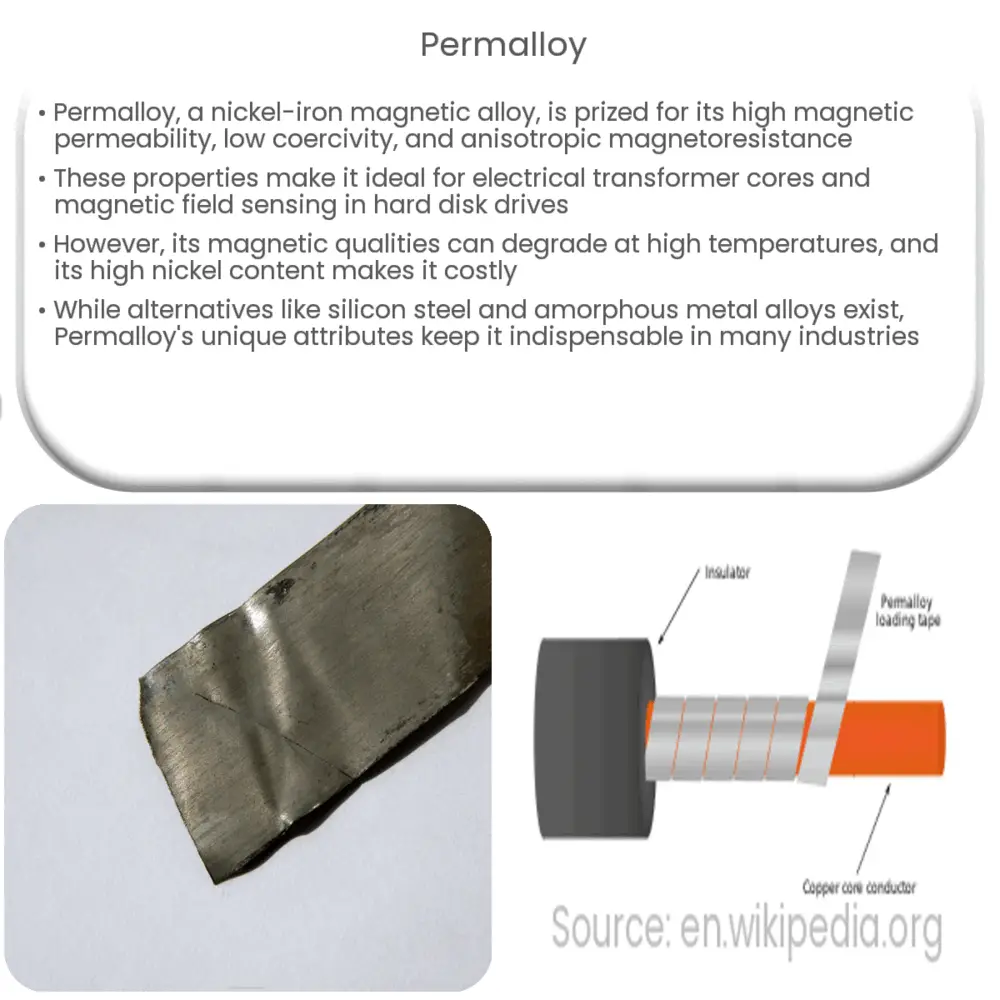
Introduction to Permalloy
Permalloy, a nickel-iron magnetic alloy, is highly significant in a variety of industries due to its exceptional magnetic properties. Predominantly composed of nickel and iron, its unique characteristics are largely attributed to the precise ratio of its components.
Composition and Properties
Permalloy typically consists of approximately 80% nickel, 15-20% iron, and a small amount of molybdenum. It’s renowned for its high magnetic permeability, low coercivity, and significant anisotropic magnetoresistance.
- High Magnetic Permeability: Permalloy’s ability to attract and carry magnetic lines of force is impressive. This property, known as magnetic permeability, allows it to excel in applications that require efficient magnetic field conduction.
- Low Coercivity: The alloy’s low coercivity means it can quickly reach magnetic saturation and be easily demagnetized. This characteristic makes it ideal for use in devices that require rapid magnetic field changes.
- Anisotropic Magnetoresistance: Permalloy’s electrical resistance changes based on the magnetic field’s direction relative to the electrical current’s direction, a phenomenon known as anisotropic magnetoresistance. This property is particularly useful in sensing applications.
Manufacturing Process
The production of Permalloy begins with the combination of iron, nickel, and molybdenum in a furnace under specific conditions. The process results in a malleable material that can be further processed and shaped according to application requirements. The final product can be in the form of sheets, wires, or cores.
Applications
Permalloy’s unique properties make it indispensable in a variety of applications. Its high permeability and low coercivity have made it a popular choice for the cores of electrical transformers, where it improves efficiency and reduces energy loss. Additionally, its anisotropic magnetoresistance has led to its use in magnetic field sensing applications, such as in read heads of hard disk drives.
Other Notable Uses
Aside from its extensive use in electrical transformers and hard disk drives, Permalloy is also employed in a range of other technologies. These include telecommunication devices, magnetic amplifiers, and shielding materials to protect sensitive electronic devices from magnetic fields. Because of its high magnetic permeability, it’s frequently used to create a pathway for magnetic fields in various devices, such as radio-frequency transformers and inductors.
Challenges and Alternatives
While Permalloy is highly versatile, it’s not without its challenges. For instance, its magnetic properties can degrade at high temperatures, limiting its use in certain applications. Additionally, the alloy is relatively expensive due to its high nickel content. As a result, researchers are exploring cheaper alternatives with similar magnetic properties, such as silicon steel and amorphous metal alloys.
- Silicon Steel: This is a cheaper alternative used primarily in power transformers. However, it doesn’t match Permalloy’s high magnetic permeability.
- Amorphous Metal Alloys: These alloys exhibit high magnetic permeability and low losses, similar to Permalloy. However, their brittle nature makes them challenging to work with.
Conclusion
In conclusion, Permalloy’s exceptional magnetic properties make it a critical material in many industries, from telecommunications to data storage. Despite its limitations, such as its cost and sensitivity to high temperatures, its unique combination of high magnetic permeability, low coercivity, and anisotropic magnetoresistance make it difficult to replace entirely. As researchers continue to explore alternative materials, Permalloy remains an essential component in many technologies that underpin our modern world. Its ongoing use and importance are a testament to the powerful role that materials science plays in advancing technology.