
Explore the workings, applications, advancements, and future prospects of Optical Imaging Touch Sensors in our comprehensive guide.
Introduction to Optical Imaging Touch Sensors
Touch sensors have revolutionized the way we interact with technology. Among the various types, the Optical Imaging Touch Sensor holds a unique position due to its innovative method of detecting touch inputs. This article explores the technology behind these sensors and their applications in various fields.
Working Principle of Optical Imaging Touch Sensors
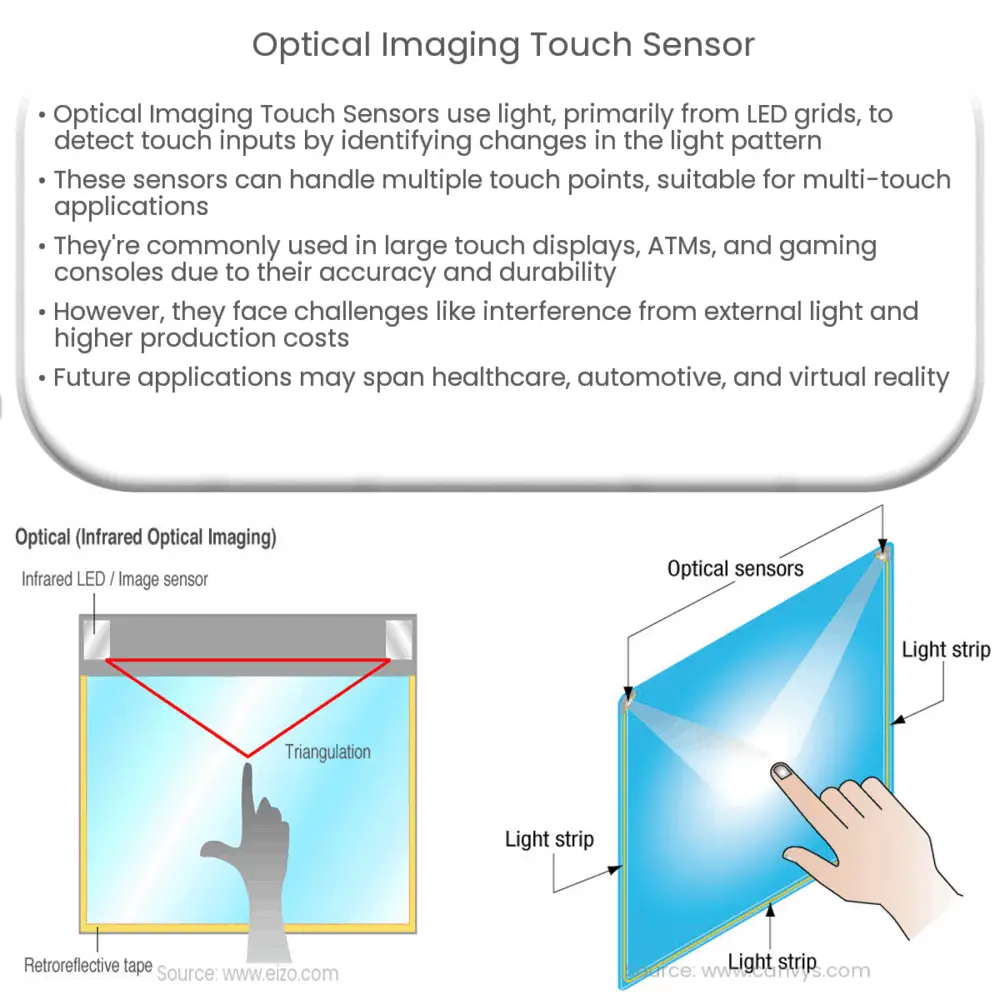
The fundamental principle behind optical imaging touch sensors is the use of light. These sensors function by casting an array of lights across the touch surface, usually in the form of an LED light grid. When an object touches the surface, it interrupts the light grid, causing a change in the light pattern.
This change in light is detected by optical sensors located at the edges of the touch surface. The sensors then process this information to determine the exact location of the touch on the surface. This type of touch technology can handle multiple touch points at the same time, making it suitable for multi-touch applications.
Components of Optical Imaging Touch Sensors
- Light Source: The light source, often an array of infrared LEDs, casts a uniform light grid across the touch surface. This light is invisible to the human eye but is crucial for the functioning of the touch sensor.
- Optical Sensors: These sensors, usually placed along the edges of the touch surface, detect changes in the light pattern caused by touch inputs. They relay this information to the controller for processing.
- Controller: The controller processes the information received from the optical sensors and translates it into specific coordinates on the touch surface. This information is then sent to the device’s operating system.
Applications of Optical Imaging Touch Sensors
Optical imaging touch sensors have found extensive application in various fields due to their high accuracy and multi-touch capabilities. They are frequently used in large-format touch displays such as interactive whiteboards, digital signage, and information kiosks. Other applications include ATMs, gaming consoles, and advanced industrial control systems.
One major advantage of optical imaging touch sensors is their durability. Because they don’t rely on a specific touch medium, they can withstand rough use, making them ideal for public use applications.
The flexibility of these sensors, both in terms of size and shape, also allows them to be used in unique applications. For instance, they can be used in curved or irregularly shaped surfaces, opening up a whole new world of design possibilities.
Advancements in Optical Imaging Touch Sensor Technology
As technology advances, optical imaging touch sensors are becoming more sophisticated. New developments are focused on improving the accuracy of touch recognition, reducing the cost of production, and increasing the maximum size of the touch surface that can be accommodated. Further, there are ongoing efforts to make these sensors more energy-efficient, which is particularly crucial for portable devices.
Challenges and Limitations
Despite the many advantages, optical imaging touch sensors also have a few limitations. For example, external light sources can sometimes interfere with the sensor’s ability to accurately detect touch inputs. The sensors may also struggle to detect touch inputs from non-solid objects or objects that don’t sufficiently disrupt the light grid, such as a stylus with a very fine tip.
Moreover, these sensors are typically more expensive to produce than other types of touch sensors, which can make devices that use them more costly. However, as the technology continues to evolve, it is expected that these challenges will be overcome.
Future of Optical Imaging Touch Sensors
Optical imaging touch sensors have enormous potential for future applications. With improvements in technology, we can expect to see them used in even more diverse fields, including healthcare for diagnostic equipment, automotive for in-car controls, and in the creation of next-gen smart homes.
Moreover, there is a significant potential for these sensors in the realm of virtual and augmented reality. By enabling a more natural and intuitive method of interaction, they could fundamentally transform our experiences with these technologies.
Conclusion
In conclusion, optical imaging touch sensors are a powerful and versatile technology that has already begun to transform our interaction with digital devices. While there are some challenges to be overcome, the future looks bright for this technology. As advancements continue, we can expect to see optical imaging touch sensors play an increasingly important role in a wide range of applications, heralding a new era of touch technology.



