
Explore the world of Low Dropout Regulators (LDOs), their operational principles, key features, advantages, and broad applications in modern electronics.
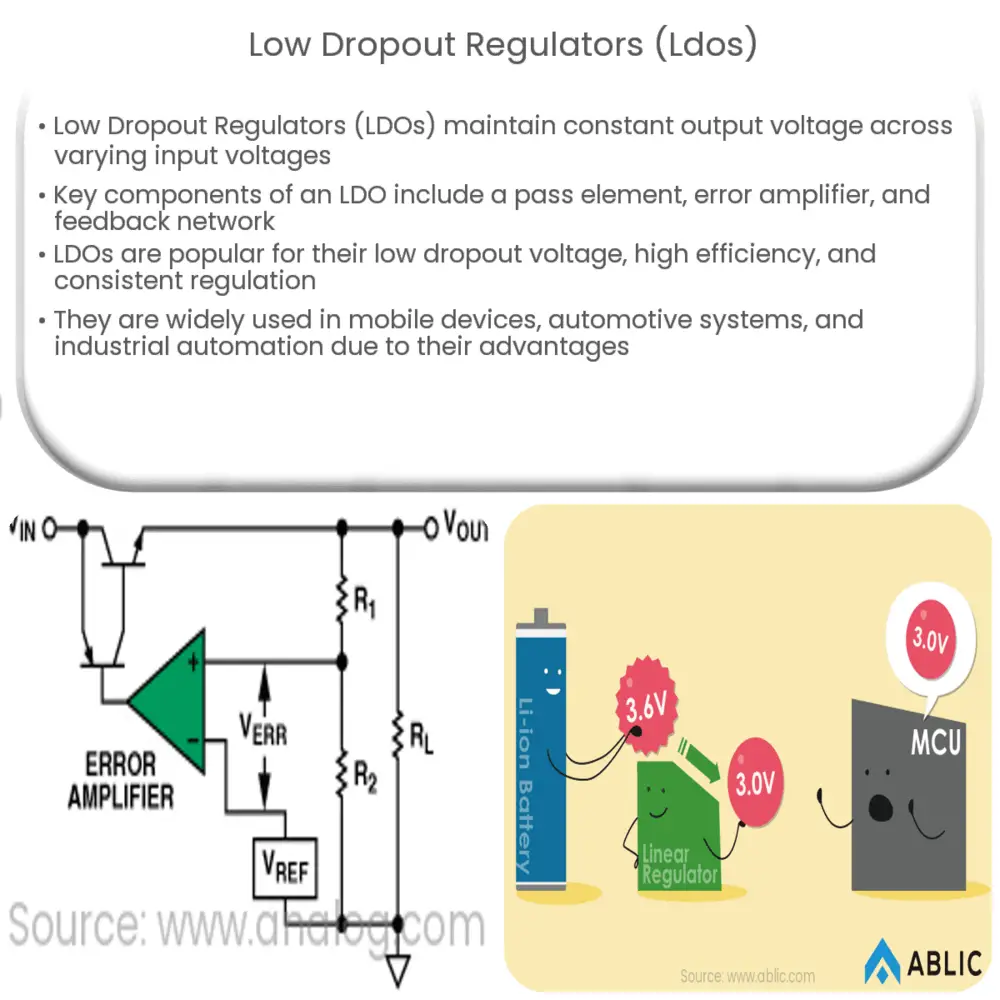
Introduction to Low Dropout Regulators (LDOs)
Low Dropout Regulators (LDOs) are an essential subset of linear voltage regulators that perform the critical task of maintaining a constant output voltage for a wide range of input voltages. LDOs are particularly valuable in scenarios where the difference between the input and output voltage is small, hence the term “low dropout”.
Operational Principle of LDOs
At the heart of an LDO lies a pass element, an error amplifier, and a feedback network. The pass element is typically a transistor, which controls the voltage drop from input to output. The error amplifier compares the output voltage with a reference voltage, and the difference or “error” is used to control the pass transistor. The feedback network provides the reference voltage to the error amplifier.
- Pass element: This component controls the voltage drop from input to output. It acts like a variable resistor, adjusting its resistance according to the input voltage to maintain a constant output voltage.
- Error Amplifier: It compares the output voltage with a reference voltage. The difference or ‘error’ is used to control the pass transistor.
- Feedback Network: This is usually a simple network of resistors providing the reference voltage to the error amplifier.
Characteristics of LDOs
LDOs come with several distinguishing characteristics that make them a popular choice in many electronic systems. A few of them are listed below:
- Low Dropout Voltage: This is the key feature of LDOs. It refers to the smallest difference required between the input and output voltage while still maintaining regulation.
- High Efficiency: Due to their low dropout voltage, LDOs can operate efficiently in systems with little difference between input and output voltages.
- Good Load and Line Regulation: LDOs maintain a steady output voltage despite changes in the input voltage (line regulation) or output load (load regulation).
In the next section, we’ll discuss the advantages of LDOs and their applications in various fields.
Advantages of LDOs
LDOs offer a host of advantages that make them a favourable option for voltage regulation tasks:
- Simple Design: LDOs have a simpler circuit design compared to switching regulators. This simplicity leads to reduced noise and makes the design process easier.
- Noise Reduction: LDOs are less noisy than switching regulators, making them ideal for noise-sensitive applications such as audio and RF communication systems.
- Small Form Factor: Due to their simple design, LDOs can be packaged into small form factors, which is beneficial for compact electronic devices.
Applications of LDOs
LDOs find a wide range of applications in various sectors, thanks to their beneficial characteristics:
- Mobile Devices: The small form factor and high efficiency of LDOs make them suitable for use in mobile phones, tablets, and other portable devices.
- Automotive Systems: LDOs are used in automotive electronics for their ability to maintain a stable output voltage despite fluctuations in the input voltage.
- Industrial Automation: In industrial control systems, LDOs are employed to provide reliable and steady power supply.
Conclusion
In summary, Low Dropout Regulators (LDOs) are versatile power management devices that offer an array of advantages including low dropout voltage, high efficiency, good line and load regulation, and reduced noise. Their simple design and small size make them a popular choice in a variety of applications, from mobile devices and automotive systems to industrial automation. As technology continues to evolve, so too will the capabilities and applications of LDOs, cementing their place as indispensable tools in the world of electronics.