
Explore the world of Light Emitting Diodes (LEDs), their structure, advantages, uses, future prospects, and impact on energy efficiency.
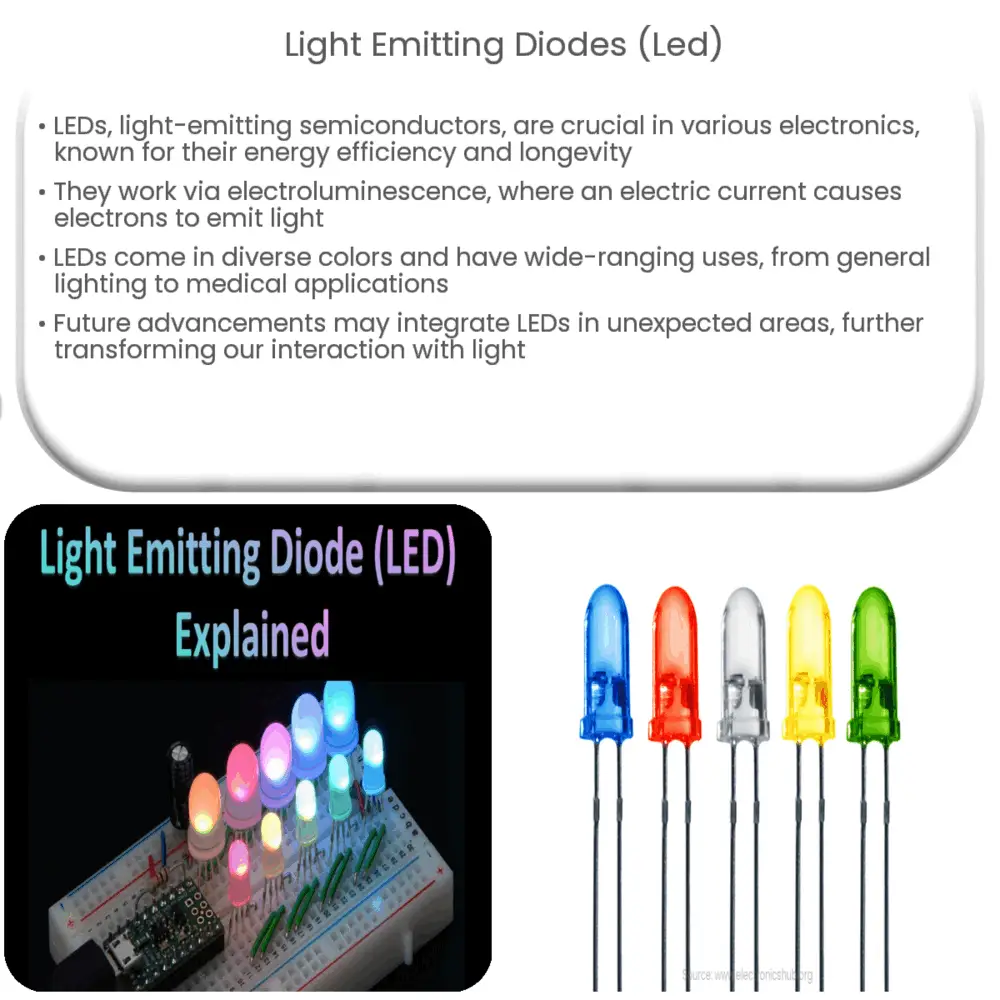
Introduction to Light Emitting Diodes (LED)
Light Emitting Diodes, commonly known as LEDs, are a significant part of our daily lives. They are the tiny shining stars behind a wide array of electronic devices, including television screens, computer monitors, traffic lights, and even the flashlight on your mobile phone. But, what exactly is an LED, and how does it work? This article aims to provide a comprehensive understanding of these efficient light sources.
What is an LED?
An LED is a type of semiconductor device that emits light when an electric current passes through it. This process is known as electroluminescence. Unlike traditional incandescent or fluorescent lights, LEDs do not have a filament that gets hot. Instead, they are illuminated solely by the movement of electrons in the semiconductor material, which makes them significantly more energy efficient.
The Basic Structure and Principle of Operation
Typically, an LED comprises two layers of semiconductor material. The N-type semiconductor layer has an abundance of free electrons, whereas the P-type layer has an abundance of ‘holes’—spaces where electrons can go. When a suitable voltage is applied to the LED, electrons can move from the N-type layer across to the P-type layer. When an electron meets a hole, it falls into a lower energy level and releases energy in the form of a photon – light.
Advantages of LEDs
- Energy Efficiency: LEDs use only about a tenth of the energy of an incandescent bulb. This means you can save on your energy bill while also contributing to a more sustainable future.
- Longevity: LEDs last longer than traditional light bulbs, often for tens of thousands of hours, because they do not burn out or fail like traditional incandescent bulbs.
- Compact Size: LEDs can be very small (less than 2mm2) and are easily populated onto printed circuit boards, making them particularly beneficial for compact electronic devices.
- Environmentally Friendly: Unlike fluorescent lights, LEDs contain no mercury or other hazardous substances, making them environmentally friendly.
Colors and Uses of LEDs
LEDs are highly versatile and can be designed to emit different colors of light, not just white. The color of the light is determined by the energy gap of the semiconductor, resulting in a wide spectrum of possible colors, including infrared and ultraviolet. This feature makes LEDs highly versatile for different applications, including:
- General Lighting: LEDs are commonly used for residential and commercial lighting due to their energy efficiency and long lifespan.
- Displays: LEDs are used in televisions, computer monitors, and mobile phone screens, offering vibrant colors and deep blacks.
- Indicator Lights: LEDs serve as status indicators in various devices like routers, chargers, and vehicles.
- Medical Applications: Specialized LEDs are used in medical and scientific instrumentation for their precise light output.
Future Prospects
As technology continues to evolve, the use of LEDs is expected to become even more widespread. With advancements in LED technology, they are becoming more efficient, brighter, and even more compact. In the future, we could see LEDs in unexpected places such as wallpaper, clothing, or even contact lenses, fundamentally changing the way we interact with light.
Conclusion
In conclusion, Light Emitting Diodes or LEDs have transformed the way we light up our world. Their energy efficiency, longevity, compact size, and environmental friendliness make them a superior choice for a wide range of applications. Whether we notice them or not, LEDs are an integral part of our everyday lives and will continue to shape our future with their limitless possibilities. As we continue to strive towards more sustainable and efficient solutions, the importance and prevalence of LEDs in our world will only increase.