
Explore the Inverted-L Antenna (ILA), its design, function, advantages, limitations, and solutions for optimal radio communication.
Inverted-L Antenna: An Overview
The Inverted-L Antenna (ILA), as the name suggests, is a type of antenna designed in the shape of an inverted ‘L’. It is a variation of the monopole antenna and is highly regarded for its simplicity, versatility, and effective performance, especially in terms of high-frequency (HF) radio transmission.
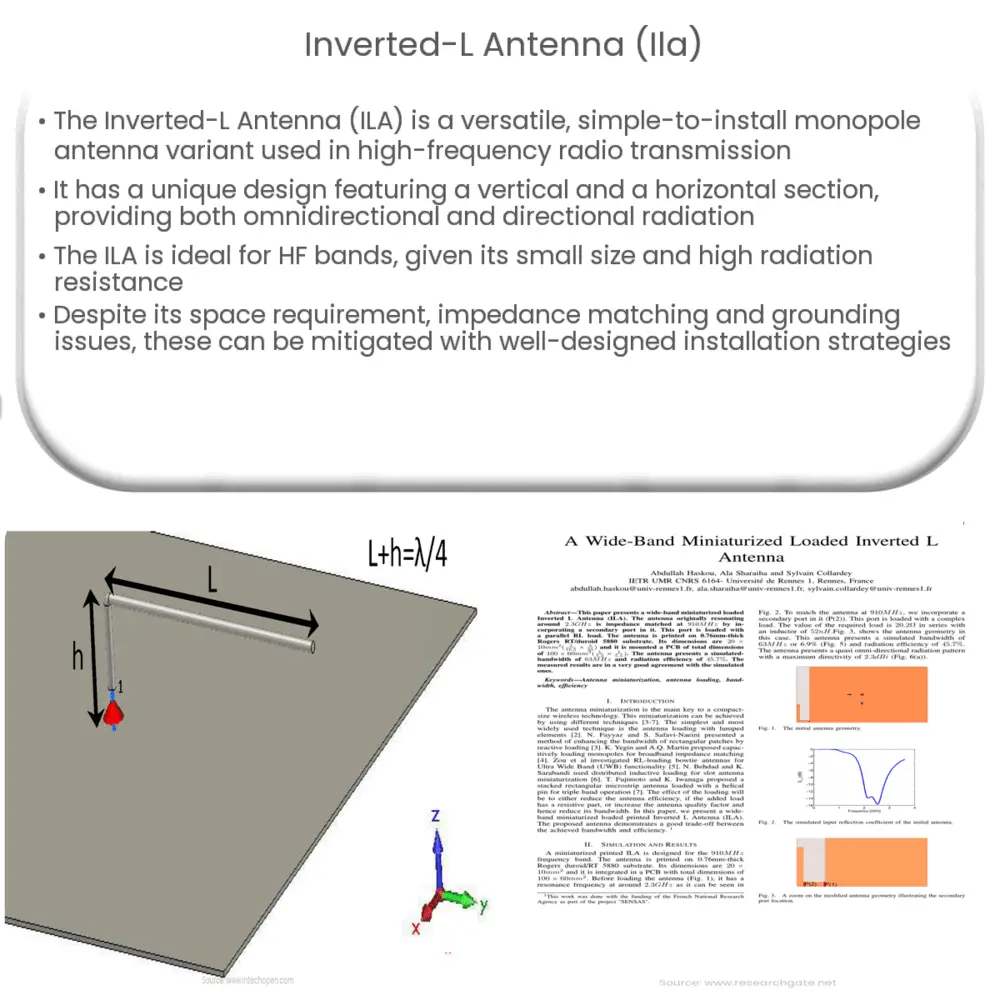
The basic structure of an ILA includes a vertical section and a horizontal section. The antenna is fed at the junction of these two sections, which is at the lower end of the vertical section. The overall length of the antenna (the sum of the vertical and horizontal sections) is typically a quarter-wavelength at the frequency of interest.
Design and Function
- Design: The Inverted-L Antenna is relatively easy to construct. It starts with a vertical radiator extending upward from the ground, and then a horizontal wire extends from the top of the vertical section, forming an L-shape. Its installation doesn’t require a very tall supporting structure because much of the antenna runs horizontally.
- Function: ILA functions as an electrically short antenna, meaning it’s shorter than half of the wavelength it’s designed to receive or transmit. Despite its shorter length, it maintains a high radiation resistance, making it an effective radiator. It is primarily used in HF bands where wavelengths are long, and full-sized antennas would be impractically large.
Advantages of Inverted-L Antenna
There are several advantages to using an Inverted-L Antenna. Notably:
- Its simple design allows for easy installation and maintenance.
- It provides good low-angle radiation, making it suitable for long-distance communication on HF bands.
- Its vertical component provides omnidirectional radiation, while the horizontal component contributes to some directional radiation.
The combination of its design, function, and advantages makes the Inverted-L Antenna a popular choice for amateur radio operators and professional communication systems alike.
Despite its benefits, the ILA has some limitations as well. In the next section, we will explore these limitations and discuss potential solutions.
Limitations of Inverted-L Antenna
Like any other antenna design, the Inverted-L Antenna does come with a set of limitations:
- Space Requirements: Although it doesn’t need a tall structure for installation, the ILA still requires a significant amount of horizontal space, which may pose challenges in constrained environments.
- Impedance Matching: As an electrically short antenna, the ILA presents a high reactance and a low radiation resistance. These characteristics can make impedance matching difficult, and therefore, a good matching network is often required to ensure efficient operation.
- Ground System: The performance of an ILA is heavily dependent on a good ground system. Without a proper ground, the antenna’s efficiency can be significantly reduced.
Solutions and Alternatives
Despite these challenges, solutions exist that can make an ILA more practical for a wider range of applications:
- Utilizing Available Space: The horizontal section of an ILA can be configured in various ways (e.g., bent, zigzagged, or sloped) to fit available space.
- Impedance Matching: A well-designed matching network, such as an L-network or a pi-network, can be used to match the impedance of the antenna to the transmitter or receiver.
- Enhancing Ground System: A radial ground system, consisting of numerous wires radiating outward from the base of the antenna, can significantly improve the antenna’s performance.
Conclusion
In conclusion, the Inverted-L Antenna is a versatile and effective tool for high-frequency radio communication. Its simple design, coupled with its ability to provide both omnidirectional and directional radiation, makes it a preferred choice for many radio amateurs and professional communication systems. Although there are limitations concerning space, impedance matching, and grounding, these can be addressed with thoughtful installation and configuration. The ILA, therefore, continues to be an enduringly popular option in the world of radio communication.