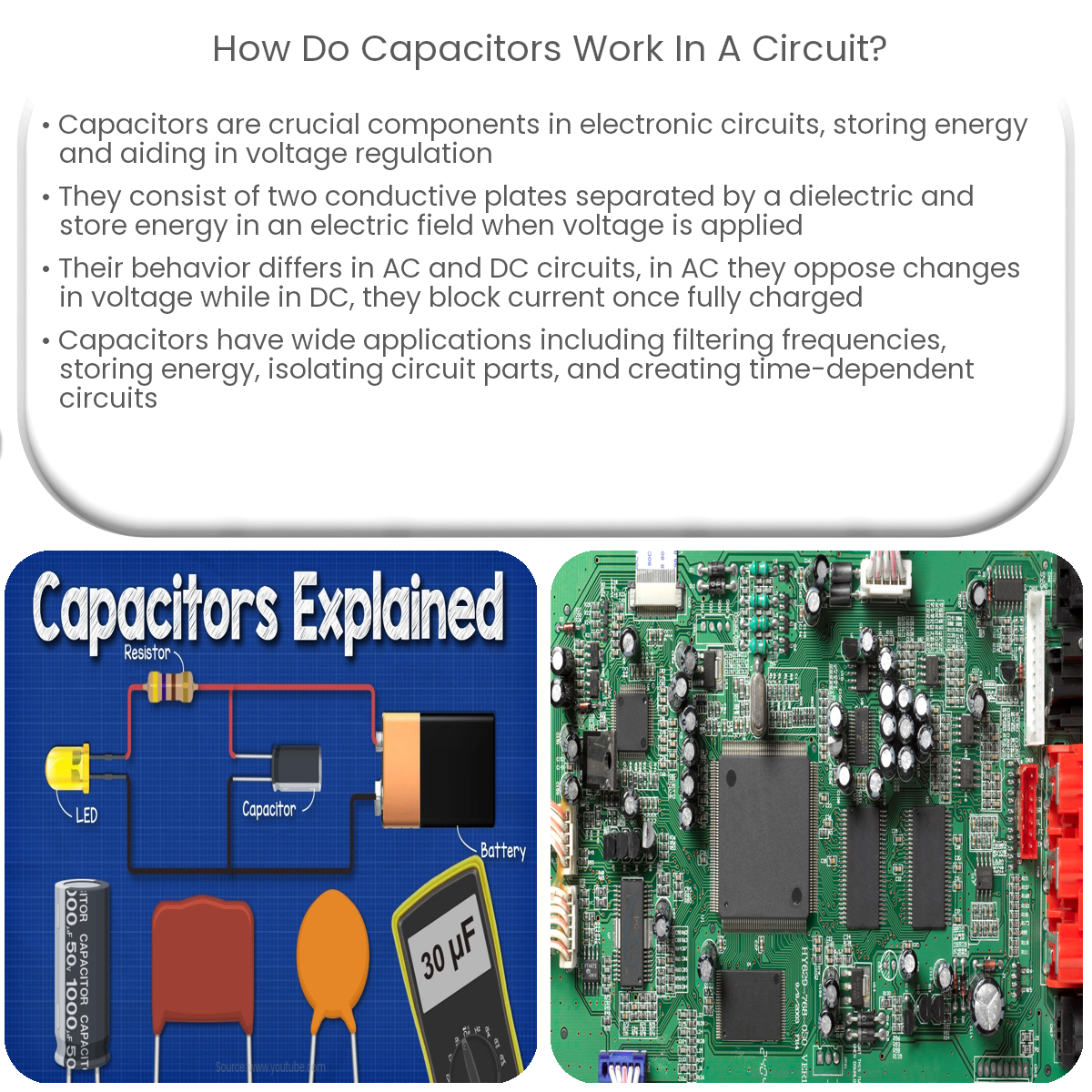
In a circuit, capacitors store electrical energy in an electric field, oppose voltage changes, and serve various roles like filtering and decoupling.
Understanding Capacitors in Electronic Circuits
Capacitors are fundamental components in electronic circuits, playing a crucial role in energy storage, filtering, and voltage regulation. This article explores how capacitors work in a circuit and their common applications in electronics.
1. Capacitor Basics
A capacitor is a passive electronic component consisting of two conductive plates separated by an insulating material, known as a dielectric. Capacitors store electrical energy in the form of an electric field between their plates when a voltage is applied. The capacitance, measured in farads (F), determines a capacitor’s ability to store electrical energy and oppose changes in voltage.
2. Charging and Discharging of a Capacitor
When a voltage is applied across a capacitor, an electric field forms between the conductive plates, causing positive and negative charges to accumulate on the respective plates. This process is known as charging. As the voltage across the capacitor increases, the electric field strengthens, and more energy is stored. Conversely, when the voltage decreases or is removed, the capacitor releases energy back into the circuit, a process called discharging.
3. Capacitors in AC and DC Circuits
Capacitors behave differently in AC and DC circuits:
- AC Circuits: In AC circuits, the voltage alternates direction, causing the charges on the capacitor’s plates to oscillate. This results in an opposition to changes in voltage, which depends on the frequency and capacitance of the capacitor.
- DC Circuits: In DC circuits, the voltage is constant. When a DC voltage is first applied to a capacitor, it charges up to the applied voltage, and the current flows until the capacitor is fully charged. Once charged, the capacitor behaves as an open circuit, blocking the flow of DC current.
4. Common Applications of Capacitors in Circuits
Capacitors are widely used in various electronic applications, including:
- Filters: Capacitors, often used with inductors, form filters that can separate or pass specific frequency ranges in a circuit.
- Energy Storage: Capacitors store energy in power supply circuits to provide a stable output voltage by smoothing voltage fluctuations.
- Decoupling: Capacitors are used to isolate different parts of a circuit, preventing noise or voltage spikes from affecting sensitive components.
- Timing Circuits: In combination with resistors or other components, capacitors can create time-dependent circuits for generating delays or oscillations.
Conclusion
Capacitors play a vital role in electronic circuits, storing electrical energy in an electric field between their conductive plates, and opposing changes in voltage. Their behavior varies between AC and DC circuits, and they have numerous applications in filtering, energy storage, decoupling, and timing circuits. Understanding capacitors is essential for designing and analyzing electronic systems.