
Explore the functionality, applications, advantages, and future trends of Forward Converters in power electronics.
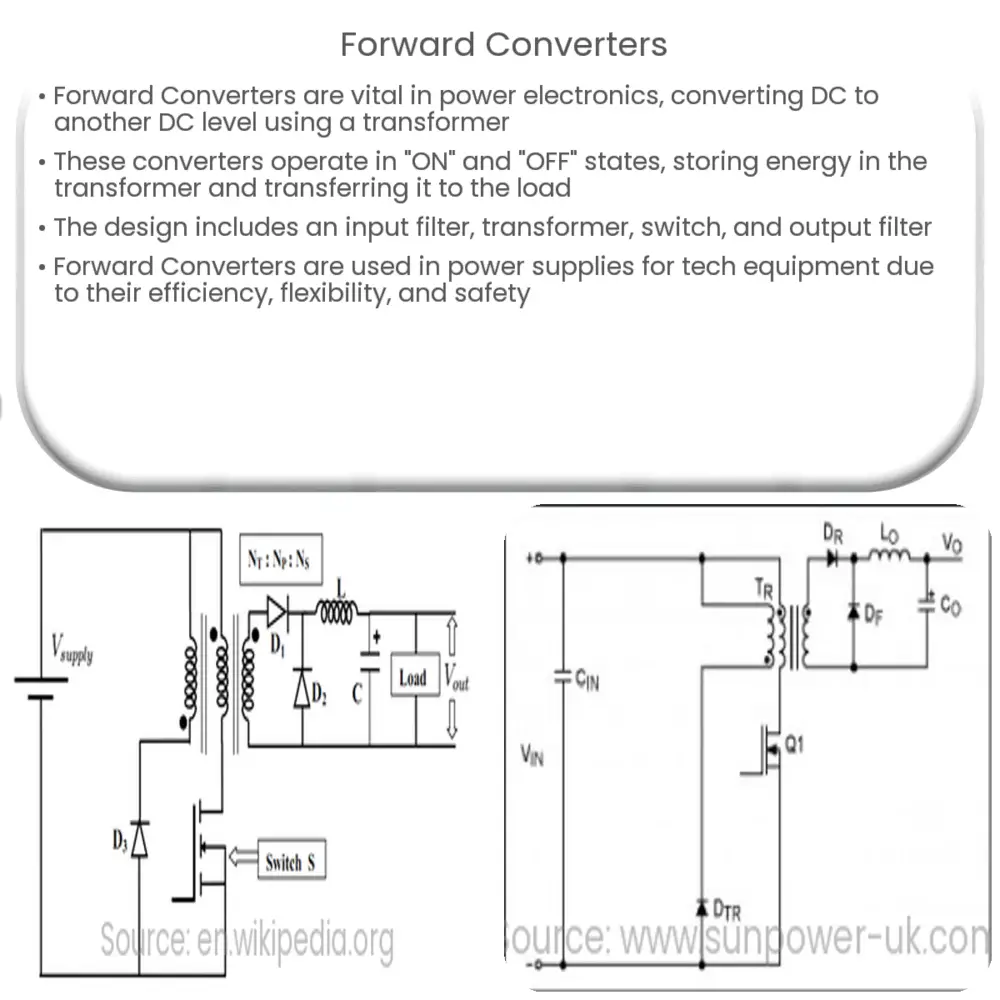
Introduction to Forward Converters
Forward Converters are a crucial component in the world of power electronics, providing essential service in converting direct current (DC) to another DC level. Essentially, a Forward Converter is a switched-mode power supply (SMPS) that uses a transformer to increase or decrease the output voltage, effectively isolating the input from the output.
Operating Principle
A typical Forward Converter operates in two states: the “ON” state and the “OFF” state. In the “ON” state, the switch conducts current, and energy is stored in the transformer. In the “OFF” state, this stored energy is transferred to the load. This operational process has several implications for the efficiency and performance of the converter.
-
The transformer’s turns ratio determines the output voltage, allowing for flexible voltage regulation.
-
Because the transformer provides electrical isolation between the input and output, safety is improved when compared to other types of converters.
Design and Components
Primarily, a Forward Converter consists of four basic components: an input filter, a transformer, a switch, and an output filter. The input filter reduces input voltage ripple, while the transformer and switch handle the core voltage conversion. The output filter smoothens the output current.
-
Input Filter: This is the first stage in the Forward Converter, responsible for minimizing input voltage fluctuations.
-
Transformer and Switch: Working together, these two components form the heart of the converter. They carry out the actual power transformation, with the transformer ensuring isolation, and the switch controlling power flow.
-
Output Filter: This component ensures a smooth, steady output, eliminating any noise or ripple that may have been introduced during the conversion process.
One important aspect to note is that the switching frequency is often higher than 20kHz, above the audible frequency range, to ensure that the Forward Converter does not produce any audible noise during operation.
Applications of Forward Converters
Forward Converters find wide application in many areas, especially where electrical isolation is essential or where a step-down or step-up DC voltage is required. Examples include power supplies for computers and telecom equipment, battery chargers, and LED drivers. Their efficiency, flexibility, and safety make them a popular choice in these sectors.
Advantages and Disadvantages of Forward Converters
Like any device, Forward Converters come with their own set of advantages and disadvantages. Here, we will explore these attributes, providing a well-rounded understanding of these power electronics devices.
-
Advantages:
-
The transformer provides isolation, enhancing the safety of the system.
-
The transformer’s turn ratio allows for flexible voltage regulation.
-
They have a high efficiency rate, making them suitable for a wide range of applications.
-
-
Disadvantages:
-
They require more complex control mechanisms to handle switching and to ensure consistent performance.
-
The high switching frequency can lead to higher power loss and may necessitate additional cooling systems.
-
Recent Developments and Future Trends
As technology advances, Forward Converters are also evolving, with recent developments focusing on enhancing efficiency, reducing size, and improving performance. One significant trend is the use of digital control methods to manage the switching process, which can result in better performance and easier integration with other systems.
Another promising area of research is the use of wide bandgap semiconductors like Silicon Carbide (SiC) and Gallium Nitride (GaN) in Forward Converters. These materials can operate at higher frequencies and temperatures, potentially improving efficiency and reducing size.
Conclusion
Forward Converters have proven to be an integral part of power electronics, offering efficient and flexible voltage conversion, along with the added safety provided by electrical isolation. While they have their challenges, such as the need for complex control mechanisms and potential power loss due to high switching frequencies, ongoing research and technological advancements promise to address these issues.
Looking towards the future, the adaptation of digital control methods and the incorporation of wide bandgap semiconductors could revolutionize the design and application of Forward Converters. As these developments take hold, we can expect Forward Converters to continue playing a vital role in a multitude of applications, powering our technology and our lives.



