
Explore the evolution of Force Sensitive Touchscreens, their working principle, applications, benefits, challenges, and future perspectives.
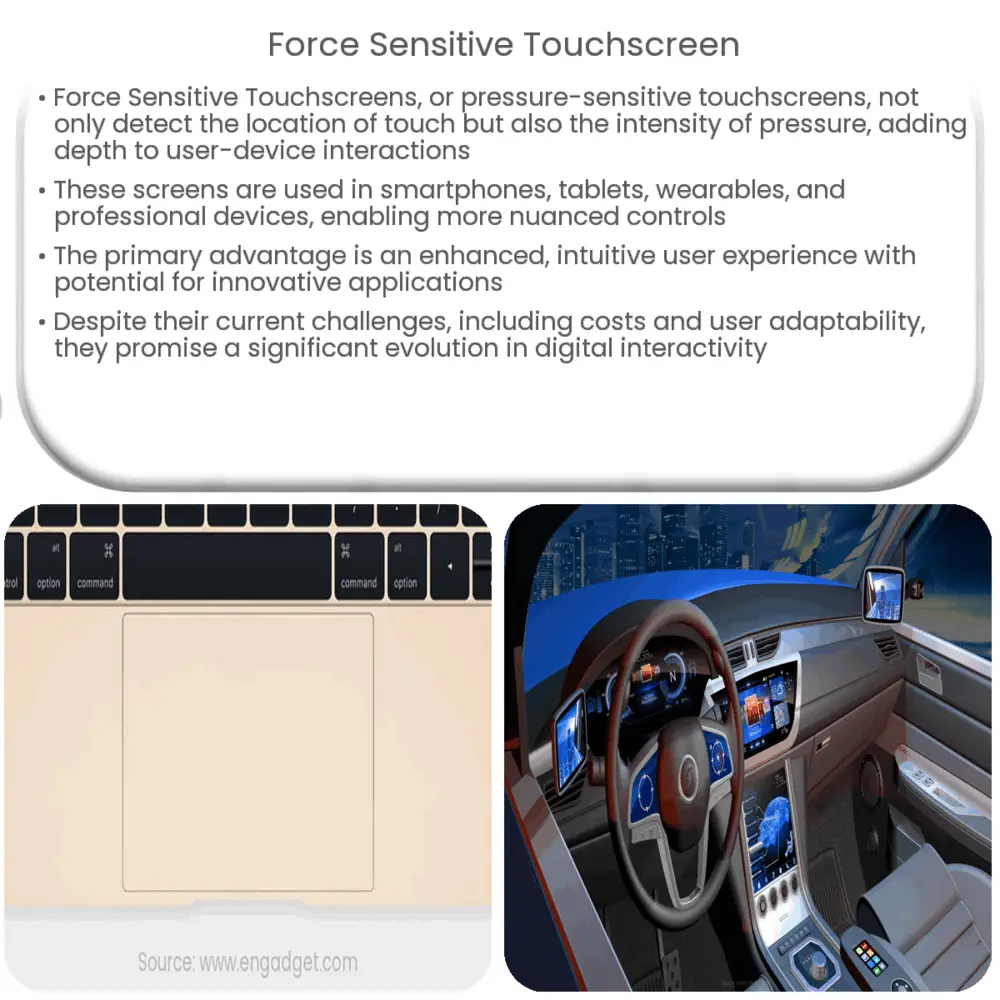
Introduction to Force Sensitive Touchscreens
As technology evolves, the ways we interact with our devices also change. One of the most revolutionary advancements in recent years is the advent of Force Sensitive Touchscreens. This innovative technology has unlocked new dimensions in user-device interaction, adding depth to the conventional touch interface.
Understanding the Concept
Force Sensitive Touchscreens, also known as pressure-sensitive touchscreens, are advanced interfaces that not only register the location of a touch, but also the amount of pressure applied. The touchscreen’s ability to differentiate between light taps and harder presses brings a whole new level of interactivity and offers an expanded set of commands for users.
Working Principle of Force Sensitive Touchscreens
The principle behind force sensitive touchscreens is simple yet ingenious. The screen contains multiple layers, including a pressure-sensitive layer that can sense different levels of pressure. When a user interacts with the screen, the pressure is measured, and the corresponding action is triggered based on the intensity of the pressure applied.
Applications of Force Sensitive Touchscreens
- Smartphones and Tablets: Many high-end smartphones and tablets now feature force sensitive touchscreens, enabling users to access different functions by applying varying degrees of pressure. For example, a light tap might open an app, while a harder press could reveal additional options.
- Wearable Technology: Wearable devices like smartwatches have also adopted this technology. The limited screen size of these devices makes the added layer of interactivity provided by pressure sensitivity extremely valuable.
- Professional Devices: Devices used for professional purposes, like graphic tablets and medical equipment, also benefit from force sensitive touchscreens. They allow for more nuanced control, which is particularly useful in precision-oriented tasks.
Advantages of Force Sensitive Touchscreens
The primary advantage of force sensitive touchscreens is the enhanced user experience they offer. They provide a more natural, intuitive way to interact with devices, allowing for a wider range of inputs. This reduces the need for excessive buttons or complex gestures, making interfaces simpler and more efficient. Furthermore, by recognizing the degree of pressure applied, these screens can offer a more personalized interaction, adjusting responses based on individual user input.
Force sensitive touchscreens also offer potential for innovative applications and features that can be uniquely designed to take advantage of pressure sensitivity, opening up new possibilities for developers and designers.
Challenges and Future Perspectives
Despite their significant advantages, force sensitive touchscreens also come with their own set of challenges. One of the primary concerns is the increased complexity of these screens, which can make them more expensive to produce and repair. Additionally, there can be a learning curve for users who are accustomed to traditional touch interfaces.
However, as the technology matures and becomes more widespread, these challenges are likely to be mitigated. Improvements in manufacturing techniques and user interface design could reduce costs and enhance ease of use, making force sensitive touchscreens more accessible to a wider audience.
Conclusion
In conclusion, force sensitive touchscreens represent a significant step forward in the evolution of interactive technology. They offer a more immersive, intuitive, and personalized user experience, opening up new possibilities for both users and developers. Despite current challenges, the future of force sensitive touchscreens looks promising, with vast potential for growth and innovation. As with any new technology, it will require time for users to fully adapt and for the technology to reach its full potential. Yet, the benefits it offers suggest that it’s not just a passing trend, but a significant evolution in how we interact with our digital devices.
Force Sensitive Touchscreens: A New Era of Interactivity
As we move forward into the digital future, force sensitive touchscreens will likely become a standard feature in many of our devices. They have the potential to fundamentally change the way we interact with technology, making our devices more responsive, intuitive, and personalized. While we have yet to see the full extent of their capabilities, there is no doubt that force sensitive touchscreens are paving the way for a new era of interactivity.