
Explore the history, types, applications, and future of DIN connectors, their role in audio, video, and computing, along with their pros and cons.
DIN Connectors: An Overview
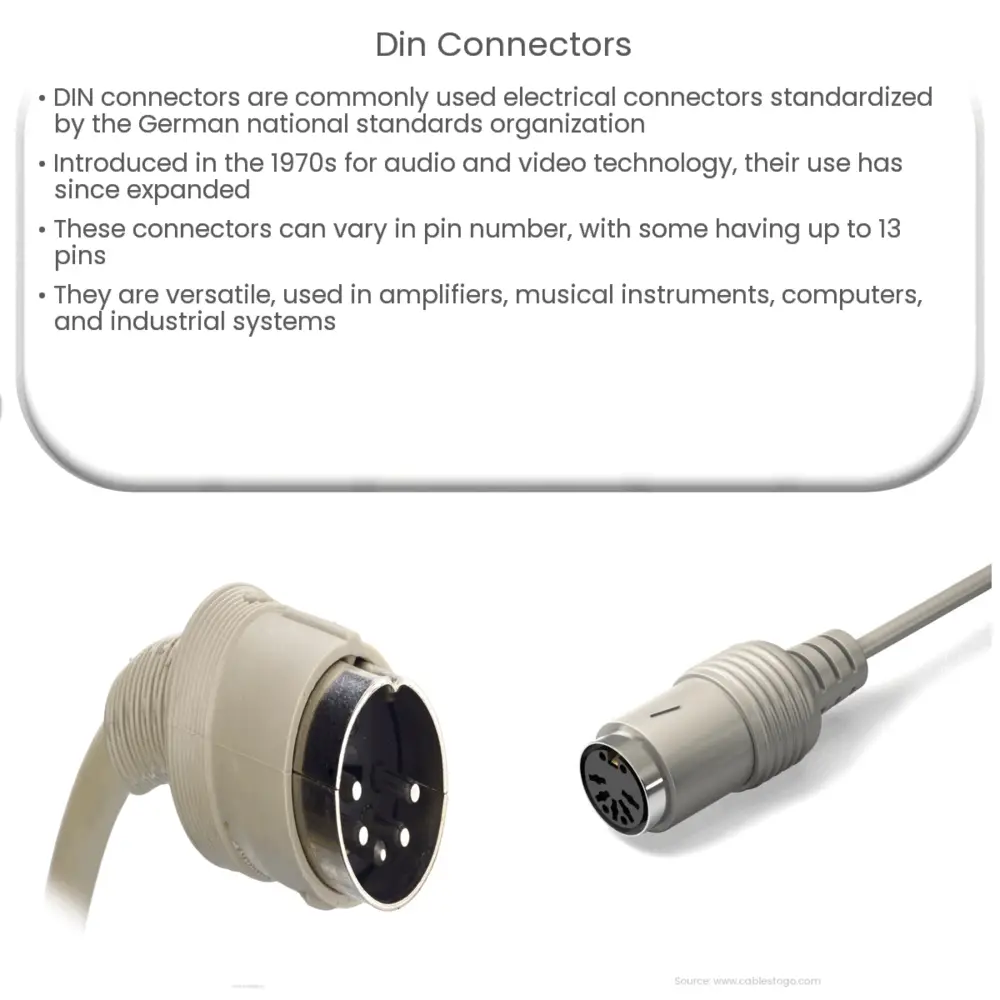
DIN connectors are a type of electrical connector that are commonly used in several applications. The term ‘DIN’ is an acronym for ‘Deutsches Institut für Normung’, which is the German national standards organization that originally standardized these connectors.
These connectors are characterized by their circular design and a number of pins that can vary depending on the specific type of DIN connector. The design allows for a secure and reliable connection, making them an ideal choice for many types of electronic equipment.
The Origin of DIN Connectors
DIN connectors were first introduced in the early 1970s. At that time, they were primarily used in the field of audio and video technology, including for connections to tape decks, radios, and similar devices. The design was found to be versatile, and over time, the use of DIN connectors expanded to other fields.
Types of DIN Connectors
- 3-Pin DIN Connector: This type of DIN connector was traditionally used for tape input/output.
- 5-Pin DIN Connector: Also known as the 180° 5-pin DIN connector, this version was widely adopted in the audio industry and was used for stereo audio connections.
- 7-Pin DIN Connector: This connector has additional pins for extra functionality and was popularly used in MIDI (Musical Instrument Digital Interface) devices.
Over the years, variations of these basic types have been developed, with the number of pins ranging up to 13 in some models. The assignment of these pins can be configured to suit various specific needs.
Application of DIN Connectors
DIN connectors are still widely used today in many different applications. In the audio and video industry, they are often found in devices such as amplifiers, musical instruments, and audio mixers. However, their application is not limited to this sector.
Another major area of application for DIN connectors is in the realm of computing. For example, the PS/2 connector, which was widely used for connecting keyboards and mice to personal computers, is a type of DIN connector. Furthermore, DIN connectors also find significant application in industrial automation systems.
Other Applications and Advancements
DIN connectors are also prominently used in amateur radio devices. They serve to connect various devices and peripherals, like microphones and data terminals, to the main transceiver unit. Additionally, DIN connectors are found in some types of power plugs and sockets, making them a versatile solution for electrical connections.
There have been advancements in the design and functionality of DIN connectors over the years, reflecting the evolving needs of technology and industries. Some DIN connectors now incorporate locking mechanisms for a more secure connection. Others are designed to be water and dust resistant, suitable for harsh environments.
Pros and Cons of DIN Connectors
- Advantages: DIN connectors are appreciated for their robust design, reliability, and versatility. The circular shape of these connectors allows for multiple pin configurations, making them adaptable to a wide range of applications. Additionally, some DIN connectors offer the benefit of a locking mechanism, providing a secure connection.
- Disadvantages: On the downside, DIN connectors can be slightly more complex to connect and disconnect compared to some other types of connectors. Moreover, as technology advances, some applications are moving towards smaller, more compact connectors, making the relatively larger DIN connectors less suitable in certain scenarios.
Conclusion
In conclusion, DIN connectors play a crucial role in the world of electrical and electronic connections. Since their inception, they have adapted and evolved to meet the changing requirements of various industries, proving their robustness and versatility. While some applications are shifting towards more compact connectors, the DIN connector’s reliable performance and secure connections ensure it still holds a significant place in numerous applications, from audio and video equipment to computing and industrial automation. As technology continues to advance, it will be interesting to see how DIN connectors adapt to meet these new challenges and demands.