
Dive into the world of Digital Signal Processors (DSPs), exploring their architecture, applications, types, future prospects, and impact on modern technology.
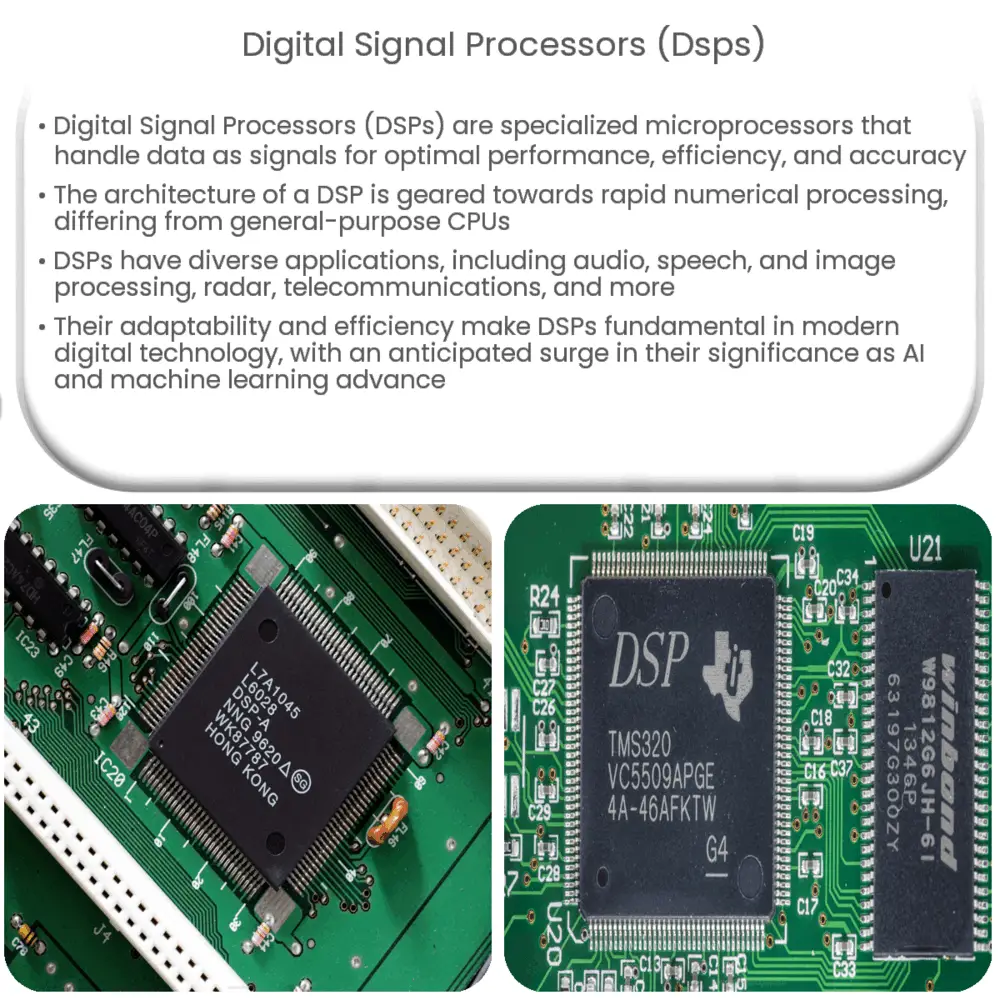
Digital Signal Processors (DSPs): An Insight into Digital Processing
Digital Signal Processors, also known as DSPs, are specialized microprocessors. These digital electronics utilize data in the form of signals and manipulate these signals to achieve performance, power efficiency, and accuracy that far exceed typical software solutions. Specifically designed for calculations on digital signals, DSPs are integral in a wide variety of applications.
The Architecture of DSPs
The architecture of a DSP is optimized for high-speed numerical processing, with an emphasis on repetitive calculations. Its key elements include high-speed execution units, memory architecture designed for rapid access, and data buses that can handle wide data words. This differs from general-purpose CPUs that prioritize a broad mix of operations.
Applications of Digital Signal Processors
DSPs find their application in a multitude of domains. They are used extensively in audio signal processing, speech signal processing, and image processing. Other areas of application include radar and sonar signal processing, sensor array processing, spectral estimation, statistical signal processing, digital filter design, and signal processing for telecommunications.
- Audio Signal Processing: This involves the processing of sound signals. It can include audio compression, audio effects such as equalization, and other forms of digital audio processing.
- Speech Signal Processing: This refers to the manipulation of speech signals for tasks like speech recognition, synthesis, and enhancement. DSPs are used in devices like digital assistants and hearing aids.
- Image Processing: DSPs are used to analyze and manipulate images in order to improve their quality or extract information. They’re crucial in systems like digital cameras and medical imaging devices.
The versatility and performance of DSPs make them a cornerstone of modern digital technology. As technology evolves, the importance and usage of Digital Signal Processors continue to grow.
Working Principle of DSPs
At their core, DSPs use mathematical algorithms to manipulate and interpret digital signals. This data is often represented in binary form as a series of ones and zeroes. Signals are sampled and then processed into digital form, where the DSP can manipulate them.
The manipulation process often involves altering the characteristics of the signal in some way, such as changing the signal’s amplitude, phase, or frequency. This involves complex mathematical functions, which is where the DSP’s optimized architecture comes into play.
Types of Digital Signal Processors
DSPs come in various types, each with unique characteristics and uses. The two main types are general-purpose DSPs and application-specific DSPs.
- General-Purpose DSPs: These are used in a wide range of applications where customization and flexibility are essential. They can handle various algorithms and are employed in many products, from consumer electronics to military systems.
- Application-Specific DSPs: These are designed for a particular application. They are more efficient in their specialized tasks but lack the versatility of general-purpose DSPs. Examples include DSPs designed specifically for audio encoding or cellular communication.
The Future of Digital Signal Processors
The future of Digital Signal Processors appears promising as we continue to innovate and rely on digital technology. With advancements in artificial intelligence and machine learning, DSPs are expected to become even more central in processing and interpreting complex data. Future generations of DSPs may see further improvements in power efficiency, processing speed, and architectural sophistication, enabling even more advanced applications.
Advantages and Limitations of DSPs
While DSPs offer many advantages, they also come with their share of limitations.
- Advantages: DSPs provide a high degree of accuracy, efficient processing, and power optimization. They offer versatile signal processing capabilities, which are useful in numerous applications across various industries.
- Limitations: DSPs require carefully designed algorithms for efficient operation. Developing these algorithms can be time-consuming and require significant expertise. DSPs also need a steady power supply, which can limit their use in low-power or battery-operated devices.
Conclusion
Digital Signal Processors play an essential role in modern technology, powering a vast array of applications and devices. Despite some limitations, their potential for high-speed, efficient, and accurate processing makes them indispensable in our increasingly digital world. With the continuing evolution of digital technology, the future holds exciting possibilities for the development and application of DSPs. From enhancing audio quality to enabling breakthroughs in artificial intelligence, DSPs will continue to be at the forefront of digital innovation.



