
Explore the basics of Charge Pump Converters, their working principle, applications, design considerations, and their pros & cons.
Introduction to Charge Pump Converters
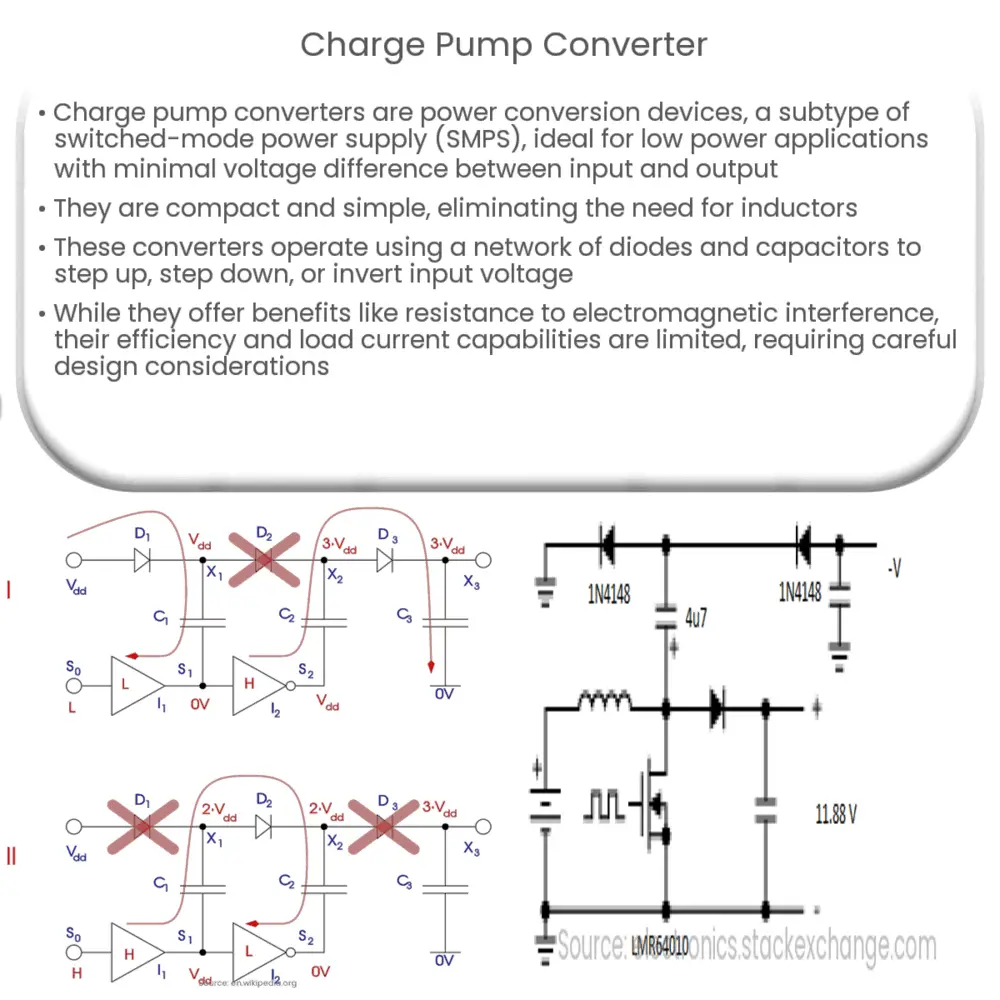
Charge pump converters, as the name suggests, are power conversion devices that use a process similar to “pumping” to generate a higher or lower voltage level than the input source. They form a class of switched-mode power supply (SMPS) which are often used in low power applications where the output voltage is not significantly different from the input voltage.
The beauty of charge pump converters lies in their simplicity and compactness. Unlike inductive converters, they do not require inductors, making them a perfect choice for applications where space is critical, and where the output current requirements are relatively low.
Working Principle of Charge Pump Converters
At the heart of every charge pump converter is a network of diodes and capacitors, which are arranged in a way to either step up, step down or invert the input voltage, based on the design. The capacitors in this arrangement store and transfer energy, while the diodes control the flow of this energy.
- Step-Up Charge Pump: In a step-up or ‘boost’ configuration, the charge pump uses the capacitors as energy storage elements. During one half of the switching cycle, a capacitor is charged up from the input source. In the next half, this charged capacitor is connected in series with the input, thereby boosting the output voltage.
- Step-Down Charge Pump: In a step-down or ‘buck’ configuration, the capacitors are connected in parallel during the charging cycle and in series during the discharge cycle. This leads to an output voltage that is a fraction of the input voltage.
- Inverting Charge Pump: In the inverting configuration, the charge pump uses a similar principle as the step-up configuration but inverts the polarity of the output voltage.
The operating frequency of the switching action is typically controlled by an external oscillator. The frequency is often set high to reduce the size of the capacitors required.
Advantages and Limitations
One of the main advantages of charge pump converters is their simplicity and the absence of inductors. This makes them easier to design and miniaturize. Furthermore, they are more immune to electromagnetic interference (EMI) compared to their inductive counterparts. However, they do come with certain limitations, especially when it comes to efficiency and load current handling capability. These factors should be taken into account during the design phase.
Charge Pump Converter Applications
Charge pump converters find extensive use in a variety of applications. Here are a few:
- Power Supply Design: Charge pumps are used in powering low current devices, where the space is a constraint, and the noise should be kept low. This includes CMOS operational amplifiers, PLLs, etc.
- LED Driving: They are also used in LED driving circuits, where a specific voltage level is needed to efficiently drive the LED.
- Battery Powered Devices: Charge pump converters are integral in battery-powered devices like mobile phones, cameras, and portable media players, where they help in boosting the battery voltage to power different sections of the device.
- RF Devices: In RF devices, charge pumps are used in frequency synthesizers and phase-locked loops.
Designing with Charge Pump Converters
Designing with charge pump converters involves careful consideration of several factors. These include the input and output voltage requirements, the maximum load current, switching frequency, and the size and type of capacitors. While designing, it’s crucial to bear in mind the efficiency and transient response of the converter, which can greatly impact the overall performance of the power supply.
Moreover, understanding the power losses in a charge pump converter is key to optimizing its efficiency. These losses primarily occur due to the charging and discharging of capacitors and the forward voltage drop across the diodes.
Conclusion
In conclusion, charge pump converters serve as a simple and effective solution for voltage conversion in low power applications. Their design simplicity, small form factor, and immunity to EMI make them a desirable choice for designers. However, their limitations, especially in terms of efficiency and current handling capability, mandate thoughtful design considerations. As technology advances, charge pump converters continue to be optimized for better performance, thus broadening their application spectrum.
Whether you are a hobbyist looking to power your next microcontroller project, or a professional designer developing a compact, noise-free power supply, understanding the fundamentals of charge pump converters can provide you with an additional tool in your power management toolkit.



