
Explore the world of charge detectors, their types, working principles, applications, and advancements in this comprehensive article.
Introduction to Charge Detectors
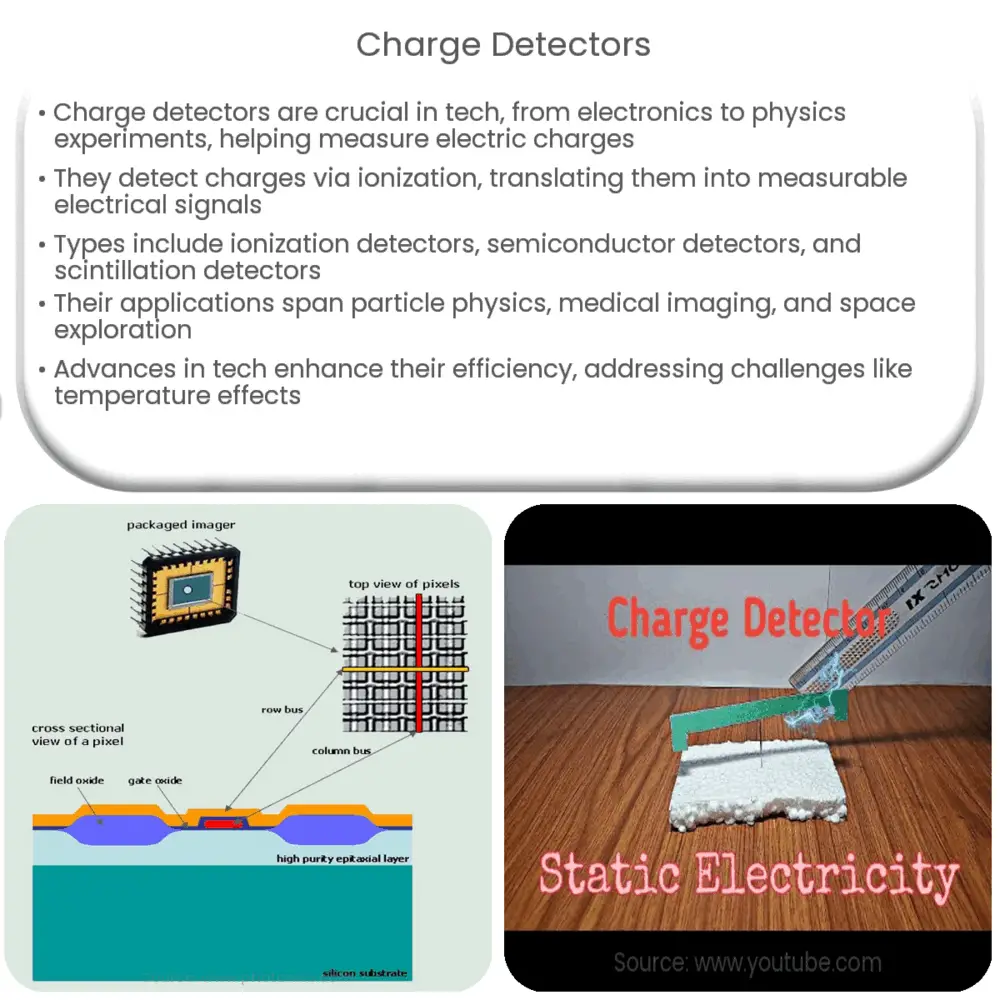
Charge detectors are key components in many fields of technology, from consumer electronics to high-energy physics experiments. Their main role is to identify and measure electric charges, providing crucial data for a multitude of applications.
Working Principle of Charge Detectors
At their most fundamental level, charge detectors work by detecting the presence of an electric charge and translating it into an output that can be measured, usually an electrical signal. The underlying process involves a phenomenon known as ionization, where an atom or a molecule loses or gains electrons, resulting in a net electric charge. The detector is designed to respond to this event, producing a measurable output.
Types of Charge Detectors
-
Ionization Detectors: These detectors use the process of ionization to detect charge. When a charged particle interacts with the gas or material within the detector, it ionizes the atoms, creating free electrons. These electrons are then attracted to a positively charged electrode, generating a detectable signal.
-
Semiconductor Detectors: Semiconductor detectors operate based on the principle of ionization as well. However, they use a semiconductor material instead of a gas. When a charged particle hits the semiconductor, it liberates electrons, which then create a current that can be measured.
-
Scintillation Detectors: These detectors use a scintillator, a material that emits light when hit by a charged particle. This light is then converted into an electric signal by a photomultiplier tube or a photodiode.
Applications of Charge Detectors
-
Particle Physics: In high-energy physics experiments, charge detectors play an essential role in determining the nature and properties of particles produced in the experiments. The detectors provide vital information about the charge of these particles, which helps in their identification.
-
Medical Imaging: In medical imaging techniques like CT scans and PET scans, charge detectors are used to detect and measure the radiation emitted by the body. This data is then used to construct images of the body’s interior.
-
Space Exploration: Charge detectors are also used in space probes and satellites to measure cosmic rays and other forms of radiation present in outer space.
Design and Operation of Charge Detectors
Charge detectors are intricately designed to ensure the accurate detection and measurement of charged particles. Various factors affect their design and operation, such as the type of radiation to be detected, the required sensitivity, and the environmental conditions.
In an ionization detector, for instance, the choice of gas or material used greatly impacts its efficiency. Similarly, for a semiconductor detector, the choice of semiconductor material, the purity of the material, and the junction design significantly affect its performance.
Challenges and Advancements
Despite their invaluable contribution, charge detectors face certain challenges. For example, ionization detectors have the limitation of gas attenuation, where the performance drops due to the ionized gas particles obstructing the path of incoming radiation. On the other hand, semiconductor detectors can be adversely affected by temperature fluctuations, leading to unreliable readings.
However, advancements in technology are continually overcoming these challenges. New materials and designs are being developed to increase the efficiency and reliability of charge detectors. For example, advances in semiconductor technology have enabled the creation of detectors that are highly resistant to temperature changes and radiation damage.
Conclusion
In conclusion, charge detectors are a cornerstone of many technological and scientific fields. They allow us to measure and understand the world of charged particles, from the infinitesimally small particles in physics experiments to the vast cosmic radiation in space. Despite the challenges faced, advancements in technology continually pave the way for more efficient and reliable detectors. As we continue to improve these devices, we expand our ability to investigate and understand the world around us and beyond.



