How do you design a wireless power transfer system using magnetic fields?
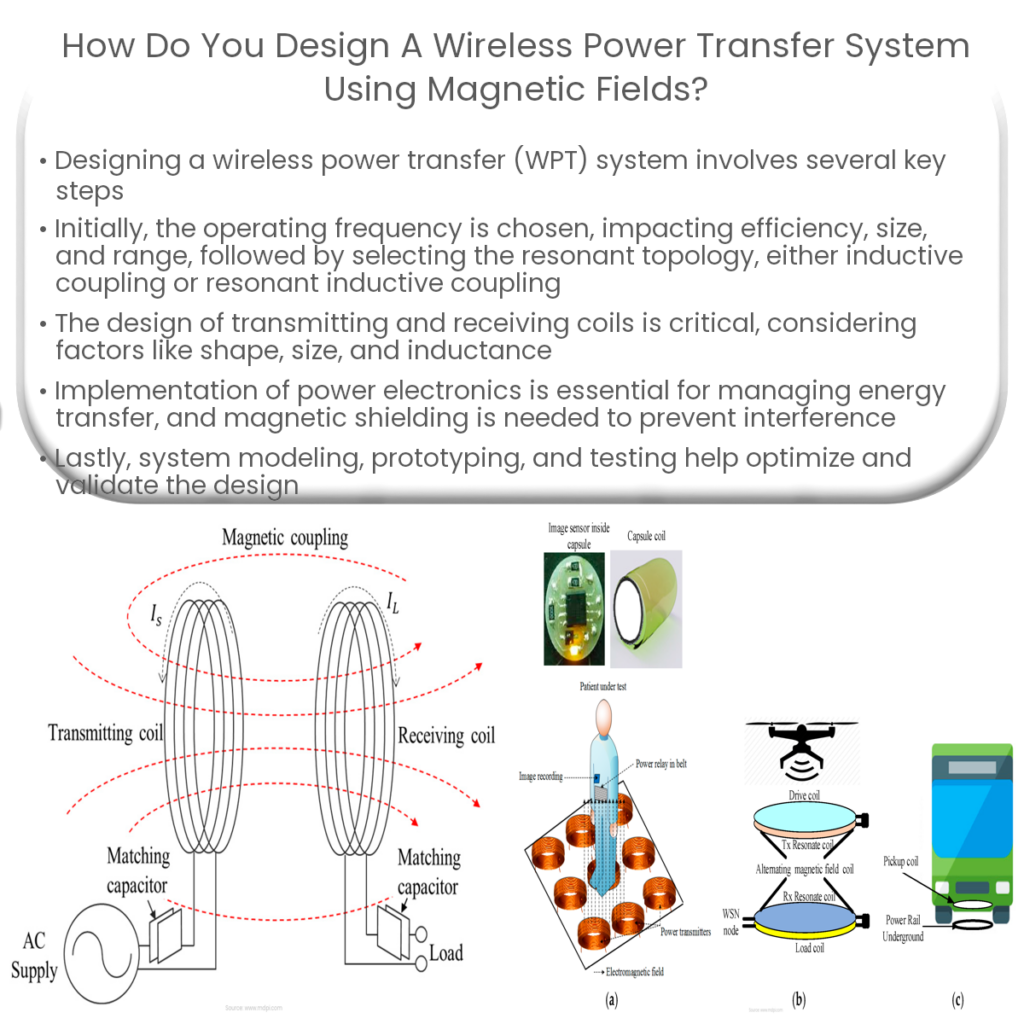
Designing a wireless power transfer system involves selecting frequency, topology, coil design, power electronics, magnetic shielding, and using simulations and testing.


Magnetic shielding materials include mu-metal, supermalloy, permalloy, ferrites, and carbon steel, chosen based on permeability, saturation, and resistivity.
Magnetic fields are vital in energy generation, storage, and transmission, being used in generators, transformers, inductive charging, and alternative energy conversion technologies.
Magnetic fields play a key role in shielding sensitive equipment from unwanted fields and controlling interference in electronic devices.
Designing a magnetic shield involves understanding the source, equipment sensitivity, selecting materials, determining geometry, evaluating performance, and prototyping and testing.
Magnetic field modeling and simulation involve techniques like FEM and BEM, using software like COMSOL, ANSYS Maxwell, and MagNet, considering geometry and material properties.
Popular magnetic field modeling tools include Finite Element Method Magnetics, COMSOL Multiphysics, ANSYS Maxwell, MagNet, and QuickField.
Magnetic fields play a vital role in designing magnetic bearings and couplings, enabling non-contact support and torque transmission in rotating components.
Magnetic bearings and couplings are used in turbomachinery, electric motors, flywheels, vacuum applications, chemical processing, power generation, automotive, and marine propulsion.
Magnetic memory devices include magnetic tape, hard disk drives, floppy disks, MRAM, magneto-optical disks, and magnetic bubble memory.

The primary purpose of this project is to help the public to learn some exciting and important information about electricity and magnetism.
Our Website follows all legal requirements to protect your privacy. Visit our Privacy Policy page.
The Cookies Statement is part of our Privacy Policy.
The information contained on this website is for general information purposes only. This website does not use any proprietary data. Visit our Editorial note.
It’s simple:
1) You may use almost everything for non-commercial and educational use.
2) You may not distribute or commercially exploit the content, especially on another website.