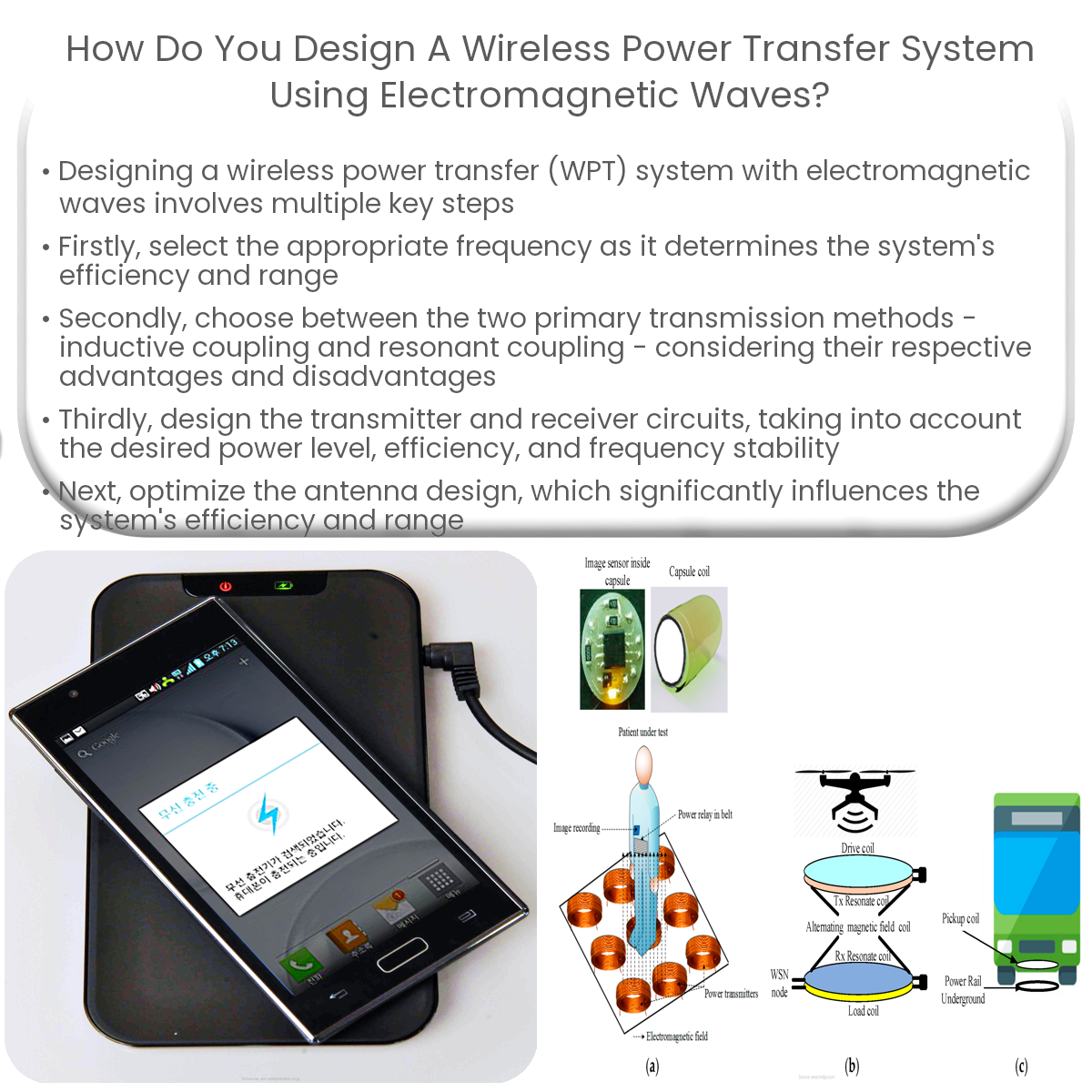
To design a wireless power transfer system using electromagnetic waves, choose the frequency, transmission method, design circuits and antennas, and test and refine the system.
Designing a Wireless Power Transfer System Using Electromagnetic Waves
Wireless power transfer (WPT) is a technology that allows for the transfer of electrical energy between two points without physical connections. This is achieved through the use of electromagnetic waves, offering the potential to revolutionize how we power and charge our devices. In this article, we will discuss the key steps to designing a WPT system using electromagnetic waves.
1. Choose the Appropriate Frequency
The first step in designing a WPT system is to choose the appropriate frequency for the electromagnetic waves. The frequency will determine the efficiency and range of the system, with lower frequencies generally providing better penetration through materials but requiring larger antennas. Common frequency ranges for WPT include the kHz, MHz, and GHz ranges.
2. Select the Transmission Method
There are two primary methods for transmitting power wirelessly using electromagnetic waves: inductive coupling and resonant coupling. Inductive coupling is based on the principle of magnetic induction, while resonant coupling relies on the interaction between two resonant circuits. Both methods have their advantages and disadvantages, so it’s crucial to select the one that best suits your application.
- Inductive Coupling: This method is suitable for short-range applications and provides high efficiency. However, it requires precise alignment between the transmitter and receiver coils, which can be a limitation for some applications.
- Resonant Coupling: This method offers a greater range and more flexibility in alignment but may have lower efficiency compared to inductive coupling. It is ideal for applications that require power transfer over greater distances or through obstacles.
3. Design the Transmitter and Receiver Circuits
Next, you need to design the transmitter and receiver circuits, which will generate and receive the electromagnetic waves, respectively. Key components of these circuits include the power source, oscillator, antenna, and matching networks. The design should take into consideration the desired power level, efficiency, and frequency stability.
4. Optimize the Antenna Design
Antenna design plays a crucial role in the efficiency and range of a WPT system. The transmitter and receiver antennas should be designed to efficiently radiate and capture the electromagnetic waves, respectively. Key factors to consider in antenna design include the size, shape, and material, as well as the chosen frequency and transmission method.
5. Test and Refine the System
Finally, it is essential to test and refine the WPT system to ensure it meets the desired performance criteria. This may involve adjusting the circuit components, modifying the antenna design, or optimizing the alignment between the transmitter and receiver. Repeated testing and refinement will help achieve the optimal balance between efficiency, range, and reliability.
In conclusion, designing a wireless power transfer system using electromagnetic waves involves selecting the appropriate frequency, transmission method, and circuit components, optimizing the antenna design, and testing and refining the system to ensure optimal performance. By carefully considering these factors, it is possible to create a WPT system that meets the specific needs of your application.