
A crystal diode is a semiconductor device that allows current to flow in one direction, used in various electronic applications like rectifiers and LEDs.
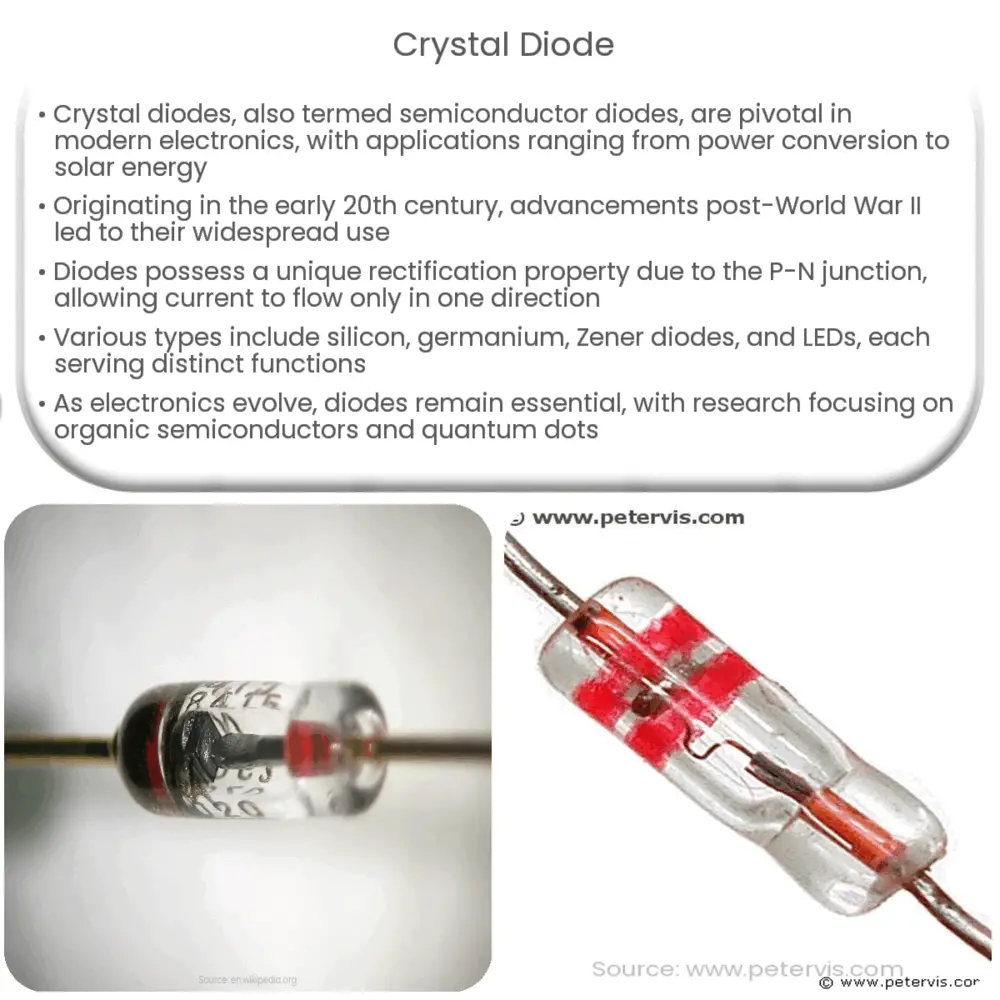
Crystal Diode: An Overview
Introduction
Crystal diodes, also known as semiconductor diodes or simply diodes, are essential components in modern electronics. They are widely used in various applications, from power supplies and signal processing to radio frequency communication and solar energy conversion. In this article, we will delve into the fascinating world of crystal diodes, exploring their history, basic principles, types, and applications.
History of Crystal Diodes
The invention of the crystal diode can be traced back to the early 20th century. Sir Jagadish Chandra Bose, an Indian physicist and inventor, made the first observation of semiconductor rectification in 1901. However, it wasn’t until 1904 when British scientist Sir John Ambrose Fleming invented the first practical diode, known as the Fleming valve, which he used in radio receivers.
Further advancements in the field of semiconductor materials, along with the growing demand for electronic devices during and after World War II, led to the development of modern crystal diodes. American engineer and inventor Russell Ohl made a significant contribution to the field by discovering the properties of a P-N junction in 1940, paving the way for the first silicon and germanium diodes. These diodes eventually replaced vacuum tubes in various applications, making electronic devices smaller, more efficient, and more reliable.
Basic Principles
A crystal diode is a two-terminal electronic device made of semiconductor materials. It has a unique property of allowing current to flow in one direction (forward-biased) while blocking it in the opposite direction (reverse-biased). This property, known as rectification, is due to the formation of a P-N junction in the diode.
The P-N junction is formed by combining two types of semiconductor materials: P-type and N-type. P-type materials have an excess of positive charge carriers (holes), while N-type materials have an excess of negative charge carriers (electrons). When these materials are brought into contact, they form a depletion region at the junction, which acts as a barrier to prevent current flow in the reverse-biased condition. However, when the diode is forward-biased, the electric field across the junction is reduced, allowing current to flow through the device.
Types of Crystal Diodes
Over the years, various types of crystal diodes have been developed to cater to specific applications and requirements. Some of the most common types include:
- Silicon Diodes: These diodes are made of silicon and are the most widely used type due to their high temperature tolerance, low reverse current leakage, and relatively low cost.
- Germanium Diodes: Made of germanium, these diodes have lower forward voltage drop and faster switching speeds compared to silicon diodes. However, they are more sensitive to temperature and have higher reverse current leakage.
- Zener Diodes: These diodes are designed to operate in the reverse-biased condition, where they exhibit a stable breakdown voltage called the Zener voltage. They are commonly used in voltage regulation circuits.
- Light Emitting Diodes (LEDs): LEDs are a special type of diode that emit light when forward-biased. They are used in various applications such as lighting, displays, and indicators.
Applications of Crystal Diodes
Crystal diodes are integral to a wide range of electronic devices and systems. Some of the most common applications include:
- Rectifiers: Diodes are commonly used in power supplies to convert alternating current (AC) to direct current (DC), providing stable and consistent voltage for various electronic devices.
- Signal Clipping: Diodes can be used in circuits to clip or limit the amplitude of a signal, preventing distortion or damage to other components.
- Switching: Fast-switching diodes like Schottky diodes are used in high-frequency applications, such as radio frequency communication and power converters.
- Voltage Regulation: Zener diodes are widely used in voltage regulation circuits to maintain a constant output voltage, despite variations in input voltage or load conditions.
- Optoelectronics: LEDs are widely used in various lighting applications, from residential and commercial lighting to automotive and display technology.
- Solar Cells: Diodes are used in solar cells to allow the flow of current generated by the photovoltaic effect, while preventing the flow of current in the reverse direction.
Future of Crystal Diodes
As the demand for energy-efficient and miniaturized electronic devices continues to grow, research and development efforts are focused on advancing the performance and capabilities of crystal diodes. Some emerging trends in the field include:
- Organic Semiconductors: Researchers are exploring the use of organic materials to create flexible, lightweight, and environmentally friendly diodes, with potential applications in wearable electronics, displays, and solar cells.
- Wide Bandgap Semiconductors: Materials like gallium nitride (GaN) and silicon carbide (SiC) are being used to develop diodes with higher voltage ratings, improved efficiency, and better thermal performance, suitable for high-power applications.
- Quantum Dots: Quantum dots are nanoscale semiconductor particles that exhibit unique optical and electrical properties. Researchers are exploring their use in creating next-generation LEDs with tunable emission wavelengths, enabling more efficient and versatile lighting solutions.
Conclusion
Crystal diodes have come a long way since their invention in the early 20th century. Today, they play a critical role in a diverse array of electronic devices and systems, enabling advanced functionalities, improved performance, and greater energy efficiency. As the field of electronics continues to evolve, crystal diodes will undoubtedly remain a key component, with ongoing research and development efforts promising exciting new applications and technologies in the future.