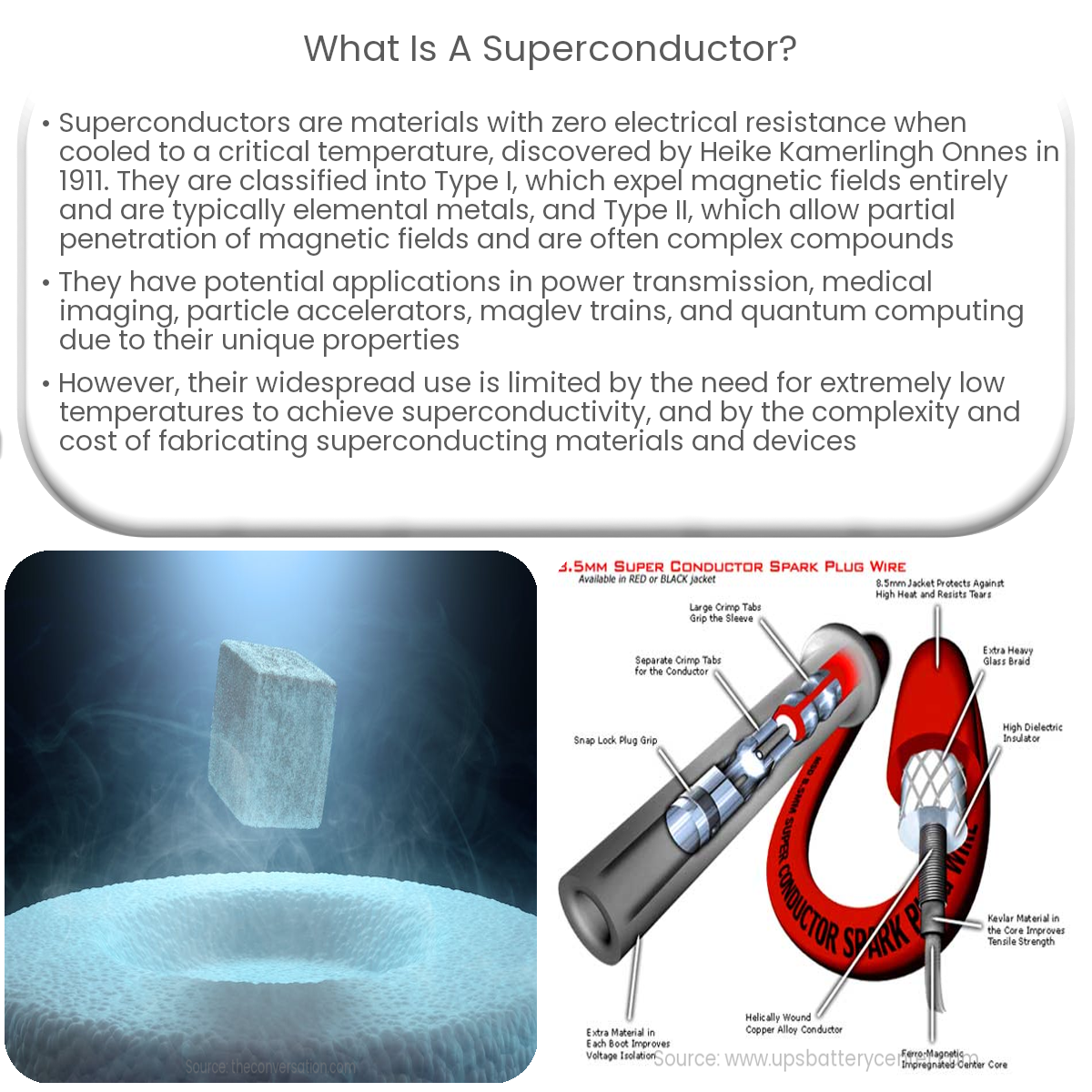
A superconductor is a material with zero electrical resistance at a critical temperature, allowing current to flow without energy loss.
What is a Superconductor?
A superconductor is a material that exhibits zero electrical resistance when cooled to a critical temperature, allowing electric current to flow through it without energy loss. The phenomenon of superconductivity was first discovered by Heike Kamerlingh Onnes in 1911.
Types of Superconductors
Superconductors are classified into two main categories based on their behavior in the presence of a magnetic field and the underlying mechanism of superconductivity:
- Type I Superconductors: These materials exhibit perfect diamagnetism, meaning they expel magnetic fields entirely when cooled below their critical temperature. Type I superconductors are primarily elemental metals, such as mercury, aluminum, and lead.
- Type II Superconductors: These materials allow some magnetic fields to penetrate their structure, creating a mixed state of normal and superconducting regions. Type II superconductors are typically complex compounds, including high-temperature superconductors like yttrium barium copper oxide (YBCO) and bismuth strontium calcium copper oxide (BSCCO).
Meissner Effect
The Meissner effect is a phenomenon exhibited by superconductors, in which they expel magnetic fields from their interior when cooled below their critical temperature. This effect is responsible for the perfect diamagnetism of Type I superconductors and the partial diamagnetism of Type II superconductors.
Applications of Superconductors
Superconductors have a wide range of potential applications, thanks to their unique properties. Some key applications include:
- Power Transmission: Superconducting cables can transmit electricity with minimal losses, improving the efficiency of power distribution networks.
- Magnetic Resonance Imaging (MRI): Superconducting magnets are used in MRI machines to generate powerful, uniform magnetic fields for high-quality imaging.
- Particle Accelerators: Superconducting magnets are employed in particle accelerators to guide and focus charged particles at extremely high speeds.
- Maglev Trains: Superconductors can be used in magnetic levitation (maglev) trains, where they enable frictionless, high-speed transportation by suspending the train above the tracks.
- Quantum Computing: Superconducting materials are used in some types of quantum computing architectures to create ultra-fast, energy-efficient processors.
Challenges and Future Prospects
Despite their incredible potential, superconductors face several challenges that hinder widespread adoption:
- Most superconductors require extremely low temperatures to exhibit superconductivity, making them expensive and energy-intensive to maintain.
- High-temperature superconductors, while promising, still require cooling to temperatures achievable only with liquid nitrogen or other cryogenic methods.
- The fabrication and scalability of superconducting materials and devices can be complex and costly.
Overcoming these challenges is the focus of ongoing research, with the ultimate goal of developing room-temperature superconductors and more practical applications for this remarkable phenomenon.