
Explore the functionality, construction, applications, and benefits of button load cells in diverse industries.
Introduction to Button Load Cells
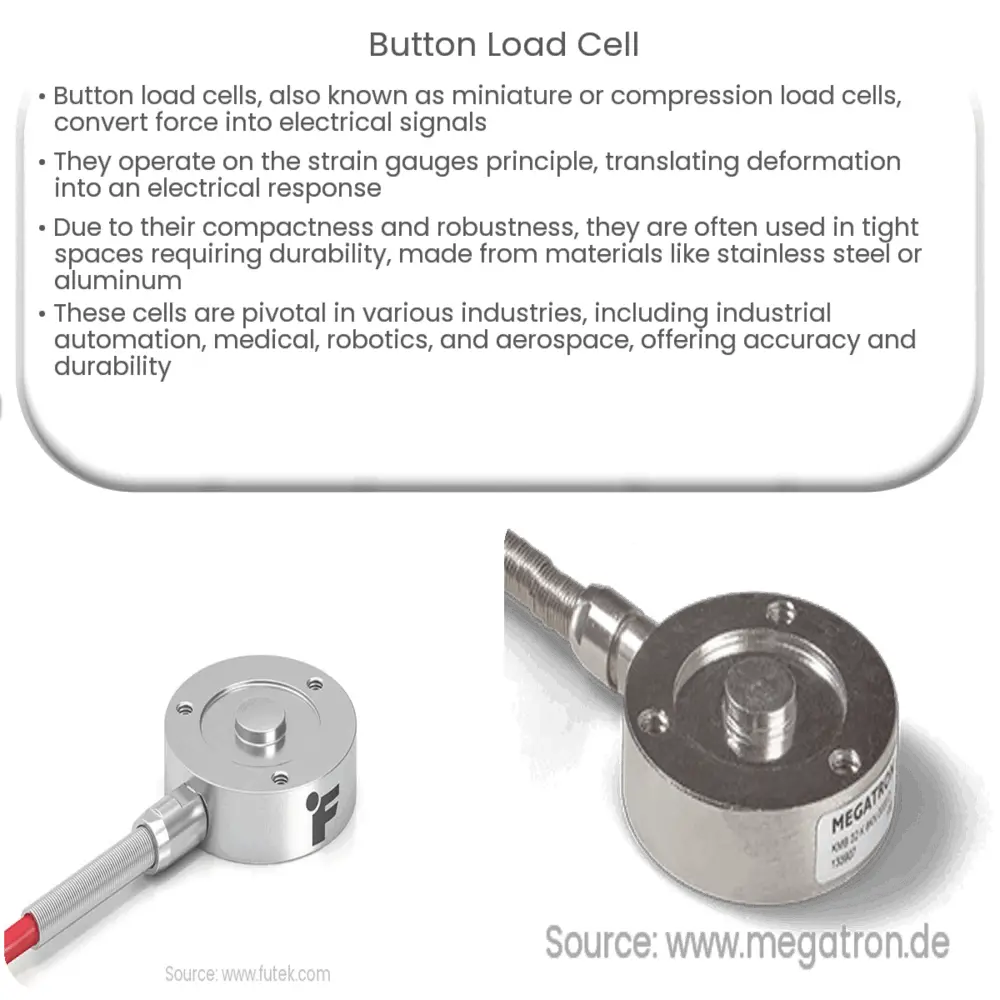
Button load cells, also known as miniature load cells or compression load cells, are a type of force sensor that operates by converting a force into an electrical signal. This force, typically compressive in nature, is applied perpendicular to the device’s upper surface, hence the name ‘button’.
The Working Principle
Button load cells work based on the principle of strain gauges, a fundamental concept in the field of electronic engineering. When a force is applied to the button load cell, it undergoes deformation, and this deformation is detected by strain gauges affixed within the cell. These gauges then convert the deformation into an electrical signal which is proportional to the applied force.
Construction and Design
Due to their compact size and robust construction, button load cells are often utilized in applications where space is limited or high durability is required. They are typically made from robust materials like stainless steel or aluminum to ensure reliability and longevity, even under challenging conditions. The specific design and materials used, however, can vary depending on the application requirements and the manufacturer.
- Stainless Steel: This material is commonly used for button load cells due to its high strength and corrosion resistance. It is suitable for applications in harsh environments or those requiring washdowns.
- Aluminum: Lighter than stainless steel, aluminum is often used in applications where weight is a critical factor. Despite its lightness, it still provides reasonable durability and strength.
Applications of Button Load Cells
Due to their unique attributes, button load cells find usage in a variety of applications. They are particularly useful in areas where precision force measurements are needed in confined spaces. A few of these applications include:
- Industrial Automation: Button load cells can be used to monitor forces within machinery or automation systems, ensuring accurate and consistent operation.
- Medical Equipment: In the medical field, these load cells can be used in devices that require precise force measurement, like infusion pumps or rehabilitation equipment.
- Testing and Quality Control: These load cells are also used in testing equipment for assessing the strength and durability of materials, as well as for quality control in various industries.
- Robotics: In robotics, button load cells can be used to measure the force exerted by a robot’s movement, helping to optimize its performance and ensure safety.
- Aerospace: Button load cells are used in various aerospace applications, including the testing of materials and systems under different load conditions.
Advantages of Button Load Cells
Button load cells offer a host of advantages that make them suitable for a wide range of applications:
- Compact Size: Their small footprint makes them ideal for use in tight spaces where traditional load cells might not fit.
- High Accuracy: Despite their small size, button load cells can offer high accuracy, making them ideal for precision measurements.
- Durability: Made from robust materials like stainless steel or aluminum, these load cells can withstand harsh conditions and heavy loads, ensuring a long operational life.
- Versatility: Due to their design and operation, button load cells can be used in a wide range of applications, from industrial automation to medical equipment.
Conclusion
In summary, button load cells play a vital role in various industries due to their unique features and advantages. These miniature devices, despite their small size, offer high accuracy and durability, making them suitable for a wide range of applications, including industrial automation, medical equipment, robotics, and aerospace. As technology continues to advance, we can expect even more sophisticated and versatile applications of button load cells in the future.



